
What Is AMRAP in CrossFit and How to Pace It Right
AMRAP stands for 'As Many Rounds (or Reps) As Possible'. It's a foundational workout format in CrossFit and high-intensity training.
The structure is simple: you have a fixed timeframe and a prescribed set of exercises. Your objective is to complete as many rounds of that sequence as possible before the clock runs out.
What an AMRAP Workout Really Means
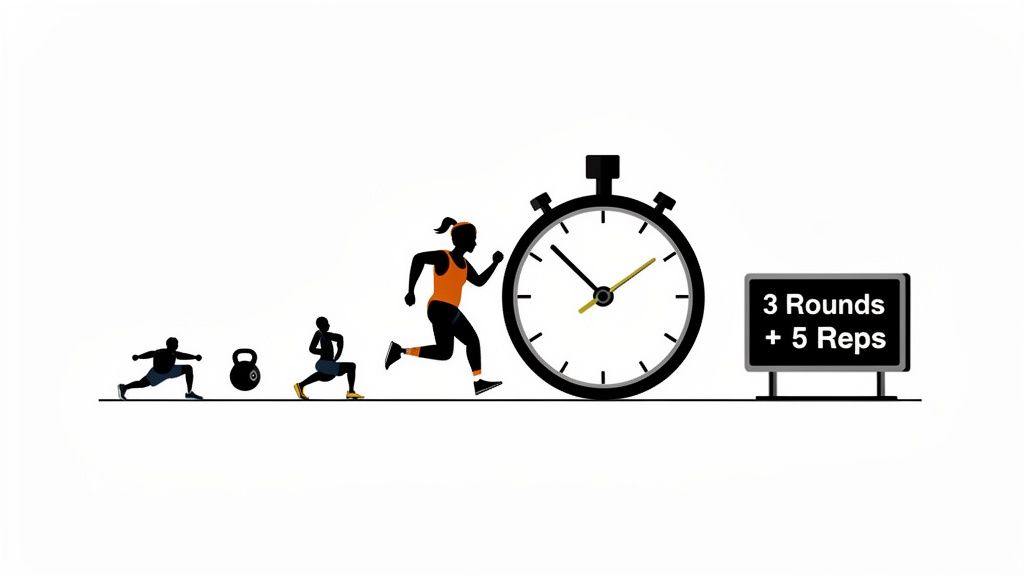
Think of an AMRAP as a race against time where total work volume is the goal. Unlike workouts with a fixed number of rounds, the clock dictates the end. This format demands a strategy beyond just going hard from the start. It's a test of pacing, endurance, and mental discipline.
The AMRAP format became a cornerstone of the CrossFit methodology in the early 2000s and is a staple in countless Workouts of the Day (WODs). For more on its origins, the history of the AMRAP format on Naked Nutrition provides good context.
Here are the core components of any AMRAP.
AMRAP at a Glance: Key Components
| Component | Description | Example |
|---|---|---|
| Fixed Time | The workout has a set duration and ends only when the timer stops. | 12 minutes |
| Set Movements | A specific list of exercises performed in a sequence. | 5 Pull-Ups, 10 Push-Ups, 15 Air Squats |
| The Goal | Complete the sequence as many times as possible within the timeframe. | Complete the 5-10-15 sequence as many times as possible in 12 minutes. |
| The Score | Your final score is the total number of full rounds plus any extra reps from an incomplete round. | 4 Rounds + 5 Pull-Ups + 2 Push-Ups |
This scoring method provides a concrete, measurable result. It's not just about how tired you feel; it's a hard number you can use to track performance and measure fitness gains over time.
Why AMRAPs Are a Powerful Training Tool
AMRAPs are more than just a brutal conditioning piece. They are a primary tool for building work capacity—your ability to perform more work in a given time.
The constantly running clock forces continuous movement, even under significant metabolic stress. This sustained effort builds cardiovascular endurance and the muscular stamina required to maintain output deep into a workout.
The real value of AMRAPs, however, is in what they teach about pacing. Any athlete can sprint the first round, but efficient athletes know how to find a sustainable gear—fast enough to be effective, but controlled enough to prevent redlining. AMRAPs force you to learn this skill, listen to your body's feedback, and develop the mental fortitude to maintain pace when fatigue sets in.
This intensity also drives significant strength gains. One study found that athletes using AMRAP protocols saw upper body strength increase by 53.89% and lower body strength increase by 17.65%, outperforming other common protocols like EMOMs. You can review the full study on the acute training effects in CrossFit protocols.
AMRAP vs. EMOM vs. For Time
CrossFit utilizes several core workout formats. Understanding the distinction between AMRAP, EMOM, and For Time is critical for targeting specific fitness adaptations.
AMRAP is designed to build your engine and test total work output. You have a fixed time, and the objective is continuous movement. In contrast, EMOM (Every Minute On the Minute) is structured for skill practice and building repeatable power by forcing cycles of work and rest. Our guide on using an EMOM timer app offers a deeper analysis.
For Time workouts are pure output tests. The work is fixed; your only variable is how fast you can complete it. Think of it as an all-out sprint from start to finish.
In short, AMRAPs build endurance and pacing discipline.
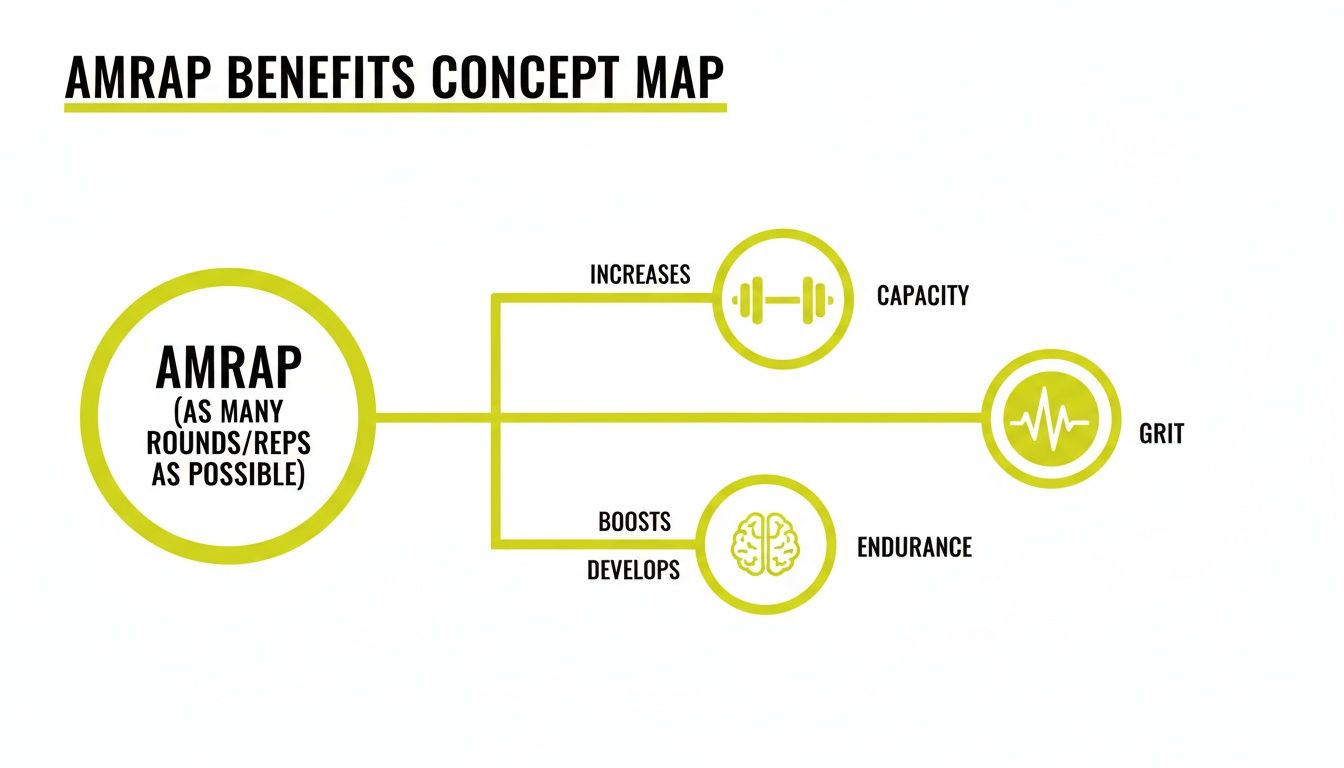
This comparison breaks down how the three formats differ in application.
Workout Protocol Comparison: AMRAP vs. EMOM vs. For Time
| Protocol | Primary Goal | Pacing Strategy | Key Benefit |
|---|---|---|---|
| AMRAP | Maximize work volume in a fixed time | Find a sustainable, steady pace to minimize rest | Builds cardiovascular and muscular endurance |
| EMOM | Develop consistency and repeatable power | Work fast to earn more rest within the minute | Hones skill efficiency and pacing under fatigue |
| For Time | Complete a set amount of work as fast as possible | Strategically push the threshold from start to finish | Tests raw speed, power output, and mental toughness |
Each format has a specific purpose. AMRAP builds your gas tank, EMOM refines skills, and For Time measures raw speed.
Executing Your Next AMRAP Workout
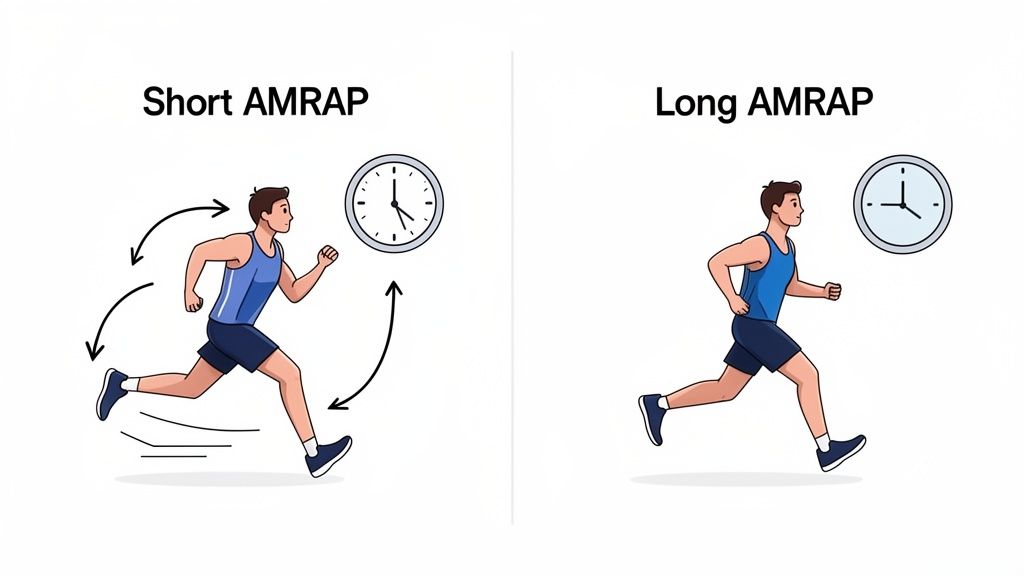
Effective AMRAP execution is about strategy, not just brute force. Your pacing plan is the single most important variable.
For a short AMRAP (under 8 minutes), you can operate at a higher threshold of output. For longer workouts (20+ minutes), you must establish a steady, repeatable rhythm from the very first rep.
The most common tactical error is starting too fast. You feel strong for the first round, but the subsequent performance drop-off is steep. Instead, break reps into manageable sets from the beginning. This strategy helps manage fatigue and maintain technical proficiency when the workout gets difficult.
Research supports this approach, showing that AMRAPs encourage a more stable, self-regulated pace that helps mitigate fatigue.
Transitions are another critical factor. Every second spent moving between exercises is a second of lost work. A reliable timer with loud, clear cues is essential—it lets you focus on execution instead of clock-watching. Our guide to the best CrossFit timer app can help you find a tool to optimize every moment.
Sample AMRAP Workouts for All Levels
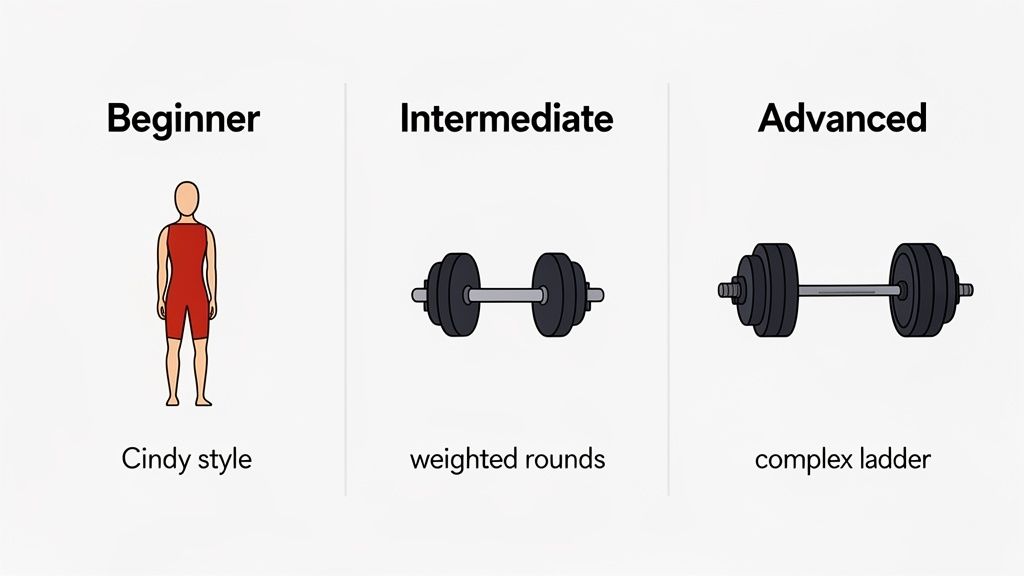
Here are three AMRAP examples, broken down by level. Each includes scaling options and target scores to provide a performance benchmark.
New athletes should focus on mastering foundational movements with proper form. Bodyweight workouts are ideal for this. Our guide to home CrossFit workouts for beginners provides several effective starting points.
Intermediate athletes should add moderate loads and gymnastics skills to test their work capacity. Advanced athletes can incorporate heavier weights and more complex skills designed to push their limits.
Use these workouts as a progression model. As you improve, you can advance to the next level, providing a clear measure of your progress.
Common AMRAP Mistakes to Avoid
Here are the most common tactical errors that compromise AMRAP performance. Small adjustments can yield significant improvements in your score.
The biggest mistake is poor pacing. The timer starts, adrenaline spikes, and you go out too fast. The result is a hard crash early in the workout.
The key is to establish a "forever pace." Settle into a rhythm on the first round that feels sustainable. This discipline is what separates good scores from great ones.
Another critical time loss occurs during inefficient transitions. Fumbling with equipment or taking long walks between stations adds up. Before the clock starts, organize your workout space to allow for seamless movement between exercises.
Finally, incorrect scaling is a frequent problem. A weight that is too heavy forces long, unplanned rest periods. A weight that is too light fails to deliver the intended stimulus. The goal is to select a load and movement variation that allows for consistent movement with minimal breaks. This is how you maintain intensity and maximize your score.
Answering Your Top AMRAP Questions
Here are answers to common questions about AMRAP training.
How Do I Choose the Right Weight for an AMRAP?
A solid guideline is to select a weight you could perform for 15-20 unbroken reps when fresh. This ensures the load is manageable once fatigue accumulates.
The objective is consistent movement, not grinding out heavy singles. If you are forced to break a set of 10 reps into three or more mini-sets in the first round, the weight is too heavy. Reduce the load to maintain intensity and minimize rest.
What Is a Good Score for an AMRAP Workout?
A "good" score is the result of your maximum physical effort on that day. The number itself is a benchmark for you. Log your score, analyze your performance, and use it as a target to beat in the future.
For context, consider the benchmark workout "Cindy" (a 20-minute AMRAP of 5 Pull-ups, 10 Push-ups, and 15 Air Squats). A proficient athlete might target the 15-20 round range. Elite-level athletes often exceed 25 rounds.
How Often Should I Do AMRAP Workouts?
AMRAPs are high-intensity and place significant stress on the body. It is advisable to incorporate them into your training 1-3 times per week.
This is not a rigid rule. The optimal frequency depends on your overall training volume, goals, and recovery capacity. Balance these high-effort sessions with strength work, skill practice, and dedicated rest to prevent overtraining and ensure long-term progress.
Can I Do AMRAPs with Just Bodyweight Exercises?
Absolutely. Bodyweight AMRAPs are highly effective for building conditioning without equipment. Workouts like "Cindy" demonstrate how fundamental movements can be used to create a potent training stimulus.
They are an excellent tool for building raw work capacity and muscular stamina. They are also a practical solution for training while traveling, at home, or whenever you need an efficient, equipment-free workout.
When every second counts, you need a timer that's as serious as you are. KNTC is a science-backed interval timer built for athletes who demand speed and precision. Go from opening the app to starting your workout in under eight seconds. Loud audio cues and strong haptics mean you can stay in the zone and focus purely on your performance. Download it for free and see the difference at the official KNTC Timer website.
Your Interval Timer for Running: The Guide to Structured Training
Stop guessing your splits. This guide shows you how to use an interval timer for running to master pacing, build speed, and execute workouts with precision.
A 3 Day Split: The Athlete's Framework for Building Strength
Discover a 3 day split to build strength for CrossFit, running, and combat sports without wasting time in the gym.