
A Practical Guide to Home CrossFit Workouts for Beginners
You don't need a warehouse full of gear to execute a demanding CrossFit-style workout. The most effective workouts—those that build a solid athletic foundation—can be done in your living room with your own body weight.
We're talking about AMRAPs, EMOMs, and Tabatas. These are the engines of CrossFit programming, and they run on intensity and structure, not equipment. Let's break it down.
Why Your Home Is the Perfect Place to Start
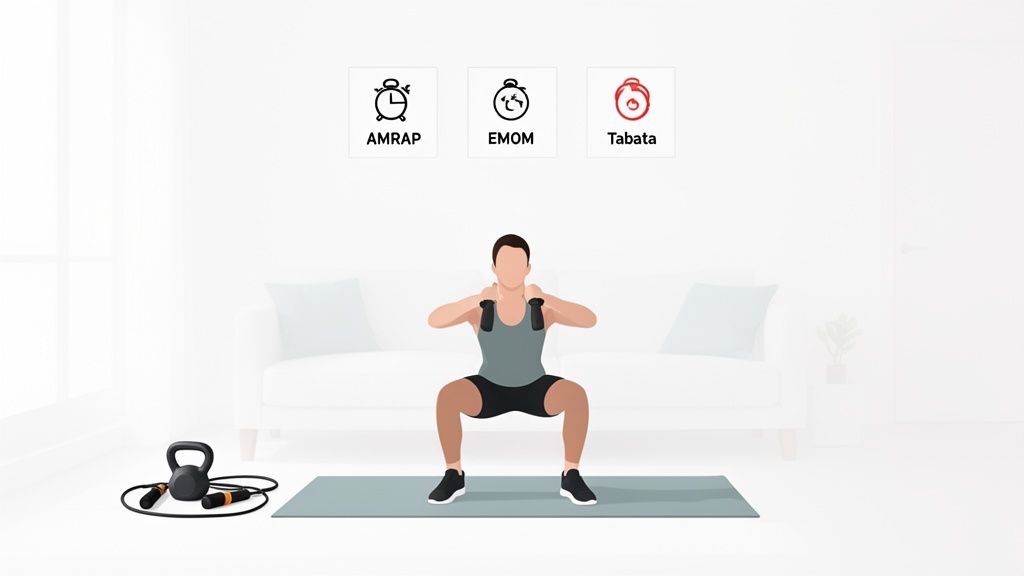
CrossFit isn’t about a specific location or a pile of barbells. It's a method built on one core principle: constantly varied functional movements performed at high intensity. Barbells, rigs, and rowers are just tools. The real work happens when you apply the principles, and you can do that in your garage, backyard, or next to your couch.
During 2020 and 2021, the world shifted to home fitness, and athletes everywhere went back to basics with classic, no-equipment workouts. They proved you could get seriously fit without a gym. Data shows a spike in home training, with searches for training benches and mats jumping by 207% and 97%, respectively. With 74% of people using no-equipment home workout apps, it was clear that progress comes from programming and effort, not your zip code. You can see more details on the rise of home fitness statistics on Market.us.
The Real Advantage of Training at Home
Working out at home strips away distractions. It’s just you, the workout, and the clock. This forces you to focus on what actually builds fitness: moving well and working hard, consistently.
- Master Your Bodyweight First: Before lifting a heavy barbell, you must own your body weight. Air squats, push-ups, and burpees aren't just warm-up moves; they are fundamentals. Get good at these, and everything else gets easier.
- Intensity Comes From the Clock: The real driver of adaptation is how you structure work and rest. This is where formats like AMRAP, EMOM, and Tabata come in. They are designed to push you in specific ways.
This isn't random exercise. It's training with a purpose. Each format is a different tool—one builds your gas tank, another hones your power, and the third elevates your metabolic rate.
Speaking the Language: Let's Decode the WOD
To get started, you need to understand the terminology. These acronyms are simple instructions for structuring your workout. Each one creates a unique stimulus.
Get fluent in the language of WODs with this quick-reference table.
| Acronym | Full Name | What It Means |
|---|---|---|
| AMRAP | As Many Rounds/Reps As Possible | This is a race against a set time. You complete a circuit of exercises as many times as possible within a given timeframe. It's a direct measure of work capacity and mental toughness. |
| EMOM | Every Minute On the Minute | At the top of every minute, you perform a set number of reps of an exercise. The remaining time in that minute is your rest. It’s an excellent format for pacing and skill work. |
| Tabata | Tabata Protocol | This is pure intensity. It’s a specific interval format: 20 seconds of all-out effort followed by 10 seconds of rest, repeated for eight rounds (four minutes total). |
Once you understand these three formats, you have the keys to unlock hundreds of effective workouts you can do anywhere.
Mastering the Foundational Movements
Intensity means nothing without good form. Before hitting a WOD, get comfortable with the basic movements that are the backbone of all effective training.
These movements are your alphabet. You can't write a novel until you know your ABCs. Rushing this part is the quickest way to stall progress or get injured.
The goal isn't perfection on day one. It's about building safe, efficient patterns you can repeat under fatigue. Let's break down the essentials: the Air Squat, the Push-Up, and the Burpee. We’ll look at proper execution, common faults, and how to scale them to your current level.
The Air Squat: Unloaded but Essential
The air squat is the cornerstone of lower-body strength. It’s more than just bending your knees—it’s a full-body movement demanding coordination, balance, and mobility. A solid air squat translates to power for everything from jumping to lifting heavy objects.
How to Execute:
- Stance: Feet shoulder-width apart, toes pointed slightly outward.
- Initiation: Hinge at your hips first—send your hips back and down as if sitting in a chair. Keep your chest up and look straight ahead.
- Depth: Descend until your hip crease drops below the top of your knee. This is the full range of motion.
- Ascent: Drive through your heels to stand, fully extending your hips at the top.
A common fault is letting your knees cave in or rocking onto your toes. To fix this, think about actively pushing your knees out and keeping your whole foot on the floor. If you struggle with depth, it’s likely an ankle or hip mobility issue. Temporarily squatting to a low box or stool can help you feel the proper movement pattern.
The Push-Up: The Ultimate Upper-Body Builder
The push-up is a true measure of upper-body strength. It engages your chest, shoulders, triceps, and core simultaneously. When done correctly, it’s one of the best upper-body exercises available.
Assume a solid plank position with your hands stacked directly under your shoulders. Your body should form a straight line from head to heels. Lower yourself until your chest touches the floor, keeping your elbows tucked at a 45-degree angle—don't let them flare out. Press back up without letting your hips sag.
Scaling Is Smart, Not Weak Can't do a perfect push-up? Don't resort to sloppy reps. The best way to build strength is with incline push-ups. Place your hands on an elevated surface like a bench, a box, or the wall. The higher the surface, the easier the movement. As you get stronger, use lower objects until you are on the floor. Knee push-ups don't engage the core in the same way, making the incline version a better choice for progression.
The Burpee: Full-Body Conditioning Machine
Nothing elevates your heart rate and tests your grit quite like the burpee. It's a squat, a push-up, and a jump combined into one fluid movement. The key to a good burpee isn't just dropping and getting up; it's about efficiency.
From a standing position, drop into a squat and plant your hands on the floor. Kick your feet back to a plank, perform a full push-up (chest to deck), then immediately hop your feet back toward your hands. From that crouched position, explode into a jump, extending your hips and reaching your hands overhead.
While burpees are intense, they don't have to be a high-impact exercise. You can learn more about adapting movements by checking out principles of low-impact high-intensity training. Once you get these basics down, you'll have a solid foundation for safe and powerful workouts.
Your First Week of At-Home WODs
Enough theory. Time to put in the work.
This is your game plan for the first week—a simple, effective 3-day template. This is a structured approach designed to introduce you to different workout styles using the core movements you’ve been practicing.
We’ll use three classic formats: a bodyweight AMRAP, a technical EMOM to dial in pacing, and a high-output Tabata to test your intensity. For each one, I’ll lay out the goal, how to scale it, and a performance target.
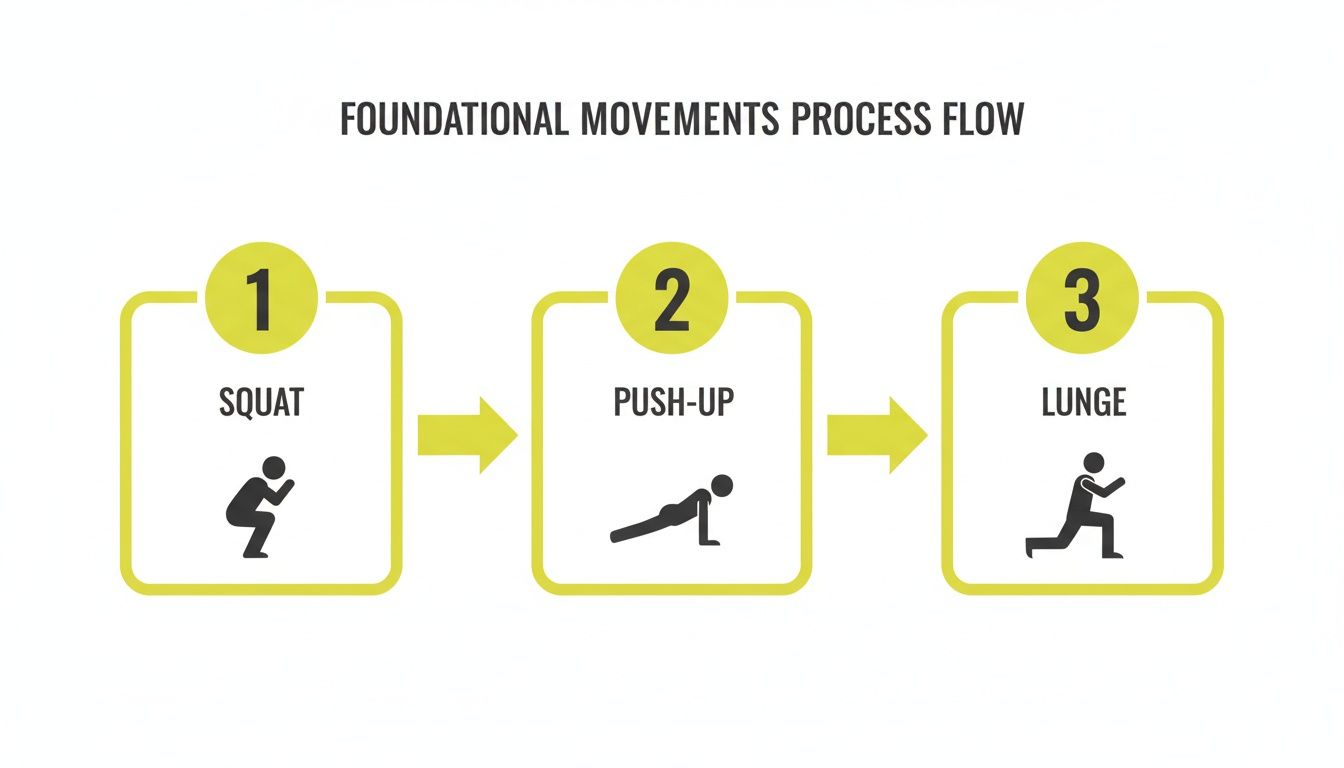
These workouts all revolve around the big three foundational movements. Competence in these is your ticket to making real, safe progress.
WOD 1: The Bodyweight Grinder (AMRAP)
First up is an AMRAP, or "As Many Rounds As Possible." The objective is pure work capacity. You’re racing against a running clock, trying to complete as many rounds of the circuit as you can before time expires.
This workout is about metabolic conditioning. Your heart rate will climb, so the key is to find a sustainable pace that prevents burnout in the first few minutes.
The Workout:
- AMRAP in 12 Minutes:
- 10 Air Squats
- 10 Push-Ups
- 10 Alternating Lunges (5 each leg)
Your Target: Aim for 6+ rounds. That is a solid starting point.
KNTC Timer Setup:
- Open the Countdown Timer.
- Set it for 12:00.
- Press start and maintain consistent movement.
Scaling is straightforward. If your push-ups degrade, switch to an incline version using a box or chair. The goal isn't perfect reps; it's consistent movement for the full 12 minutes. If you're looking for more ways to build your engine at home, our guide to the best home HIIT workouts has a ton of great ideas.
WOD 2: Pacing and Precision (EMOM)
Next is an EMOM, or "Every Minute On the Minute." This style teaches you to manage effort and recovery.
When the clock starts, you perform a set number of reps. The remaining time in that minute is your rest. It’s a constant balance between working fast enough to earn rest but not so fast that you can't recover for the next round.
The Workout:
- EMOM for 10 Minutes:
- 5 Burpees
Your Target: The primary goal is to complete all 10 rounds. Ideally, you should finish your burpees with 15-25 seconds of rest each minute.
KNTC Timer Setup:
- Go to the EMOM Timer.
- Set the rounds to 10.
- Set the interval for 01:00.
If 5 burpees take the full minute, that provides a clear performance goal to beat next time. If it feels too easy, add one more rep.
WOD 3: All-Out Intensity (Tabata)
Last is Tabata. This is a full-on sprint. The format is brutally simple and effective: 20 seconds of maximal effort, followed by 10 seconds of rest, repeated eight times.
The objective is to push your anaerobic system to its limit in a short amount of time.
The Workout:
- Tabata Air Squats (8 Rounds)
- 20 seconds of max reps
- 10 seconds of rest
Your Target: Your score is the lowest number of reps in any of the eight rounds. Aiming for 10+ reps on your lowest round is a great goal.
KNTC Timer Setup:
- Use the Intervals Timer.
- Set Work to 00:20 and Rest to 00:10.
- Set Rounds to 8.
Pro-Tip: Remember, scaling a workout isn't a sign of weakness—it's a sign of smart training. It is how you get the intended stimulus from every session, which is the only way to build lasting fitness.
The data from the official CrossFit Open proves this. In a grueling 2023 workout, 68% of the top male athletes were time-capped, showing that even elite athletes are challenged by fundamental movements. On the women's side, 33% of those aged 18-34 scaled that same workout. Smart modifications are part of the game at every level. You can explore the full analysis of the 2023 Open Test on CrossFit's site to see for yourself.
To put it all together, here’s what a solid starting week could look like. This simple plan balances intensity with active recovery so you can come back strong each session.
Beginner 3-Day Weekly Training Plan
| Day | Workout Focus | Example WOD and Timer Preset |
|---|---|---|
| Monday | Work Capacity | 12-Min AMRAP: 10 Air Squats, 10 Push-Ups, 10 Lunges (Countdown: 12:00) |
| Tuesday | Active Recovery | 20-30 min walk, light stretching, or mobility work. |
| Wednesday | Pacing & Consistency | 10-Min EMOM: 5 Burpees (EMOM: 10 rounds, 1-min interval) |
| Thursday | Active Recovery | 20-30 min walk or easy bike ride. |
| Friday | High-Intensity | Tabata Air Squats: 8 rounds of 20s work / 10s rest (Intervals) |
| Saturday | Active Recovery | Go for a hike, play a sport, or do some foam rolling. |
| Sunday | Full Rest Day | Relax and let your body rebuild. |
This template provides a solid foundation. Listen to your body, focus on form, and take rest days seriously. They are just as important as the work itself.
The Unspoken Rules of Smart Training
Intensity gets results. But what keeps you in the game for the long haul is training smart. Anyone can go all-out for a single workout, but athletes who last are the ones who treat preparation and recovery as seriously as the WOD itself.
This isn’t about adding extra time to your session. It’s about making the time you have count for more. Your warm-up and cool-down are non-negotiable parts of the program, not optional add-ons. They’re the difference between a random beatdown and a genuine step toward getting fitter.
Prime Your Engine The Right Way
Static stretching before a workout is an outdated approach. Holding a hamstring stretch does little to prepare your body for the explosive, dynamic movements you're about to perform. A proper warm-up is a dress rehearsal for the main event.
Your goal is simple: increase your core temperature, mobilize your joints, and activate the specific muscles you’re about to use. That means dynamic movement, not static holds.
Here’s a simple, effective warm-up template:
- General Movement (3-5 minutes): Start with light cardio to get the blood pumping. Think jump rope, jogging in place, or a few minutes on a bike if you have one.
- Movement-Specific Prep (5 minutes): Perform slower, controlled versions of the exercises in your workout. If you have squats, do 10-15 perfect air squats. If you have push-ups, do incline push-ups and banded shoulder pass-throughs.
This primes your body for the coming intensity and significantly reduces your risk of injury. It also gets your head in the game, shifting your focus from your workday to the work ahead.
The Cool-Down Is Not Optional
Your cool-down is where recovery begins. Abruptly stopping after high-intensity work leaves your body in a high-stress state. A deliberate cool-down helps your heart rate return to baseline gradually and can help clear metabolic byproducts from your muscles.
A 5-minute cool-down isn't about flexibility. It's about signaling to your body that the work is over and it's time to start the rebuilding process. It's a small investment that pays off for your next session.
It doesn't need to be complicated. Spend a few minutes walking or performing other light, easy movement until your breathing normalizes. After that, you can perform gentle stretches for the primary muscles used.
Recover Harder Than You Train
You don’t get stronger during the workout; you get stronger when you recover from it. The pillars of progress are sleep, nutrition, and listening to your body. Aim for 7-9 hours of quality sleep per night. Fuel with enough protein to repair muscle and carbohydrates to replenish energy.
The at-home fitness market is projected to be a $14.7 billion industry by 2028 as more people realize they can get results with structured training like CrossFit at home. This isn't just a trend; data shows overwhelming positive sentiment for strength training. To last, smart recovery is non-negotiable for avoiding burnout and injury. You can read more about fitness industry growth and trends at Mirrors Delivered.
Learn to recognize the signs of overtraining: nagging fatigue, performance plateaus, or lack of motivation. When you feel it coming on, take an extra rest day. A good CrossFit timer app is essential for keeping your work and rest periods honest during the WOD, but only you can manage the 23 hours between sessions.
Building Your Minimalist Home Gym
While bodyweight is your best starting point, a few key pieces of gear will open up a new world of workouts. Building a home gym doesn't require a garage full of squat racks and barbells. It's about acquiring smart, versatile tools that provide the biggest return.
The goal is simple: add resistance and unlock movements that bodyweight alone can't offer. Think minimalist. Every piece of equipment should serve multiple purposes. This isn't about collecting gear; it's about unlocking new levels of intensity and skill.
The Essential Toolkit
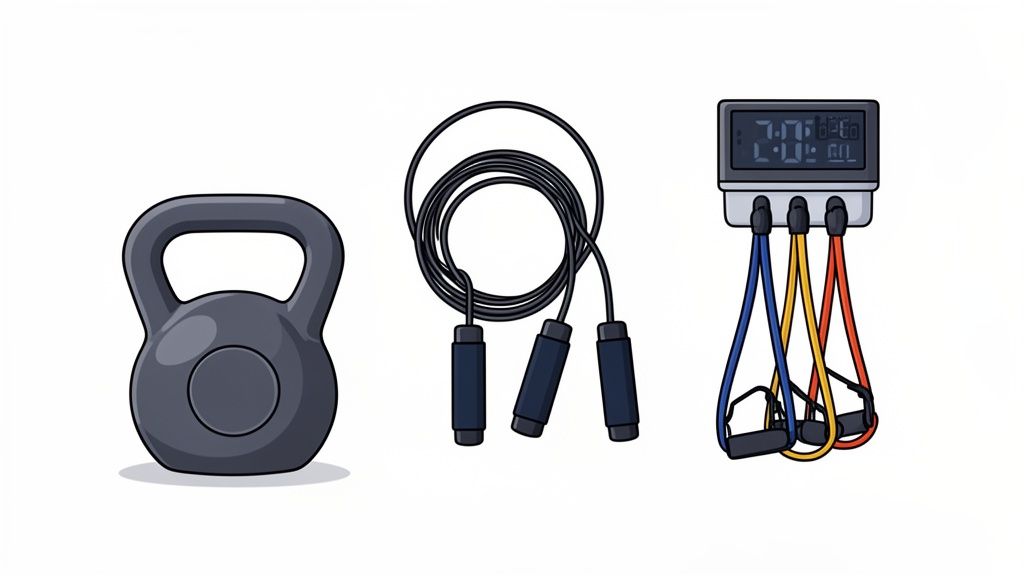
Let's start with the basics that offer the most flexibility. These three items are the foundation for an effective home CrossFit setup.
- A Solid Jump Rope: This is non-negotiable. It’s the premier conditioning tool for building coordination, footwork, and a powerful engine. Learning double-unders is a classic CrossFit milestone that builds athletic grit.
- One Kettlebell: A single kettlebell is a powerhouse for swings, goblet squats, and presses, building explosive power and core stability in a way dumbbells can't match. A good starting weight for men is 16-20kg (35-44lbs), and for women, 8-12kg (18-26lbs).
- Resistance Bands: A set of loop-style bands is a secret weapon for warm-ups, mobility drills, and scaling movements. They're ideal for assisting pull-ups or adding resistance to glute bridges and squats.
With just this small arsenal, you can design hundreds of WODs that address all aspects of your fitness—strength, power, and conditioning.
Your Most Critical Piece of Gear
Forget weights and bands for a moment. Your most important tool is a good timer. Fumbling with your phone's stopwatch between rounds kills intensity and breaks focus. When you're coaching yourself, every second counts.
A dedicated performance timer isn't a luxury; it’s a necessity. When you're deep in an AMRAP, the last thing you want to do is squint at a tiny screen or get distracted by a text message.
This is what a performance timer like the KNTC app was built for. It provides loud, clear audio cues and strong vibrations you can hear and feel over music. The ability to instantly pull up presets for an AMRAP, EMOM, or Tabata workout means zero friction. You just press go and focus on the work.
Got Questions? We've Got Answers
Stepping into CrossFit, even at home, brings up questions. That’s a good sign. It shows you’re thinking like an athlete. Let's tackle some common questions from people just getting started.
How Many Days a Week Should I Actually Work Out?
When starting, three times per week is the optimal frequency. A Monday-Wednesday-Friday schedule provides a solid training stimulus while allowing for crucial recovery and adaptation.
You will be sore. This is muscle soreness, not sharp, acute pain. Always listen to your body. After a few months of consistency, you can consider adding a fourth or fifth day. Consistency will always beat frequency.
What Gear Do I Absolutely Need to Start?
You don't need anything to start. The foundation of CrossFit is built on functional movements you can do with your own body. You can get incredibly fit with a smart mix of air squats, push-ups, and burpees.
If you are going to buy one thing, make it a good jump rope. But the most important tool isn't equipment—it's a reliable timer. A good workout timer app is what makes AMRAPs, EMOMs, and Tabatas effective. That precision drives results.
Don't fall into the trap of thinking you need a garage full of gear. Master the movements first. Intensity comes from your effort against the clock, not the weight on the kettlebell.
What if I Can't Do a Movement Perfectly?
This isn't a "what if"—it's a guarantee. No one walks in with perfect form. Every athlete starts somewhere, and this is where scaling becomes your best friend. Scaling isn't a sign of weakness; it's a sign of intelligent training.
- Can't do a full push-up? Start with your hands on a box, a sturdy coffee table, or the wall.
- Pull-ups feel impossible? Use a sturdy table for bodyweight rows to build pulling strength.
- Struggling to hit squat depth? Focus on mobility and practice squatting to a target, like a low stool or a stack of books.
The goal is never to muscle through a movement you aren't ready for. It's about finding a version that is challenging for you while allowing for good form. That is how you build real, sustainable strength without injury.
Is It Safe to Do This High-Intensity Stuff by Myself?
Yes, provided you prioritize mechanics and consistency over intensity. The biggest mistake people make training alone is getting so focused on beating the clock that their form degrades.
Start with the basics. Own your bodyweight movements before adding heavy weight or speed. A great tip is to record yourself doing a few reps of an exercise. You'll be surprised at what you see on playback. A solid program with dedicated warm-ups and cool-downs is non-negotiable. And the golden rule always applies: if you feel a sharp, sudden, or unfamiliar pain, stop.
Ready to train with focus? The KNTC timer was designed to cut out the noise so you can lock in on your workout. It has loud, clear cues and one-tap presets for AMRAP, EMOM, and Tabata. Stop messing with your phone and start focusing on your effort. Download it for free and see what a difference it makes.
Tabata Exercises for Beginners: The 4-Minute Protocol for Athletes
Discover tabata exercises for beginners: unlock fast, effective workouts with simple form guides and the science behind the 4-minute protocol.
10 Effective Home HIIT Workouts for Serious Athletes
Ditch the fluff. Here are the 10 best home HIIT workouts for athletes who need structure, intensity, and results. For CrossFit, boxing, and endurance.