
A 3 Day Split: The Athlete's Framework for Building Strength
A 3-day split is a training structure that organizes your workouts into three sessions per week. Each session targets different muscle groups or movement patterns. The entire purpose is to maximize intensity during training and optimize recovery between sessions, making it one of the most effective protocols for athletes focused on building functional strength and muscle.
Why The 3-Day Split Is Your Most Efficient Training Tool
This isn't about training less; it's about training smarter.
If you're a dedicated athlete balancing sport-specific training, a job, and life, spending five or six days a week in the weight room is unsustainable and often counterproductive. The 3-day split is the antidote to high-frequency "bro splits" that lead to burnout and wasted effort.
The philosophy is built on a non-negotiable principle: stimulate, recover, adapt. You attack the gym three times a week with high intensity, giving your body a powerful signal to grow. The other four days aren't "off days"—they are for recovery and adaptation. This is when muscle repair occurs, energy systems are restored, and you get stronger.
The Logic of Intensity and Recovery
Every hard workout is a withdrawal from your central nervous system (CNS) and your body's recovery capacity. A poorly structured plan spreads your resources too thin, leaving you going through the motions.
A 3-day split concentrates your efforts. You can train with maximum output in every session because you have at least one full day to recover before the next workout.
This structure yields tangible performance benefits:
- Heavier Lifts: Full recovery allows you to push more weight on the compound lifts that drive strength gains.
- Higher Quality Volume: Every set and rep is executed with better form and focus, not just sloppy reps performed under fatigue.
- Lower Risk of Overtraining: Adequate recovery helps you avoid CNS fatigue, joint pain, and performance plateaus.
As an athlete—whether you're in CrossFit, triathlon, or combat sports—the objective isn't to just survive training. It's to thrive. The 3-day split provides the framework to build strength without compromising the skill work and conditioning your sport demands.
Who Is This For?
This is a strategic tool for athletes who must balance strength work with other intense physical demands, not a beginner template.
If you’re a boxer, priority is time in the ring and on the road, not under a barbell. Lifting is supplemental. The same applies to a runner building a powerful engine or a CrossFit athlete who needs raw strength for WODs but cannot afford to be wrecked for the next day's metcon.
This structure integrates strength training as a powerful component of your athletic development, not the sole focus. It provides sufficient stimulus for significant gains in strength and muscle while leaving you the time and energy for sport-specific skills. This is how you build resilient, powerful, and well-rounded athletes.
Choosing Your Split: Push/Pull/Legs vs. Full Body
Once you commit to a 3-day split, the next decision is structuring the workouts. The two most effective approaches are the Push/Pull/Legs (PPL) split and the Full Body split.
There is no single "best" answer. The right choice depends entirely on your primary goal, your sport, and your individual recovery capacity. This decision is the foundation of your program—it dictates training frequency, volume tolerance, and your results.
This chart highlights a critical point: a smart, sustainable plan like a 3-day split produces real progress. Attempting to do too much is a direct path to burnout.
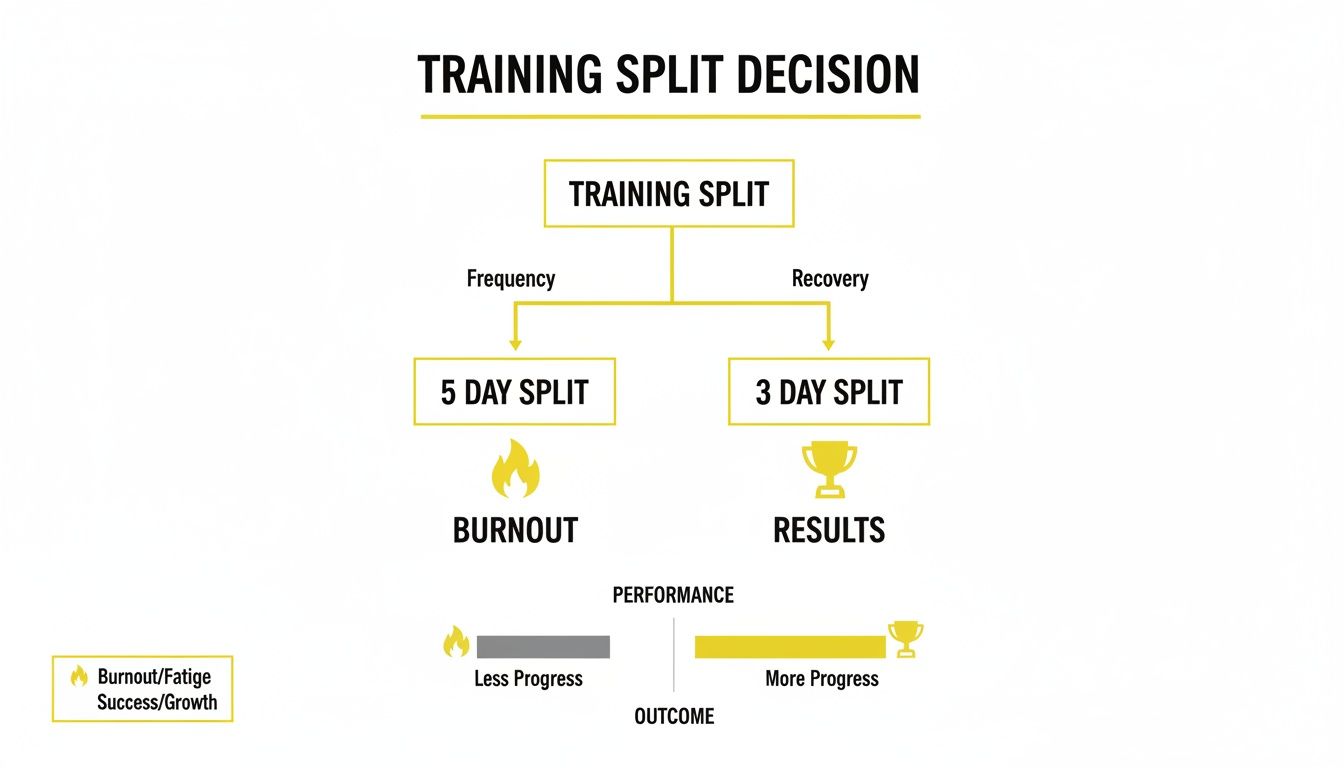
The takeaway: Strategy trumps volume. Consistent, focused training is what drives results.
The Case for Push/Pull/Legs (PP)
The PPL split is a staple in bodybuilding because it is simple and brutally effective. The structure includes one day for upper-body pushing movements (bench press, overhead press), one for pulling movements (pull-ups, rows), and one dedicated leg day. This framework is a powerhouse for building muscle.
By dedicating an entire session to related muscle groups, you can hit them with significant volume—a primary driver of hypertrophy (muscle growth). If adding size is the primary goal, PPL delivers the necessary stimulus without requiring you to live in the gym.
Recovery is a major advantage. After a heavy push day, your chest, shoulders, and triceps have several days to fully repair. This allows for high intensity in each session, which is essential for growth and injury prevention.
The efficiency of PPL is its strength. Each workout has a clear objective. You aren't just doing random exercises; you are applying surgical precision to stimulate specific muscle groups for optimal growth.
The Case for a Full Body Split
A full-body routine operates on a different principle. Instead of isolating muscle groups, you train the entire body three times a week, typically with a focus on large, compound lifts. This approach dramatically increases training frequency for every muscle.
Hitting your muscles three times a week instead of once provides a constant stimulus for strength and neurological adaptation. Your CNS becomes highly efficient at recruiting the motor units required for squats, bench presses, and deadlifts, accelerating strength gains. It is the preferred method for athletes who prioritize raw power and performance.
For muscle growth, higher frequency is also effective. Research shows that training muscles three times per week can significantly boost strength and still drive hypertrophy. For a CrossFit athlete aiming to improve an AMRAP score or an MMA fighter drilling takedowns for 3-minute rounds, this type of whole-body resilience is critical. For a deeper analysis of the science, watch Josh Pelland's analysis on training frequency.
Making the Right Choice for Your Goal
Which protocol should you use? The decision depends on your objective.
- Maximum Muscle Growth (Hypertrophy): PPL is the logical choice. The high volume you can apply to each muscle group is the most direct path to adding size.
- Pure Strength & Athletic Performance: The Full Body split generally has the edge. Higher frequency on primary lifts accelerates strength gains and refines motor patterns more quickly.
- General Fitness & Conditioning: Full Body is superior. It builds a well-rounded, resilient physique without causing the localized soreness that can interfere with other activities like running or martial arts.
- Unpredictable Schedule: Select Full Body. Missing a workout is not a major setback, as you just trained everything a couple of days prior. Missing a PPL day means an entire muscle group may go a week or more without stimulation.
This head-to-head comparison provides further clarity.
Push Pull Legs vs Full Body: Which 3 Day Split Is for You?
Use this table to align a training style with your goals, schedule, and recovery capacity.
| Factor | Push/Pull/Legs (PP) | Full Body |
|---|---|---|
| Primary Goal | Best for hypertrophy (muscle size). | Best for strength and athletic performance. |
| Frequency Per Muscle | Low (1x per week). | High (3x per week). |
| Per-Session Volume | High. Allows for many sets per muscle group. | Low to Moderate. Fewer sets per muscle group per session. |
| Best For... | Bodybuilders or anyone prioritizing aesthetics. | Powerlifters, athletes, general fitness. |
| Recovery | Allows more recovery time for a specific muscle group. | Less muscle-specific soreness, but higher systemic fatigue. |
| Flexibility | Less flexible. Missing a day means skipping an entire body part. | Highly flexible. Easy to reschedule, as every day is a full-body day. |
Ultimately, the best 3-day split is the one you can execute consistently with high intensity. Define your priority—size, strength, or performance—and choose the framework that gets you there.
Your 3-Day Split Workout Playbook
Here are three 4-week sample programs, each designed for a different objective. Use them as proven templates, not rigid prescriptions. The workouts are designed for intensity and efficiency, requiring 45-60 minutes to complete.
The most important rule is to listen to your body.
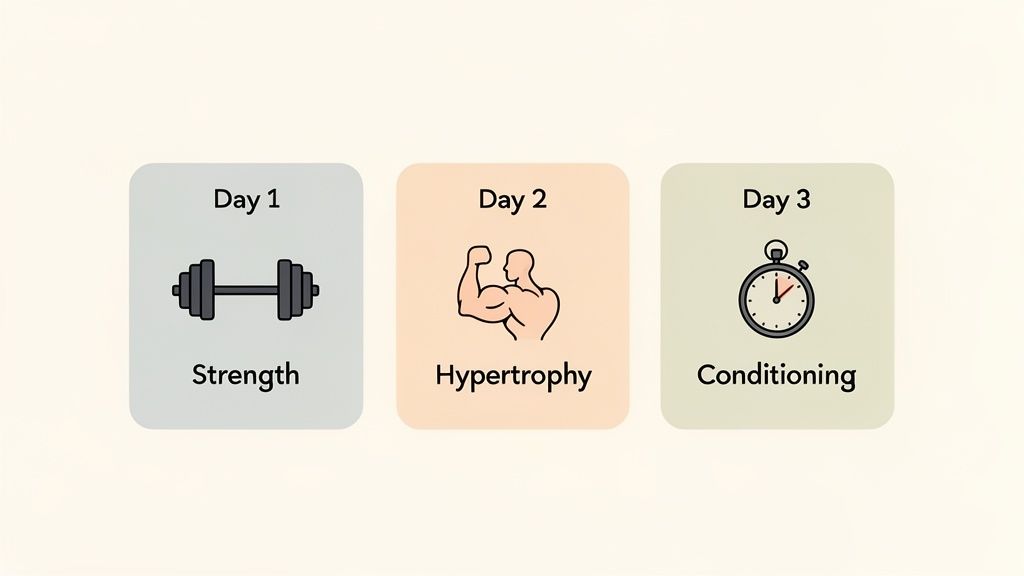
Protocol 1: Pure Strength
This full-body routine is for athletes whose main goal is moving heavy weight. It is built around the primary compound lifts. Training these fundamental movement patterns three times a week accelerates neurological adaptations, teaching your CNS to recruit more muscle fibers for each lift.
The overall volume is manageable to allow for heavy loads and full recovery. Do not cut rest periods short; they are as critical as the work sets. You should leave each session feeling strong, not destroyed.
Weekly Schedule: Monday / Wednesday / Friday
Workout A (Monday & Friday)
- Barbell Back Squat: 5 sets of 5 reps (5x5). Rest 3-4 minutes.
- Bench Press: 5 sets of 5 reps (5x5). Rest 3-4 minutes.
- Pendlay Row: 3 sets of 6-8 reps. Rest 2-3 minutes.
- Face Pulls: 3 sets of 15-20 reps. Rest 60 seconds.
Workout B (Wednesday)
- Deadlift: 1 top set of 5 reps. (Warm up properly). Rest as needed.
- Overhead Press: 5 sets of 5 reps (5x5). Rest 2-3 minutes.
- Weighted Pull-Ups: 4 sets of 6-8 reps. Rest 2-3 minutes.
- Farmer's Walk: 3 sets of 30-40 yards. Rest 90 seconds.
Pro Tip: Your training log is a critical tool here. For the 5x5 lifts, the mission is to add weight each week. Progress is not always linear, but consistent effort builds foundational strength.
Protocol 2: Hypertrophy Focus
For those pursuing muscle growth, this Push/Pull/Legs (PPL) split is a proven method. The logic is simple: you apply high, targeted volume to one group of muscles, then allow them nearly a full week to recover and grow.
Rep ranges are higher and rest periods are shorter. This is by design. The goal is to create metabolic stress and micro-trauma in the muscle—two primary drivers of hypertrophy. Focus on the mind-muscle connection, not just moving the weight.
Weekly Schedule: Tuesday / Thursday / Saturday
Day 1: Push
- Incline Dumbbell Press: 4 sets of 8-12 reps. Rest 90 seconds.
- Flat Barbell Bench Press: 3 sets of 8-12 reps. Rest 90 seconds.
- Seated Dumbbell Shoulder Press: 3 sets of 10-15 reps. Rest 75 seconds.
- Lateral Raises: 4 sets of 12-15 reps (use a drop set on the final set). Rest 60 seconds.
- Triceps Pushdowns: 3 sets of 12-15 reps. Rest 60 seconds.
Day 2: Pull
- Pull-Ups (or Lat Pulldowns): 4 sets to failure (or 8-12 reps). Rest 90 seconds.
- Barbell Rows: 3 sets of 8-12 reps. Rest 90 seconds.
- Seated Cable Rows: 3 sets of 10-15 reps. Rest 75 seconds.
- Dumbbell Curls: 3 sets of 10-15 reps. Rest 60 seconds.
- Hammer Curls: 3 sets of 10-15 reps. Rest 60 seconds.
Day 3: Legs
- Barbell Squats: 4 sets of 8-12 reps. Rest 2-3 minutes.
- Romanian Deadlifts: 3 sets of 10-12 reps. Rest 2 minutes.
- Leg Press: 3 sets of 15-20 reps. Rest 90 seconds.
- Leg Extensions: 3 sets of 15-20 reps. Rest 60 seconds.
- Seated Leg Curls: 3 sets of 15-20 reps. Rest 60 seconds.
- Standing Calf Raises: 4 sets of 15-20 reps. Rest 45 seconds.
Protocol 3: GPP and Conditioning
This protocol is for the athlete who requires a combination of strength, speed, and endurance. We blend strength work with high-intensity conditioning to build General Physical Preparedness (GPP). By training the full body each session, you develop functional strength without the deep muscle soreness that can interfere with sport-specific training.
Each workout pairs compound lifts with a high-intensity finisher to build both a powerful engine and a durable chassis.
Weekly Schedule: Monday / Wednesday / Friday
Workout 1
- A1. Goblet Squat: 4 sets of 10-12 reps.
- A2. Chin-Ups: 4 sets to failure. Rest 90 seconds between supersets.
- B. Kettlebell Swings: 5 sets of 20 reps. Rest 60 seconds.
- C. Finisher: EMOM x 10 minutes
- 10 Burpees (Every Minute On the Minute)
Workout 2
- A. Deadlift: 4 sets of 6-8 reps. Rest 2-3 minutes.
- B1. Dumbbell Push Press: 3 sets of 8-10 reps.
- B2. Inverted Rows: 3 sets of 12-15 reps. Rest 75 seconds between supersets.
- C. Finisher: 5 Rounds For Time
- 200m Row
- 15 Wall Balls
Workout 3
- A. Front Squat: 4 sets of 6-8 reps. Rest 2-3 minutes.
- B1. Single-Arm Dumbbell Row: 3 sets of 10-12 reps per side.
- B2. Dips (or Push-Ups): 3 sets to failure. Rest 75 seconds between supersets.
- C. Finisher: Assault Bike Sprints
- 8 rounds: 20 seconds max effort, 40 seconds rest
For conditioning work, precise timing of work/rest intervals is non-negotiable. A dedicated EMOM timer app removes guesswork and allows you to focus entirely on output.
Making It Your Own: Auto-Regulation and Exercise Swaps
No program is perfect every single day. This is where auto-regulation—the skill of listening to your body and making intelligent adjustments—is critical. If the prescribed 5x5 squats feel excessively heavy, it is smarter to reduce the weight and execute with perfect form than to grind through bad reps and risk injury. Conversely, if you feel strong, pushing for an extra rep or two is a valid adjustment.
The exercises listed are effective staples, but feel free to make logical substitutions based on equipment availability or individual biomechanics.
- No barbell bench? Dumbbell Press is an excellent alternative.
- Barbell Rows problematic? Try T-Bar Rows or Chest-Supported Rows.
- Leg Press occupied? Hack Squats or Bulgarian Split Squats are effective substitutes.
The key is to select exercises you can perform safely and progress over time. This playbook provides the structure; your consistent effort and smart adjustments deliver the results.
Making Your 3-Day Split Work with KNTC
A workout plan is only as good as its execution. A timer is your most honest training partner, enforcing discipline when fatigue compromises your judgment.
Using a tool like KNTC removes guesswork from the equation. You aren't just training hard; you're training with precision. Every interval, rest period, and round is executed as designed. Here are specific KNTC presets to optimize these 3-day split workouts.
KNTC Setup for Pure Strength
For strength training, rest periods are non-negotiable. They allow your body's explosive energy system (ATP-PC) to recharge, enabling maximum force production on the next heavy set. The timer's job is to enforce this discipline.
- Mode: Countdown
- Time: Set to your prescribed rest—3-4 minutes for primary lifts and 2-3 minutes for accessory work.
- Audio/Haptics: Use loud, distinct cues. The 10-second warning is your signal to approach the bar and prepare for the next set.
Create two presets in KNTC: "Main Lift Rest" (4:00) and "Accessory Rest" (2:30). After a heavy set of squats, you hit one button. This eliminates distraction and lets you focus on recovery. The timer dictates when it's time to work.
KNTC Setup for a Hypertrophy Focus
The hypertrophy program manipulates fatigue to create metabolic stress—the "pump" that signals muscle growth. Shorter rest periods and techniques like supersets are the tools, and the timer is the pacer that maintains intensity.
For hypertrophy, time under tension and metabolic stress force muscles to adapt. A precision timer prevents rest periods from extending, which keeps blood in the muscle and intensity at the required level.
For this protocol, set up an Interval Timer in KNTC, which is ideal for accessory work or supersets.
- Mode: Interval
- Work Interval: Set low (e.g., 5 seconds), as it's not needed for timing rest.
- Rest Interval: Set to your target: 90 seconds, 75 seconds, or 60 seconds.
- Rounds: Set high (e.g., 20) to run for the entire session.
After each set, tap the screen to start your rest countdown. This is more efficient than clock-watching and frees you to mentally prepare for the next set. We cover this in more detail in our guide on the best interval training timer app features.
KNTC Setup for GPP and Conditioning
For General Physical Preparedness (GPP) sessions, timing is the entire workout. Finishers like EMOMs or sprints are designed to push your metabolic limits; imprecise timing negates their purpose.
For the EMOM Finisher:
- Mode: EMOM (Every Minute On the Minute)
- Time: 1:00
- Rounds: 10
KNTC’s clear audio cues mark the start of each minute. You can forget the clock and focus on work output. The countdown beeps will alert you as the next round approaches.
For the Assault Bike Sprints:
- Mode: Interval
- Work Interval: 20 seconds
- Rest Interval: 40 seconds
- Rounds: 8
This is a classic high-intensity interval training (HIIT) protocol. Haptics and loud audio cues are essential here—they will cut through the noise of the machine and your own exertion to keep you on schedule.
For athletes who are serious about results but limited on time—boxers, coaches, busy parents—the 3-day split is a time-tested method for achieving significant progress. It provides enough stimulus for adaptation without causing excessive fatigue. When you combine this intelligent structure with a precision tool like KNTC, you ensure flawless execution.
Making the 3-Day Split Work for Your Sport
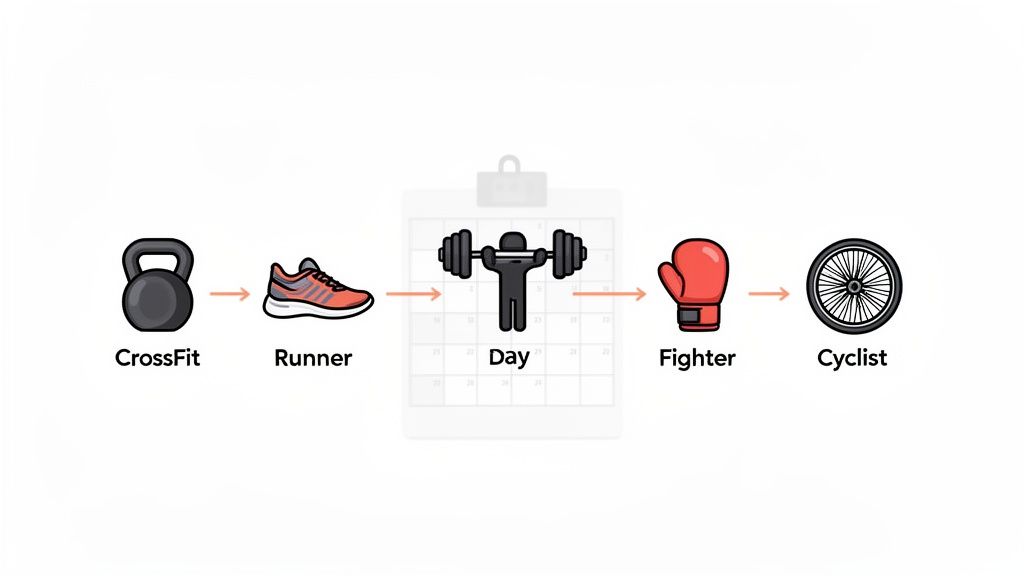
Your training plan must support your primary goals, not detract from them. A 3-day split is an excellent tool for building strength, but its real value lies in its integration with your specific athletic demands. The objective is synergy, not interference.
Your lifting days must complement your main sport. Here is how different athletes can adapt this structure to their needs.
For the CrossFit Athlete
CrossFit combines strength and conditioning, so adding a separate 3-day split requires a strategic approach to avoid burnout. The main risks are redundant training and excessive CNS fatigue.
Program your split around your box’s WODs. Use lifting days to target weaknesses or build the foundational strength that is sometimes neglected in daily metcons.
- Smart Scheduling: Schedule lifting days as far as possible from heavy, CNS-intensive WODs. If Tuesday's WOD includes a heavy clean and jerk, that is not the day for a high-volume leg session.
- Targeted Focus: A Push/Pull/Legs split is highly effective. It allows you to build strength in a controlled environment with strict movements like weighted pull-ups, overhead presses, and tempo squats. This develops a solid foundation that improves the safety and efficiency of your kipping and Olympic lifts.
- Volume Management: On days when you lift and do a WOD, one must be prioritized. If you complete a heavy squat session in the morning, approach the afternoon WOD as skill practice, not a race.
For Runners and Cyclists
Endurance athletes require strength, but not at the cost of having heavy legs for a long run or ride. The goal is to build power and durability without compromising your primary sport. For this, a full-body split is almost always the optimal choice.
Place your lifting sessions on easier training days or allow at least 24-48 hours before your most demanding endurance workout. For example, if your long run is on Saturday, your last heavy leg day should be Wednesday or Thursday.
A sample week could look like this:
- Monday: Full Body Strength (lower intensity)
- Tuesday: Tempo Run / Interval Ride
- Wednesday: Full Body Strength (higher intensity)
- Thursday: Easy Recovery Run / Ride
- Friday: Full Body Strength (moderate intensity)
- Saturday: Long Run / Ride
- Sunday: Rest
This structure helps ensure your legs are fresh for the most critical session of the week. Improving speed is not just about logging more miles; strength development is a key component. For more on this, see our guide on how to improve your running pace.
For Boxers and Combat Athletes
For a fighter, skill work is paramount. Roadwork builds endurance, and sparring sharpens technique. Your strength training must support these activities, not hinder them. The goal is to increase punching power, clinch strength, and takedown defense—without creating stiffness or fatigue that compromises technique.
Again, a full-body routine is typically the best option, with an emphasis on explosive, athletic movements.
A fighter's strength program should be built around movement patterns, not isolated muscles. Focus on explosive pushes for striking, powerful pulls for clinching, and rotational core work. The 3-day split is the ideal framework for this.
Schedule lifting sessions after skills training on the same day. This ensures you are mentally and physically sharp for technical work. A grueling lifting session before boxing practice is a recipe for slow, sloppy technique. The ideal approach is to complete boxing drills in the morning and a full-body strength session in the afternoon or evening.
For Busy Parents and Professionals
When time is your most scarce resource, consistency is more important than complexity. The 3-day split is effective because it is sustainable. Missing a workout in a 5-day plan can disrupt the entire week. With this structure, it is a minor issue.
The full-body split offers maximum flexibility. If you miss Wednesday's session, you can shift it to Thursday without an entire muscle group going untrained. Schedule your workouts like unbreakable appointments in your calendar and protect that time.
Even a focused 45-minute session is a significant win.
Got Questions About The 3-Day Split? I've Got Answers.
Even the best training plan will encounter obstacles. Questions are normal. Here are direct answers to the most common questions about running a 3-day split.
"What Should I Do on Rest Days?"
Rest days are not "off days." They are recovery days, and they are as important as your training sessions. The goal is not inactivity; it is active recovery.
Active recovery involves low-intensity movement to increase blood flow, which delivers nutrients to sore muscles and accelerates the repair process. The key is to keep intensity low to avoid adding more stress to your body.
Effective options include:
- Light Cardio: A 20-30 minute walk, a slow bike ride, or a very easy jog. You should be able to hold a conversation without difficulty.
- Mobility Work: Use a foam roller, perform light stretching, or go through a simple yoga routine. Focus on tight areas like the hips, shoulders, and thoracic spine.
- Hydrate and Eat Well: This is non-negotiable. Your body requires water and quality protein to rebuild. Do not neglect this.
Treat these days as an investment in your next workout. You are preparing your body to come back stronger.
"I Missed a Workout. Now What?"
It happens. One missed session will not derail your progress, but your response matters. There are two intelligent options, depending on your schedule.
Option 1: Pick Up Where You Left Off This is the simplest solution. Shift your week. If you missed Wednesday's workout, do it on Thursday and move Friday's session to Saturday. This ensures you complete all three training days.
Option 2: Skip It and Move On If your schedule is rigid, it is often better to forget the missed workout and proceed to your next scheduled session. This is particularly true for a full-body split, since you will be training those muscle groups again in a couple of days.
Do not try to cram two workouts into one day to "make up for it." This leads to poor performance in both sessions and significantly increases your risk of injury. One missed workout is a minor event.
"When Is It Time to Add More Weight?"
Progressive overload is the fundamental principle of getting stronger. However, many people add weight prematurely. The signal to increase the load is not a feeling; it is hitting your target reps with perfect form.
The "2-for-2 rule" is a simple and effective guideline. If you can complete two more reps than your target on your first two work sets for a given exercise, it is time to increase the weight in the next session.
For example, if your program calls for 3 sets of 8 on the bench press and you achieve 10 clean reps on your first two sets, you have earned the right to add 5-10 pounds the following week. This method ensures your strength gains are legitimate.
"How Long Should I Stick With This Program?"
Program-hopping is a major impediment to progress. Your body needs time to adapt to a training stimulus. You should commit to any well-designed 3-day split for at least 4-6 weeks before considering a change.
During that period, your mission is to get stronger within the program. This means adding weight to the bar, completing an extra rep, or reducing rest times. That is what real progress is.
Only consider changing your routine if you hit a genuine plateau for two or more consecutive weeks—meaning you cannot add weight or reps to your main lifts, despite adequate sleep, nutrition, and effort.
Your training plan is the map; execution is what gets you to your destination. The KNTC timer eliminates guesswork, ensuring every set, interval, and rest period is timed with precision. Stop guessing and start performing. Download KNTC for free and feel what a difference precision makes.
What Is AMRAP in CrossFit and How to Pace It Right
What is AMRAP in CrossFit? Learn how this workout drives progress, master pacing strategies, and find practical examples to improve your performance.
Master Your Running Interval Training App with This Guide
Stop guessing and start training. This guide shows you how to use a running interval training app to build powerful, precise workouts that get results.