
Your Interval Timer for Running: The Guide to Structured Training
If you're serious about getting faster, an interval timer is the single most important tool in your arsenal. It’s what separates random running from structured, purposeful training that builds speed and endurance. Unlike a basic stopwatch, a dedicated timer automates your work and rest periods with precision. This lets you execute complex workouts like 400m repeats or Tabata sprints with zero guesswork, keeping you locked into the intended training zone.
Why Precision Timing is a Non-Negotiable for Athletes
If you're guessing your rest periods, you're leaving performance on the table. For any athlete looking to improve, unstructured training is a massive missed opportunity. Precision timing isn’t just about counting seconds; it’s about strategically applying stress to force adaptation. When you nail your work-to-rest ratios, you take direct control over the energy systems you’re trying to build.
This structured approach is the foundation of real progress. Every cue from a good interval timer is like a coach in your ear—an objective standard that keeps you honest when fatigue sets in. It eliminates the mental debate of, "Am I ready to go again?" so you can focus all your energy on execution.
This breaks down the difference between standard timing tools.
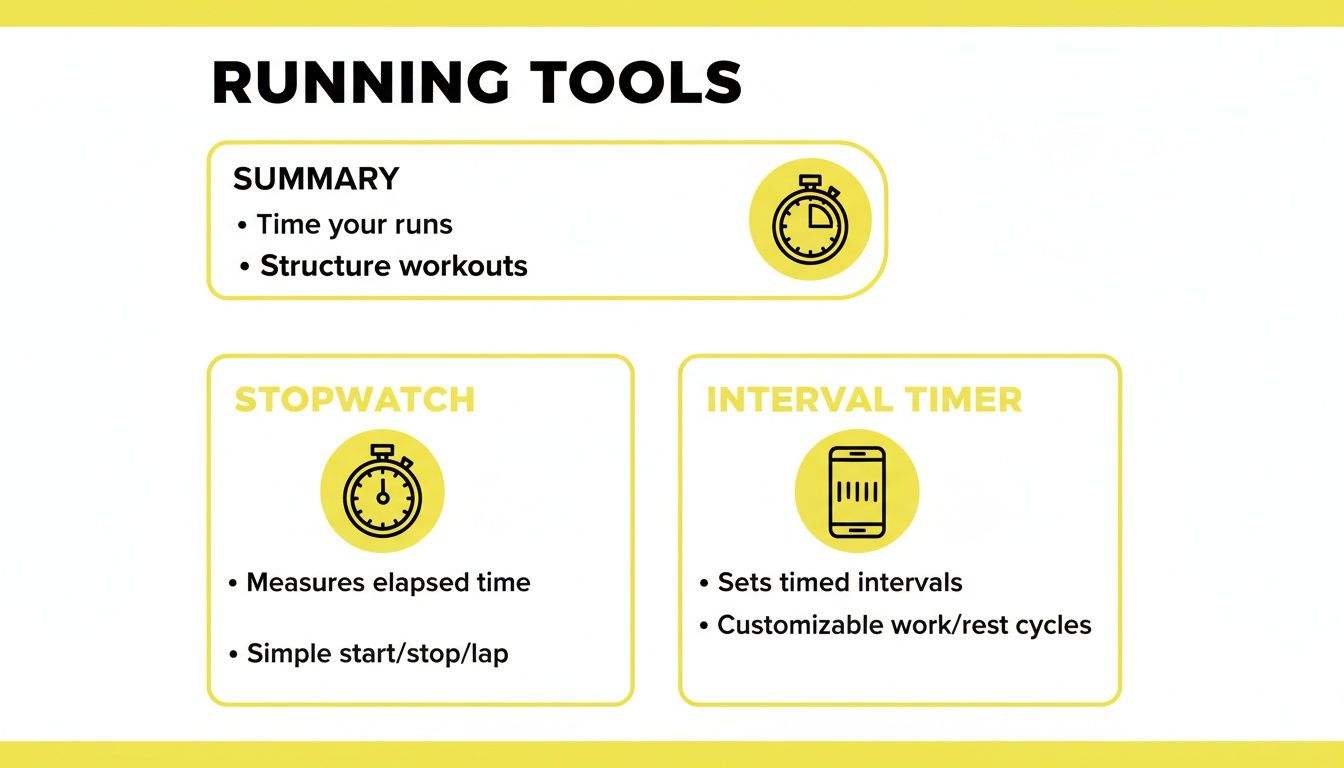
A stopwatch only tells you total elapsed time. An interval timer manages the entire session—intensity, recovery, and volume—with absolute precision.
The Training Logic Behind Structured Intervals
When you follow a specific work-to-rest protocol, you're manipulating your body's energy systems to achieve a specific outcome.
Here’s the breakdown:
- Improving VO2 Max: Short, intense efforts with equally short recovery periods (e.g., a 1:1 work-to-rest ratio) push your cardiovascular system to its limit. This forces your body to improve its ability to transport and utilize oxygen, directly increasing your aerobic capacity.
- Boosting Lactate Threshold: Longer intervals with shorter rest periods train your body to clear metabolic byproducts more efficiently while working at a high intensity. This is the key to sustaining a faster pace for longer before fatigue shuts you down.
- Building Anaerobic Speed: All-out sprints followed by long recovery periods (e.g., a 1:5 ratio) target your fast-twitch muscle fibers for pure power development. This is what builds a powerful finishing kick.
A simple stopwatch can't manage this level of detail. It tells time, but an interval timer orchestrates the entire workout.
From Unstructured Effort to Purposeful Training
The shift from just running to interval-based training is what separates recreational jogging from serious athletic development. The demand for these tools reflects this. The global gym timer market, which includes tools for all athletes, hit a value of $425 million and is projected to more than double to $900 million by 2033. According to recent market research, this 8.7% annual growth is fueled by the explosion of running and HIIT, where precise timing is essential.
The difference is clear when you compare the tools.
Standard Stopwatch vs. Interval Timer For Running
| Feature | Standard Stopwatch | Dedicated Interval Timer |
|---|---|---|
| Workout Structure | Manual start/stop for each segment | Pre-programmed work, rest, and warm-up/cool-down |
| Consistency | Highly variable; easy to misjudge rest periods | Perfect consistency every session |
| Mental Focus | Requires constant clock-watching | Allows 100% focus on effort and form |
| Workout Complexity | Only practical for simple, continuous runs | Easily handles complex protocols like Tabata or pyramids |
| Progress Tracking | Difficult to replicate workouts exactly | Ensures every session is measurable and repeatable |
The table makes it clear: a stopwatch is fine for a casual jog, but an interval timer is essential for performance-oriented training.
A dedicated timer removes decision fatigue. When the plan is locked in, your only job is to execute. This mental freedom is critical for pushing through the toughest reps.
Using an interval timer for running is about training smarter. It turns effort into measurable, repeatable workouts designed for progress. It's the difference between just going for a run and systematically building a faster, stronger athlete.
Programming Your Go-To Running Workouts
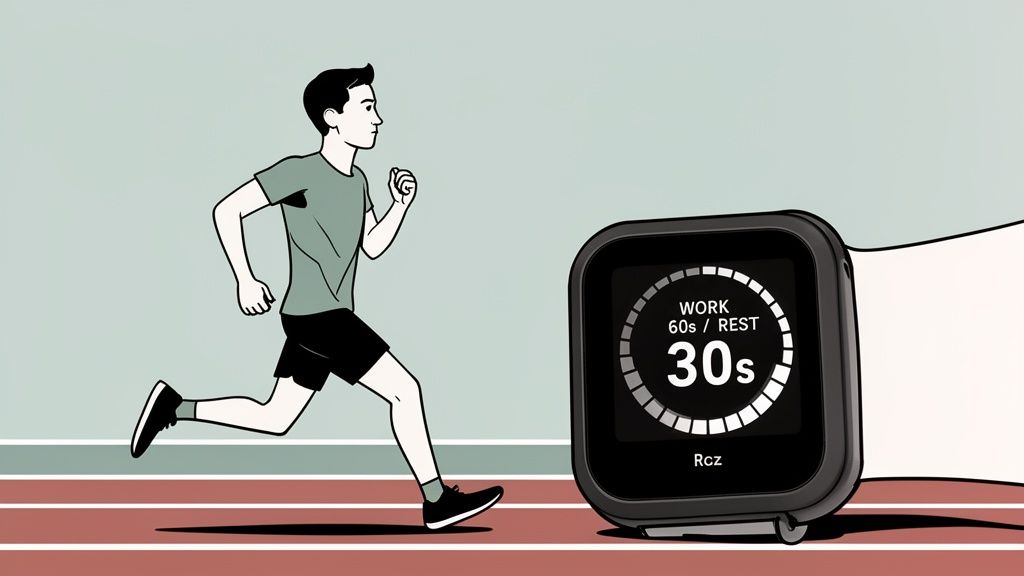
Let's move from theory to application. Here’s how to program three of the most effective running workouts into your interval timer for running.
These aren't random drills; they are foundational sessions that target different systems to make you a more complete athlete. The goal is to set them up as presets so you can execute without fumbling with your watch when you should be focused on your stride.
The Classic: 400m Repeats for Speed Endurance
The 400-meter repeat is a staple for a reason. It builds speed endurance—the ability to hold a fast, uncomfortable pace. This workout trains your body to clear metabolic waste while operating at high intensity.
The objective is simple: hit each 400m at a consistent, challenging pace, with just enough rest to repeat the effort. Your timer enforces that honesty.
Here’s how to program a classic 8 x 400m session:
- Warm-up: 10 minutes (Set as a single countdown.)
- Work Interval: Program your goal 400m time. If your target is 90 seconds, set it here.
- Rest Interval: 90 seconds (A 1:1 work-to-rest ratio is a solid starting point.)
- Rounds: 8
- Cool-down: 10 minutes (Add as the final interval.)
When you program your goal time as the work interval, you’ve created a pacer. You know exactly where you need to be on the track when the signal sounds. No guesswork. For more on structuring these sessions, our guide on a running interval training app has additional details.
The Grinder: VO2 Max Intervals for Aerobic Power
This is where you build your aerobic engine. The objective is to spend sustained time at or near your maximum oxygen uptake (VO2 max), forcing your heart and lungs to become more efficient at delivering oxygen to working muscles. The payoff is the ability to sustain a harder pace for longer.
These efforts are longer than sprints, performed at an intensity you can only hold for a few minutes. Precise timing of both work and recovery is crucial to get the intended stimulus.
Let's set up a 5 x 3 minutes hard, 2 minutes easy VO2 max session:
- Warm-up: 10-15 minutes of easy jogging and dynamic drills.
- Work Interval: 3 minutes (Run at a pace you could hold for a 10-minute race, max.)
- Rest Interval: 2 minutes (Active recovery: slow jog or walk.)
- Rounds: 5
- Cool-down: 10-15 minutes of easy jogging to flush the system.
A workout like this is a mental battle. Offloading the timekeeping to your interval timer lets you focus on form, breathing, and pushing through the final minute of each rep.
The Finisher: Tabata Sprints for Anaerobic Capacity
Tabata is pure intensity in a four-minute package. The protocol is brutally effective: 20 seconds of all-out effort followed by 10 seconds of rest, repeated eight times. This workout completely taxes your anaerobic system.
It’s an excellent tool for developing a finishing kick. The intervals are too fast to manage by glancing at a watch; you need an interval timer for running with loud, clear cues.
Here’s how to set up one round of Tabata:
- Prepare: 10 seconds (A brief countdown before the work begins.)
- Work Interval: 20 seconds (This is a 100% flat-out sprint.)
- Rest Interval: 10 seconds (Just enough time to take a breath. Do not extend it.)
- Rounds: 8
Tabata's efficiency comes from its short rest period, which prevents full recovery and forces your body to produce power under extreme metabolic stress. For a tougher session, stack multiple rounds with a few minutes of rest in between.
Building Your Personal Workout Library
Once programmed, save these workouts as presets. Name them clearly: "Track 400s," "VO2 Max Grinder," or "Tabata Finisher."
This is how your interval timer becomes a reliable training partner. It stores your key workouts, ensures perfect execution, and removes friction so all you have to do is perform.
Using Your Timer to Master Pacing and Recovery
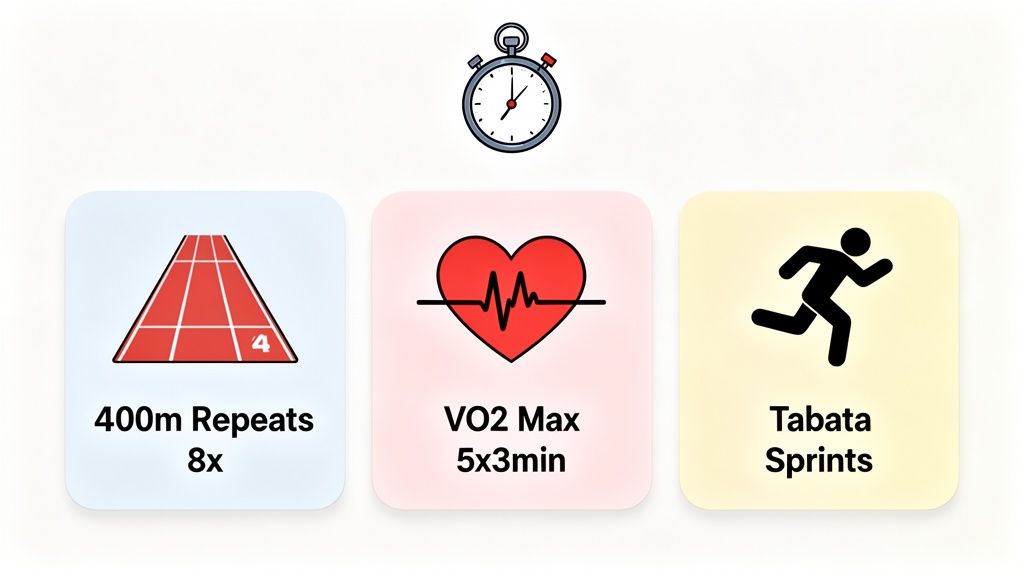
An interval timer is more than a stopwatch; it’s your impartial coach. It keeps you honest when fatigue compromises your judgment, preventing you from slowing down or starting the next rep before you’re properly recovered.
By offloading the mental task of clock-watching, you can focus on what actually improves performance: form, breathing, and body awareness. You stop guessing your pace and start knowing it.
Letting Cues Keep You on Target
The best timers cut through the noise of a hard workout. When your heart is pounding in the last 100 meters of a repeat, you can't be fumbling with a screen.
- Audio Cues: You need distinct, sharp signals that clearly mark the start and end of each interval without requiring you to look down.
- Haptic Feedback: On a windy day or in a loud gym, a strong vibration on your wrist is an undeniable cue that keeps you locked into your rhythm.
Over time, these cues become automatic. Beep means "go." Vibration means "recover." This automation builds consistency—the foundation of all progress. It forces you to adhere to the plan, rep after rep, even when your body wants to quit.
Turning Passive Waiting into Active Recovery
The rest interval is a strategic component of the workout, not just downtime. Your timer structures this recovery, ensuring it’s just long enough for you to execute the next hard effort effectively.
Use this time actively. Walk or slow jog, focusing on deep, controlled breathing to lower your heart rate. Many athletes treat rest as a total break, which is a mistake. It’s a tool to ensure your next "on" interval is as strong as the last.
Your timer provides the objective framework; your body provides the real-time feedback. A well-designed workout should feel hard but repeatable. If you're falling apart by the third rep, the workout parameters—not your effort—are likely the problem.
Making Smart Adjustments on the Fly
Even the best plan can meet reality. Some days you feel flat; other days you feel unstoppable. A smart athlete listens to their body and uses the timer as a flexible guide, not a rigid master.
Scenario A: The Struggle Is Real You’re doing 800m repeats, but your times are dropping significantly after the second one. Instead of grinding through with poor form, pause the timer. Add an extra 30 seconds to your next rest period. This small adjustment can be the difference between a productive session and one that digs you into a recovery hole.
Scenario B: You’re Feeling Unstoppable You're hitting your 400m repeat times and feeling strong during recovery. For your last two reps, try cutting 10-15 seconds from your rest time. This is a simple application of progressive overload, pushing your lactate threshold and building fatigue resistance. For a deeper look, see our guide on how to improve running pace.
An interval timer for running is a dynamic tool. Use it to build discipline, manage energy, and make intelligent, in-the-moment adjustments that turn every workout into a step forward.
Advanced Timer Features For Serious Athletes
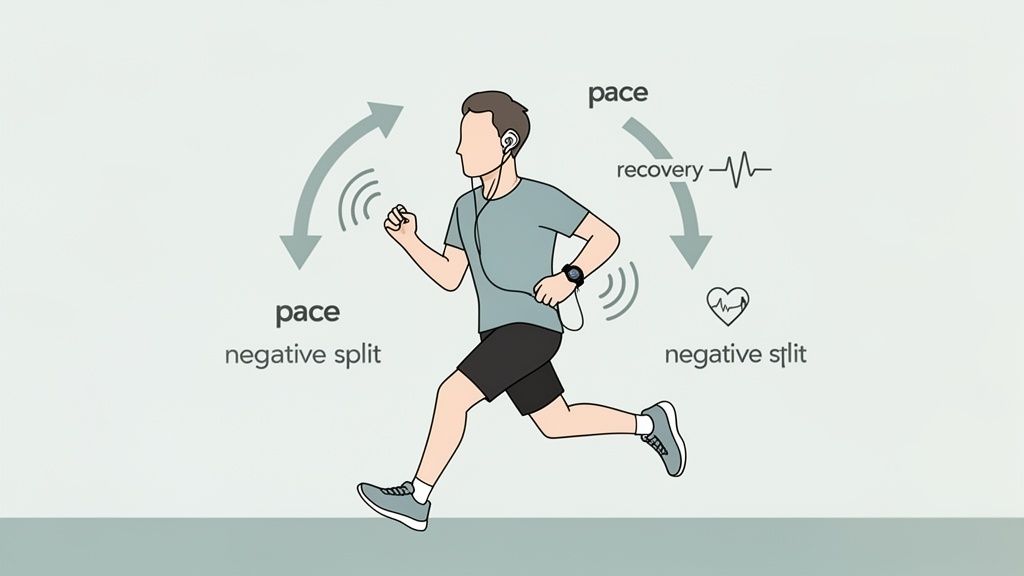
Once you move beyond basic timing, the details in your interval app matter. For any serious athlete, efficiency and focus are paramount. The best features aren’t gimmicks; they are tools designed to solve real-world problems during training, stripping away distractions so you can concentrate on performance.
These are the features that separate a good timer from a great one. They anticipate an athlete's needs when they're deep in a workout—fatigued, breathing hard, and requiring zero friction from their equipment.
Eliminate Setup with Custom Presets
Your training plan is structured. Why waste mental energy programming the same workout repeatedly? The ability to create and save custom presets is a must-have for any athlete on a consistent program. It reduces decision fatigue before you even begin your warm-up.
Consider your weekly schedule. Track day is 8 x 400m repeats. Tempo day is 3 x 10 minutes at threshold. A reliable interval timer for running lets you build each of those workouts once, name it, and save it. From then on, starting your session is a single tap—no more adjusting work, rest, and round settings. It's a small detail that preserves mental energy for the actual work.
Saving presets turns your timer into a personal training library. You're building a collection of your go-to sessions, ready to launch at a moment's notice.
Train Undistracted with Background Mode
Most of us run with music or a podcast. A timer app that forces a choice between its cues and your audio is useless. A reliable background mode is essential.
This feature allows the timer to run perfectly behind other apps. You can have your music playing while still getting sharp, distinct beeps or vibrations signaling your intervals. You never miss a cue, allowing you to stay focused on your audio without sacrificing the precision of your workout. This is critical for long tempo runs where audio can be a key motivational tool.
Cut Through the Noise with Clear Cues
When you're fighting for air on the last rep, you can't be looking at a screen. Audio and haptic feedback must be impossible to miss. It’s not about volume; it’s about clarity.
Look for a timer that offers:
- Loud, Sharp Audio: You need a sound like a boxing bell, not a gentle chime, that cuts through wind, traffic, or gym noise.
- Strong Haptics: A powerful vibration on your wrist is an undeniable signal, perfect for training without headphones or in loud environments. You can explore options for an interval timer on Apple Watch to get this right.
These cues create a direct line of communication between your workout plan and your body, removing all guesswork.
See Your Progress at a Glance
For track or treadmill workouts, a large, high-contrast display is a major advantage. Propping your phone where it’s visible allows you to check remaining time with a quick glance. A landscape mode with huge digits means you don't have to break form or lose focus to know where you are in an interval.
This visual feedback is a powerful pacing tool. Seeing the clock count down helps you manage your effort, whether that means holding back on early reps or emptying the tank in the final seconds. It's no surprise that tools like these are becoming standard. Fitness apps, including specialized interval timers, saw daily active users jump 24% in the first half of a recent year. Discover more insights about running app usage statistics on RunRepeat.com.
Making Your Timer a Part of the Bigger Picture
A single workout is just one component. Real progress comes from stringing together effective sessions, week after week. Your interval timer isn't just for today's run; it's the tool that helps you execute an entire training cycle, ensuring every workout builds on the last and moves you closer to your goal.
Whether you're targeting a 10k PR, building a bigger engine for CrossFit, or tackling a half-marathon, your timer provides the structure for your most critical training days. It transforms a random collection of runs into a deliberate, effective plan, connecting the daily grind to long-term performance.
How to Structure Your Training Week
A solid training week balances intensity, volume, and recovery. It’s not about going all-out every day—that’s a direct path to overtraining. Your timer is essential on high-effort days, ensuring you apply the precise stimulus needed.
A balanced performance-focused week might look like this:
- Day 1 (Intensity): Your key interval day. This could be track repeats like 8 x 400m or a VO2 max session of 5 x 3 minutes hard. Your timer ensures perfect execution.
- Day 2 (Recovery): An easy, conversational-pace run. Set a simple 30-minute countdown and focus on light effort.
- Day 3 (Strength): Resistance training is crucial for building injury resilience and power.
- Day 4 (Endurance): A sustained, steady effort like a tempo run. Program this as 3 x 10 minutes at lactate threshold pace with short, easy jogs between reps.
- Day 5 (Recovery): Another easy day or a complete day off. Listen to your body.
- Day 6 (Long Run): The classic long, slow distance run. A simple stopwatch or programmed run/walk intervals works here.
- Day 7 (Rest): Full recovery. This is when adaptations occur.
This structure ensures you challenge different energy systems while allowing your body time to adapt and get stronger.
Playing the Long Game: Periodization and Progressive Overload
Periodization is simply planning your training in phases to peak for a specific event. Your interval timer for running is how you apply progressive overload—the principle of making workouts slightly harder over time—within that plan.
Here are practical ways to use your timer to progress your key interval sessions:
- Add Reps: If you completed 6 x 400m repeats this week, aim for 7 reps next week at the same pace.
- Reduce Rest: If you handled 8 x 400m with 90 seconds of rest, try it with 75 seconds next week.
- Increase Duration: For tempo intervals, turn 3 x 10 minutes into 3 x 12 minutes at the same effort level.
Using your timer to track these small, incremental changes provides concrete proof of your fitness gains. When you can handle more reps or less rest, you know the training is working.
This disciplined, measurable approach is why HIIT has exploded in popularity. The global HIIT market is projected to grow from $9.84 billion to $23.73 billion, largely because digital tools have made precise training accessible. Track running participation has jumped 65% and HIIT 56% year-over-year as more athletes chase measurable improvements. You can explore more insights on the HIIT market's growth here.
Integrating your timer into a broader plan is about training smarter, not just harder. It gives you the control to balance stress and recovery, ensuring every workout serves a clear purpose in building a more resilient, faster, and stronger athlete.
Your Top Running Timer Questions, Answered
Here are practical answers to common questions about using a dedicated interval timer for running.
Can I Use An Interval Timer For Marathon Training?
Absolutely. Interval timers are not just for sprinters. They are a game-changer for marathon prep. Use one to structure tempo runs—for example, 3 x 15 minutes at goal marathon pace with a 5-minute jog for recovery. A timer makes that protocol foolproof.
It's also essential for workouts like Yasso 800s or for structuring fartlek runs. The precision helps you hit target paces and control recovery, which is critical for building endurance without overtraining. It’s also the perfect tool for managing run/walk intervals on very long training days.
Are Haptics Or Audio Cues Better For Running?
The best setup is often a combination of both, depending on your environment.
In a noisy gym or on a windy road, a strong vibration on your wrist is undeniable. For focused track sessions, a sharp audio beep is excellent for signaling intervals without breaking your gaze. A great interval timer for running will let you customize both to ensure you get the right cue at the right time.
The best cue is the one you can’t ignore. When you’re deep in a workout, the signal to start or stop must be unambiguous.
How Do I Choose The Right Work-To-Rest Ratio?
This is determined by the goal of the workout. There is no single magic ratio; it depends on the physiological system you are trying to improve.
Here are some solid starting points:
- For Pure Speed (Anaerobic Power): For short, all-out sprints (100-200m), you need long recovery periods to ensure maximal effort on each rep. A 1:5 ratio is a good starting point (e.g., 20 seconds sprint, 100 seconds rest).
- For VO2 Max (Aerobic Power): For workouts with 400-800m repeats designed to push your aerobic ceiling, a 1:1 ratio is classic (e.g., 3 minutes hard, 3 minutes easy jog).
- For Lactate Threshold (Endurance): During longer tempo intervals, rest periods are much shorter. A ratio around 4:1 works well (e.g., 8 minutes at tempo pace with a 2-minute easy jog).
Use these as a foundation and adjust based on your performance. If your pace falls off significantly in the later reps, your rest is likely too short or your work interval is too ambitious for that day.
Stop guessing and start training with precision. The KNTC interval timer is built for athletes who demand focus and reliability. Program your workouts in seconds, get cues that cut through any noise, and concentrate on what matters—your performance. Download KNTC for free and feel the difference on your next run.
The Best Free Workout Timer App for Serious Athletes
Ditch your phone's stopwatch. Discover the best free workout timer app to perfectly execute your HIIT, CrossFit, and boxing workouts with precision and focus.
What Is AMRAP in CrossFit and How to Pace It Right
What is AMRAP in CrossFit? Learn how this workout drives progress, master pacing strategies, and find practical examples to improve your performance.