
Unlocking Peak Conditioning with Tabata HIIT Workouts
A true Tabata isn't just another interval workout. It's a specific, brutal, four-minute protocol. The structure is non-negotiable: eight rounds of 20 seconds of all-out effort, followed by 10 seconds of complete rest. This isn’t a suggestion; it’s the formula, designed to push your physiological limits and trigger massive adaptations.
Deconstructing The Original Tabata Protocol
Let's be clear. Most "Tabata-style" workouts are not Tabatas. Using a 20/10 timer doesn't make it a Tabata. The protocol's effectiveness comes from the intensity applied within those 20-second windows. This method comes from a scientific study, not a fitness trend.
In 1996, Dr. Izumi Tabata conducted a study with Olympic speed skaters. He had them perform a routine on an ergometer bike: 20 seconds of work at maximum capacity, followed by 10 seconds of rest, repeated eight times. Four minutes a day, five days a week. The original study findings put this method on the map.
The Science Of The 20/10 Split
The 20/10 split is about the work-to-rest ratio.
The 20-second work interval is long enough to redline your system. The 10-second rest is intentionally too short for full recovery. This incomplete recovery is the key.
With every round, you re-engage under increasing fatigue. This forces your body to become more efficient at clearing lactate and performing under metabolic stress. It attacks two critical energy systems simultaneously:
- Aerobic System (VO2max): Your engine for endurance, governing how efficiently your body uses oxygen.
- Anaerobic System: Your capacity for short, explosive efforts when oxygen supply can't meet demand.
The biggest mistake is pacing. Trying to "survive" the four minutes defeats the purpose. The goal is to push so hard in every 20-second interval that you're hitting failure by round six or seven. If you can hold a conversation afterward, you didn't do a Tabata.
The results from the original experiment were significant. After just six weeks, the athletes' VO2max (a key measure of aerobic fitness) increased by 14%. Their anaerobic capacity increased by 28%.
A control group doing an hour of steady, moderate cardio only saw a 10% increase in VO2max and zero improvement in their anaerobic system.
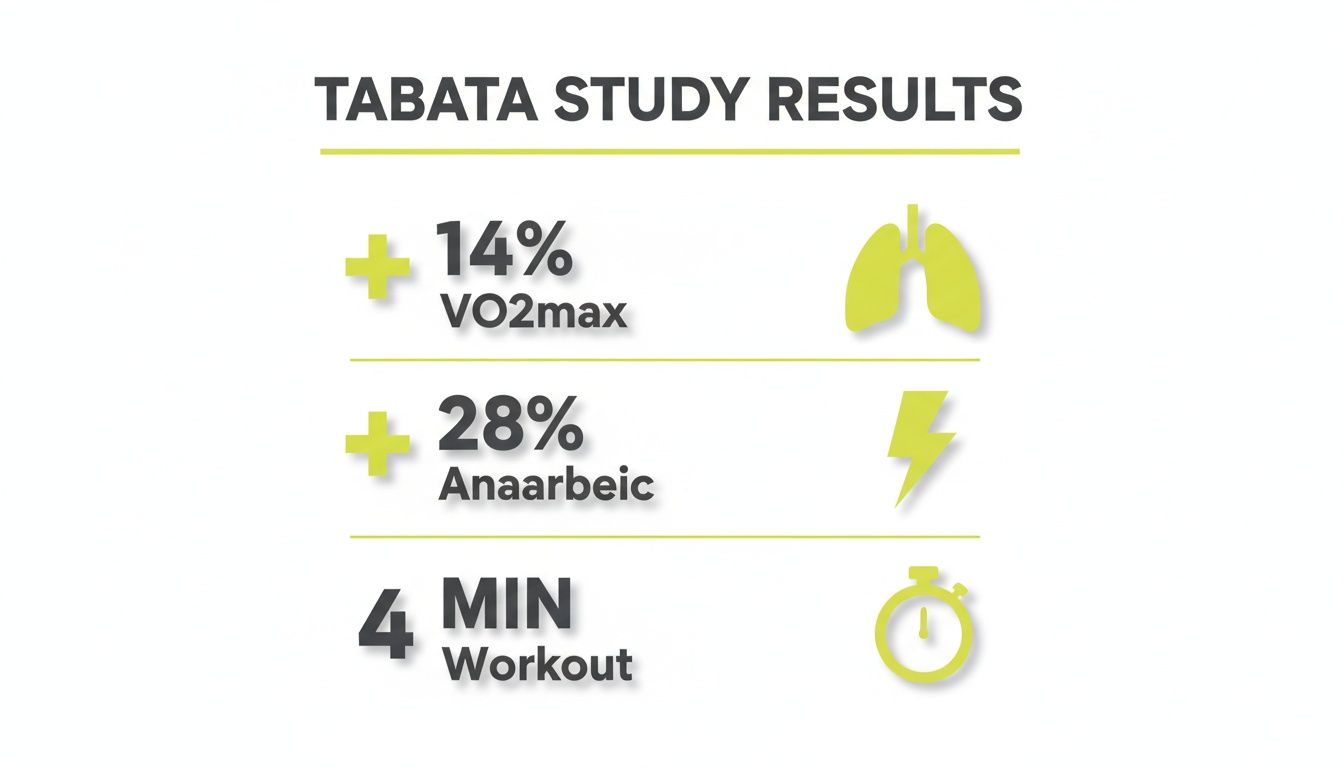
These numbers demonstrate the protocol's efficiency. In four minutes, it boosts both endurance and power in a way longer, slower workouts cannot.
True Tabata vs Generic HIIT
"Tabata" and "HIIT" are not interchangeable. Tabata is a specific type of HIIT, but most HIIT workouts are not Tabatas. All squares are rectangles, but not all rectangles are squares.
Here's the breakdown:
| Attribute | True Tabata Protocol | Generic HIIT |
|---|---|---|
| Work Interval | Exactly 20 seconds | Varies (e.g., 30s, 45s, 60s) |
| Rest Interval | Exactly 10 seconds | Varies (e.g., 30s, 45s, 60s, 90s) |
| Work-to-Rest Ratio | Always 2:1 | Typically 1:1, 1:2, or 1:3 |
| Total Duration | Always 4 minutes (8 rounds) | Varies (often 15-30 minutes) |
| Required Intensity | Maximum sustainable effort (~170% VO2max) | High, but sub-maximal (often 80-95% max HR) |
| Primary Goal | Simultaneously push aerobic & anaerobic thresholds to their absolute limits | General cardiovascular conditioning and calorie burn |
A true Tabata demands an intensity that is not sustainable for the longer durations of typical HIIT sessions. It’s a surgical tool for performance enhancement, not a general cardio workout.
Why This Four-Minute Protocol Builds Elite Athletes
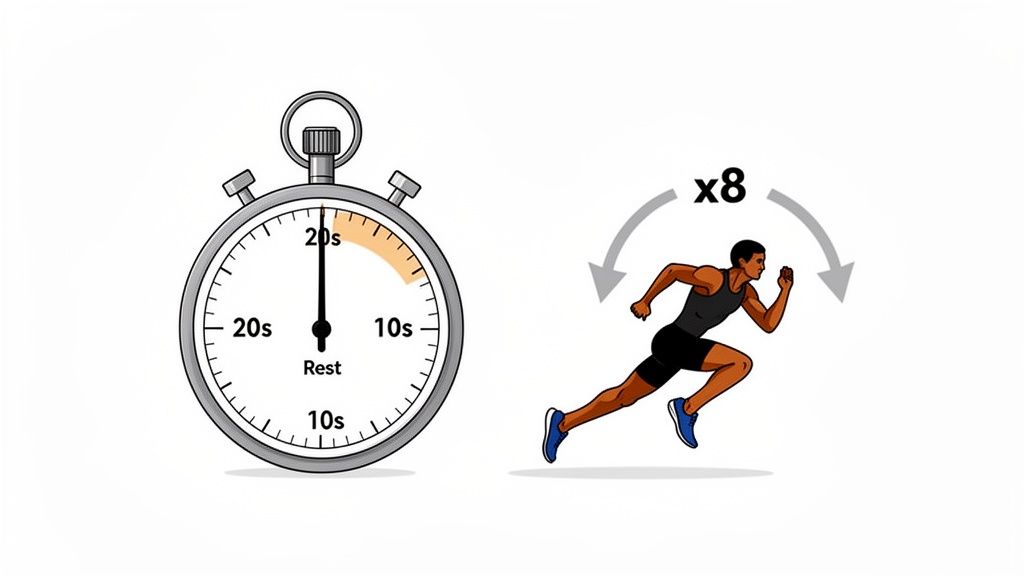 The protocol works by creating a massive oxygen debt that forces physiological adaptation. This stress is what builds a more efficient engine.
The 2:1 work-to-rest ratio is the mechanism. It holds you near your maximum heart rate for the entire duration. The 10-second rest is designed to be insufficient for full recovery. You start each 20-second work interval in a state of oxygen deficit, which triggers powerful fitness adaptations.
The Afterburn Effect and EPOC
This all-out effort elevates your Excess Post-exercise Oxygen Consumption (EPOC), also known as the "afterburn" effect. Your body works for hours post-workout to return to baseline—replenishing oxygen, clearing metabolic waste, and initiating muscle repair.
This elevated metabolism increases calorie expenditure long after the session ends. While calorie burn isn't the primary goal for performance athletes, EPOC is a reliable indicator of workout intensity and the degree of metabolic disruption achieved.
A Tabata session is a four-minute event that creates a metabolic ripple effect lasting for hours. The work is short, but the physiological response is long.
The efficiency of tabata hiit workouts drove their popularity. In 2014, High-Intensity Interval Training became the #1 worldwide fitness trend according to the American College of Sports Medicine (ACSM), a position it held for years. Athletes and coaches recognized that protocols like Tabata could produce aerobic and anaerobic gains comparable to workouts lasting an hour or more. You can dive deeper into the science of HIIT in this detailed training analysis.
Building a Bigger Engine for Performance
For performance-focused athletes, the real gain isn't calorie burn. The stimulus from a true Tabata workout drives critical improvements:
- Boosting VO2max: Pushing your cardiorespiratory system to its limit forces it to become more efficient at transporting and utilizing oxygen. A higher VO2max allows you to sustain harder efforts for longer, whether it's the final lap or the last round.
- Increasing Anaerobic Capacity: Tabata trains your body to generate power without sufficient oxygen. This translates directly to more explosive strength, a stronger finishing kick, and faster recovery between intense efforts.
This dual-system impact makes the protocol potent. You improve endurance and sprint power simultaneously. It’s a tool for building next-level work capacity, making it valuable for anyone serious about their performance, including those who need low-impact high-intensity training.
Executing Tabata with Precision and Safety
Execution determines the outcome of a tabata hiit workout. This isn't about going through the motions; it's about a maximal, exhaustive effort.
If you finish eight rounds and feel you could do another set, you didn't go hard enough. The intent is to push so hard during the 20-second intervals that the 10-second rest feels insufficient.
This intensity requires mental fortitude. Around round five or six, your lungs will burn, your muscles will scream, and your brain will signal you to stop. Pushing past this point is what forces adaptation.
To maintain this intensity without technical breakdown, you need a reliable timer. Fumbling with a phone's stopwatch is inefficient. A dedicated HIIT timer app with loud, clear cues is essential for maintaining integrity when you're deep in the workout.
Smart Exercise Selection Is Crucial
The right exercise is critical. You need a movement that allows for maximal effort without risking technical failure under extreme fatigue. This is why complex movements like Olympic lifts or small isolation exercises like bicep curls are inappropriate for a true Tabata.
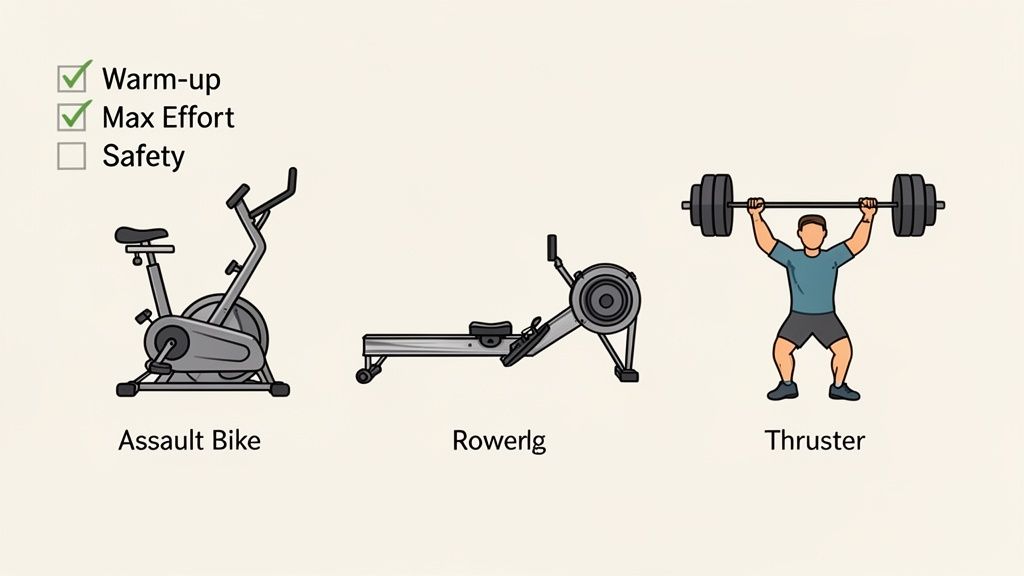
Select full-body movements that let you maximize power output. Good options include:
- Assault Bike or Echo Bike: The gold standard. It's a total-body movement that allows for massive power generation with minimal risk of poor form.
- Rower: Another excellent choice. It engages the entire body and allows you to track output (watts or calories) to ensure consistent effort.
- Thrusters (with a light weight): A CrossFit staple that taxes the legs, core, and shoulders, driving your heart rate sky-high.
- Burpees: The classic bodyweight conditioning tool. No equipment required, and it challenges every major muscle group.
The goal is to choose an exercise that pushes your cardiovascular system to its limit, not one that tests technical skill or isolates a small muscle group.
Safety and Prerequisites
Respect the intensity. Tabata is an advanced training method and is not for beginners. A solid fitness base is a prerequisite due to the extreme demand on the cardiorespiratory system.
A proper warm-up is non-negotiable. Spend 10-15 minutes elevating your heart rate, mobilizing joints, and performing lighter-intensity versions of your chosen exercise. Your body must be primed for the shock it is about to endure.
Actionable Tabata HIIT Workouts You Can Use Today
Theory is useless without application. Here are three tested Tabata HIIT workouts.
Each is designed for a specific objective, from building raw power to forging aerobic capacity. The timer settings are provided. Program them, commit to the intensity, and execute.
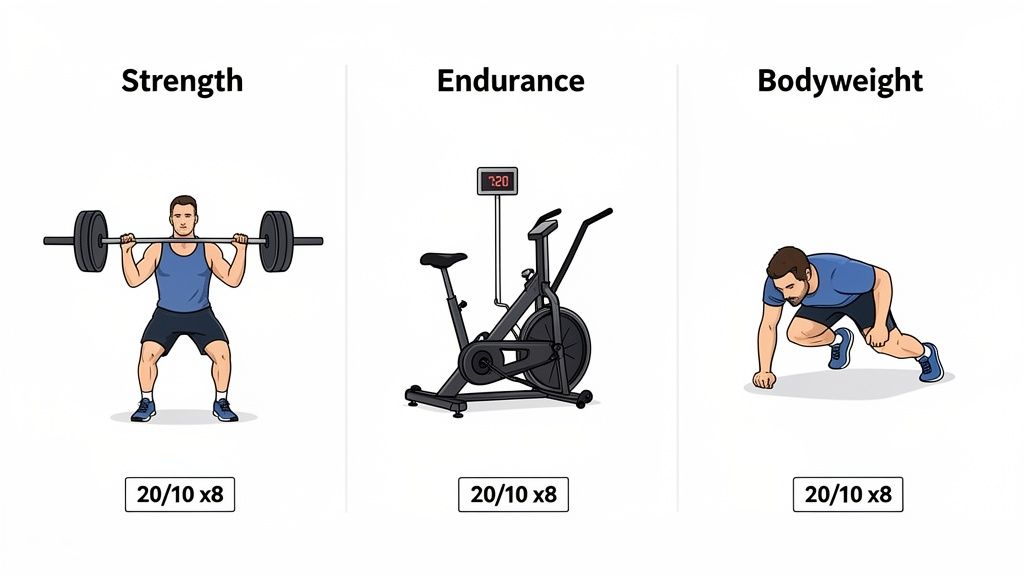
Workout 1: The CrossFit Classic
A full-body metabolic workout using a single barbell movement. The goal is consistent output. If your reps drop off by more than two between your first and last round, the weight was too heavy.
- Exercise: Thrusters (95lbs / 65lbs)
- Target: Legs, core, shoulders, lungs.
- Coaching Cue: Explode out of the squat. Use hip drive to punch the barbell overhead. Exhale forcefully at the top of each rep.
- Timer Setup:
- Work: 20 seconds
- Rest: 10 seconds
- Rounds: 8
Workout 2: The Endurance Engine Builder
For any athlete building aerobic capacity—cyclists, runners, rowers—the Assault Bike is a prime tool. This workout is a test of sustained power output. Your score is the lowest number of calories achieved in any single round.
- Exercise: Assault Bike Sprints
- Target: Maximal aerobic power (VO2max) and mental toughness.
- Coaching Cue: The first pedal stroke is an all-out attack. Sit upright to open your diaphragm and drive with both arms and legs. Focus on a fixed point and maintain intensity.
- Timer Setup:
- Work: 20 seconds
- Rest: 10 seconds
- Rounds: 8
This protocol is broadly effective. One study on a 12-week functional Tabata program found young adults increased their active time by nearly 15% while maintaining heart rates in the 80.8% to 86.6% max range. With a 98% adherence rate, it outperformed moderate training in a fraction of the time. Read more on the broad impact of Tabata training for the supporting data.
Workout 3: The Bodyweight Grinder
No gym, no problem. The burpee is a classic conditioning tool for a reason. Your score is the total number of reps across all eight rounds.
- Exercise: Burpees
- Target: Muscular endurance, agility, and cardiovascular conditioning.
- Coaching Cue: Find a smooth, repeatable rhythm. Efficiency is key; eliminate wasted movement. Chest to deck, pop the hips up, and get just enough air to clap overhead. Focus on the next rep, not the remaining rounds.
Repeatable effort is the objective. Always record your score—total reps, lowest calories, or consistent thruster numbers—and aim to beat it in the next session. This is how you verify progress.
Training with minimal equipment is a key skill. For more ideas, see our guide to the best home HIIT workouts.
Tabata Workout Presets For Your Interval Timer
Here is a quick reference table. Select a workout, input these settings into your timer, and begin.
| Workout Focus | Exercise | Interval Timer Setup (Work/Rest/Rounds) |
|---|---|---|
| Full-Body Strength & Metcon | Thrusters (95/65 lbs) | 20s Work / 10s Rest / 8 Rounds |
| Max Aerobic Power | Assault Bike Sprints | 20s Work / 10s Rest / 8 Rounds |
| Equipment-Free Conditioning | Burpees | 20s Work / 10s Rest / 8 Rounds |
These presets are designed for maximum impact. Choose one that aligns with your training goal and execute with maximum intensity.
How to Program Tabata Workouts Into Your Training
A powerful tool requires intelligent application. Integrating Tabata HIIT workouts into a training week must be done strategically to maximize gains without causing systemic overtraining. It’s about adding the right intensity at the right time.
A true Tabata session places a significant demand on your central nervous system (CNS). More is not better. For most conditioned athletes, one to two sessions per week is the effective dose. Exceeding this risks overtraining and can compromise performance in other areas.
Think of Tabata as a precision tool for conditioning, not a daily workout.
Athlete-Specific Programming Examples
Application depends on your primary training goals. The protocol can serve as a finisher, a substitute for a lower-intensity cardio day, or a sport-specific conditioning piece.
For the CrossFit Athlete: Add a Tabata session after your main strength work. A four-minute Assault Bike or rower Tabata is an effective way to finish a lifting day, driving a conditioning stimulus without compromising recovery for the next day's strength program.
For the Endurance Athlete: A runner or cyclist can swap a moderate-intensity tempo session for a Tabata to target VO2max. A four-minute, all-out effort on an air bike provides a significant aerobic stimulus in a fraction of the time, helping to break through performance plateaus.
For the Combat Sport Athlete: Boxers and MMA fighters can use Tabata to simulate the high-intensity bursts of a round. A Tabata of burpees or heavy bag strikes mimics the work-rest demands of a fight, improving your ability to re-engage under fatigue.
Measuring Progress to Ensure Adaptation
You can't improve what you don't measure. Tracking progress in a Tabata is straightforward and provides direct feedback on your conditioning. The goal is not just to survive the four minutes, but to improve your output within that window.
Keep a training log and track one of these metrics:
- Total Reps: For exercises like burpees or thrusters, your score is the total number of repetitions completed across all eight rounds. The objective is to increase this number over time.
- Lowest Round Score: On a machine like an Assault Bike or rower, your score is the lowest calorie or watt output from any single 20-second interval. This metric forces you to resist fatigue and penalizes any drop-off in intensity.
- Average Output: If available, logging average watts or RPMs over the full four minutes is another excellent way to track performance improvements.
Your log is your proof of performance. Seeing those numbers improve—total thruster reps increasing from 45 to 50, or your lowest Assault Bike round jumping from 8 to 10 calories—is concrete evidence that the protocol is working.
Got Questions About Tabata? I've Got Answers.
Let's address common questions about Tabata HIIT workouts. Correct application is the difference between simply working hard and achieving the specific performance benefits of the protocol.
Can I Do Tabata With Strength Exercises Like Bicep Curls?
No. A true Tabata requires exercises that recruit large muscle groups to elevate your heart rate to the necessary level. Isolation movements like bicep curls or calf raises cannot create the required metabolic demand.
To achieve the aerobic and anaerobic adaptations from the original study, you must use full-body, compound movements. This includes the assault bike, rower, thrusters, burpees, or heavy kettlebell swings. These tools force high power output and oxygen consumption, which is the entire point.
How Often Should I Do Tabata HIIT Workouts?
This is a critical point. Because Tabata is extremely intense and taxes the central nervous system, it must be used strategically.
For most well-trained athletes, one to two sessions per week is the maximum effective dose. More frequent application leads to overtraining, diminished performance, and increased injury risk. Use Tabata as a targeted tool for elite conditioning, not a daily workout.
Is Tabata Good for Building Muscle?
Tabata is a conditioning protocol. It was not designed for hypertrophy (muscle growth). Its sole purpose is to dramatically improve VO2max and anaerobic capacity.
While the high-intensity effort provides some stimulus for muscle maintenance, it is not a substitute for a dedicated strength program. If your primary goal is building muscle mass, stick to programs based on progressive overload.
Tabata drives metabolic adaptation—making your body's engine more powerful and efficient. Strength training creates mechanical tension to trigger muscle growth. They are different tools for different jobs.
What Is the Difference Between Tabata and an AMRAP?
The structure and objective are completely different. Tabata is a rigid interval format: eight rounds of 20 seconds of work followed by 10 seconds of rest. It is always four minutes long. The goal is to hit maximum sustainable power output in each 20-second interval.
An AMRAP ("As Many Rounds/Reps As Possible") provides a set time block (e.g., 10 or 20 minutes) and challenges you to complete the most work possible with self-managed rest. In a Tabata, the timer dictates the work. In an AMRAP, you control your pace to maximize your total score.
To execute these protocols with the required precision, you need a timer that performs. The KNTC interval timer app was built for athletes who understand every second matters. It provides loud, clear cues and boxing-style beeps, and lets you save presets to start training instantly. Stop fumbling with your phone and focus on your effort. Train smarter and harder by downloading KNTC.
How to Improve Running Pace and Run Faster Today
Learn how to improve running pace with science-backed training methods. This guide covers interval training, strength work, and pacing strategies.
Tabata Exercises for Beginners: The 4-Minute Protocol for Athletes
Discover tabata exercises for beginners: unlock fast, effective workouts with simple form guides and the science behind the 4-minute protocol.