
10 Effective Home HIIT Workouts for Serious Athletes
The internet is saturated with generic fitness advice. This isn't that. This is a tactical breakdown of the most effective, battle-tested protocols for athletes who train with purpose. You're not here for novelty; you're here for structure that delivers measurable performance gains. We’re cutting through the noise to give you a definitive guide to the best home HIIT workouts, complete with the logic, scaling, and precise timing details you need to execute them flawlessly.
This guide is designed for serious athletes, from CrossFitters and combat sports practitioners to endurance runners and personal trainers. We assume you already train and are looking for better, more efficient ways to build capacity. Forget vague tips and motivational fluff. Instead, you'll get actionable frameworks you can implement immediately.
We will break down 10 elite training protocols, including:
- Classic Structures: Tabata, EMOM (Every Minute on the Minute), and AMRAP (As Many Rounds as Possible).
- Minimal-Equipment Power: Bodyweight circuits, dumbbell complexes, and kettlebell HIIT.
- Engine-Building Workouts: Assault bike sprints, 400m running repeats, and rowing machine intervals.
Each section provides a complete blueprint: the "why" behind the workout, specific movements, interval structures, and practical scaling options. You'll also find suggested timer presets to ensure your training sessions are precise. Let’s get to work.
1. Tabata Protocol
The Tabata Protocol is a cornerstone of high-intensity interval training, known for its brutal efficiency. Developed by Dr. Izumi Tabata, this format is a scientifically validated method for simultaneously boosting both aerobic and anaerobic systems. For athletes seeking the best home HIIT workouts, Tabata offers a precise, structured, and potent training stimulus.
The structure is simple: 20 seconds of all-out effort, followed by 10 seconds of complete rest, repeated for 8 rounds. This totals four minutes per exercise. The key is maximal, 100% effort during the "on" period to trigger the intended physiological adaptations.
Why It Works for Home Training
Tabata is effective for a home setting because it demands intensity, not equipment. The rigid 20/10 split forces a high work rate, leaving no room for distraction. This structure is one of a handful of proven ways to build metabolic conditioning and push your VO2 max with little more than body weight.
Sample Tabata Movements & Progressions
Apply the Tabata protocol to nearly any explosive movement. To build a complete session, perform two or three different Tabata blocks with a few minutes of rest in between.
- Full-Body Conditioning: Alternate between burpees and mountain climbers. Burpees on rounds 1, 3, 5, 7 and mountain climbers on rounds 2, 4, 6, 8.
- Strength Endurance: Use a kettlebell for 8 rounds of swings. Track the total number of reps and aim to beat it in your next session.
- Combat Sports: Perform 8 rounds of non-stop boxing combinations on a heavy bag or shadowboxing. The short rest mimics the explosive bursts required in a fight.
Pro Tip: Use a timer's built-in Tabata preset. Sharp audio cues for work and rest periods allow you to focus entirely on output without watching the clock.
2. EMOM (Every Minute on the Minute)
EMOM, or "Every Minute on the Minute," is a versatile and strategic format that builds discipline and pacing. Unlike the sprint of Tabata, EMOM challenges you to complete a specific task at the start of each minute, earning the remaining time as rest. This structure forces you to manage output and recovery, making it a powerful tool for building work capacity and skill under fatigue.
The format is straightforward: at the top of each minute, perform a set number of reps. If the work takes 35 seconds, you get 25 seconds of rest. The goal is to choose a rep count that is challenging but repeatable, allowing for consistent performance round after round. This makes it one of the best home HIIT workouts for developing both strength endurance and mental toughness.
Why It Works for Home Training
EMOM is a masterclass in self-regulation. The constant clock pressure keeps you honest, preventing extended rest or a drop in intensity. It also allows you to accumulate a high volume of quality reps in a condensed timeframe, ideal for building skill and strength with minimal equipment.
Sample EMOM Movements & Progressions
Structure an EMOM to target conditioning, strength, or technical skill. Select a rep scheme that leaves you with at least 15-20 seconds of rest each minute.
- Full-Body Conditioning: Set a 12-minute EMOM. On odd minutes, perform 8 dumbbell thrusters. On even minutes, perform 10 burpees.
- Strength and Skill: For a 10-minute EMOM, perform 3-5 heavy kettlebell clean and jerks (per side). The focus here is on perfect, powerful reps, not speed.
- Core Endurance: Try a 15-minute EMOM alternating between 15 V-ups, 20 Russian twists, and a 30-second plank.
Pro Tip: Use a timer’s dedicated EMOM mode to handle the tracking. Set your total rounds and let the timer cue you, so your focus stays on the movement.
3. Assault Bike Sprint Intervals
The Assault Bike, or any fan-driven air bike, is a brutally effective tool for HIIT. Unlike a traditional stationary bike, its resistance is created by a fan that works against the air; the harder you push, pull, and pedal, the more resistance it generates. This makes it an unparalleled instrument for developing raw power, anaerobic capacity, and mental toughness.
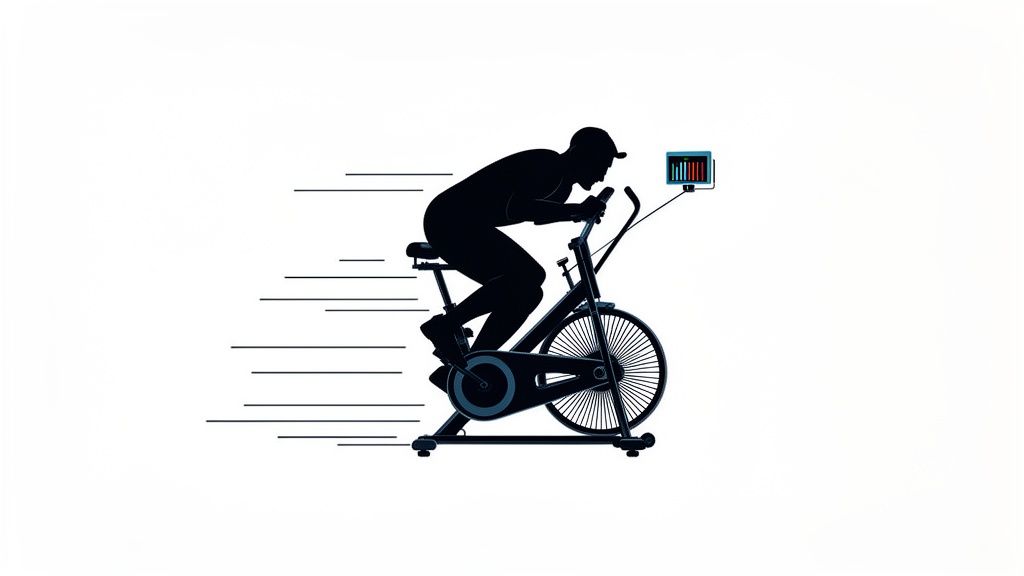
The structure for these sprints typically involves a 30-40 second all-out effort followed by a longer 90-120 second active recovery period. The goal during the sprint is maximal wattage output. The extended rest allows for just enough recovery to repeat the effort with near-maximal intensity, making it one of the best home HIIT workouts for pushing your VO2 max.
Why It Works for Home Training
For those with the equipment, an assault bike is a self-contained engine builder. It combines upper and lower body work, driving heart rate higher than almost any other cardio machine. The variable resistance automatically scales to your output, forcing an honest effort every single time without needing to adjust settings.
Sample Sprint Intervals & Progressions
The key to assault bike sprints is managing the work-to-rest ratio to maintain high-quality output. The focus is on power and repeatable intensity.
- Anaerobic Threshold Builder: Perform 8 rounds of a 30-second max-effort sprint followed by 90 seconds of easy, active recovery pedaling.
- Endurance Focus: Complete 10 rounds of a 40-second hard effort (around 85-90% intensity) with 2 minutes of low-intensity recovery.
- Pyramid Sprints: Build up and then back down. Perform sprints of 10, 20, 30, 20, and 10 seconds, with a 1:3 work-to-rest ratio (e.g., 30 seconds of rest after the 10-second sprint).
Pro Tip: The fan on an assault bike is loud. Use an interval timer with loud audio cues so you never miss a start or stop cue. Record your average watts or RPM for the work intervals and aim to increase that number over time.
4. 400m Repeat Running Workouts
A staple for track and field athletes, 400m repeats are one of the most effective and humbling forms of high-intensity interval training. This workout is built around running 400 meters at a near-maximal pace, followed by a recovery period. This structure is designed to push your lactate threshold, build speed endurance, and improve running economy, making it one of the best home HIIT workouts for those with a treadmill or access to a measured outdoor space.
The format typically involves running 400 meters at 90-95% effort, followed by a recovery period of equal or slightly longer duration, repeated for multiple sets. The goal is to maintain a consistent, challenging pace across every single repeat, teaching your body to clear lactate and sustain high output under fatigue.
Why It Works for Home Training
The 400m repeat is adaptable to a home setting. A treadmill allows for precise control over speed and incline, removing environmental variables. For outdoor runners, measuring a 400m stretch is simple with any running app. This structure turns a simple run into a potent, results-driven HIIT session.
Sample 400m Repeat Workouts
The structure of these workouts can be scaled to target different energy systems. Manipulate the number of reps, the recovery time, or the type of recovery to change the stimulus.
- Classic Speed Endurance: Perform 8-10 repetitions of 400m runs at your target pace, with a 400m light jog for recovery between each.
- Maximum Aerobic Power: Complete 8 repetitions of 400m runs, but with a strict 60-second standing rest. This short rest challenges your recovery capacity.
- Pyramid Challenge: Build up and back down with 1x 400m, 1x 800m, 1x 1200m, 1x 800m, and 1x 400m. Rest for the same amount of time it took you to complete the preceding interval.
Pro Tip: Use a timer's Countdown mode for each interval. Set your target 400m time and recovery time to receive precise cues. This allows you to lock in your pace and hit your splits without constantly checking your watch.
5. Boxing Combination Intervals
Boxing Combination Intervals transform a classic combat sport into a dynamic and engaging form of high-intensity training. This method involves throwing a series of pre-planned punches at maximum speed and power for a set work period, followed by a short rest. It’s a powerful tool for developing explosive power, hand speed, and cardiovascular endurance, making it one of the best home HIIT workouts available.
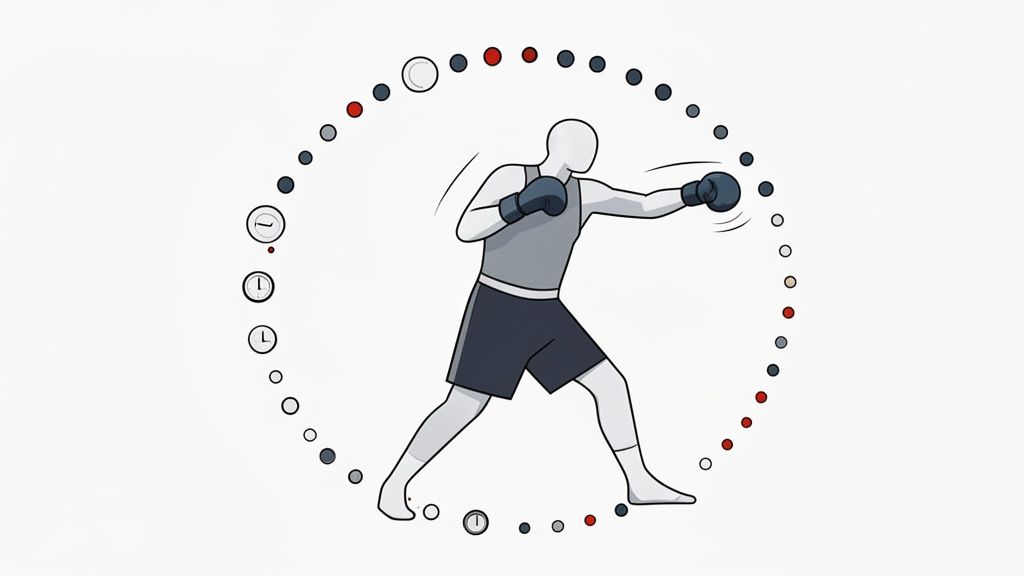
The structure typically involves longer work intervals than Tabata, often 60 to 90 seconds of continuous combinations, followed by 15 to 30 seconds of active rest. This format mimics the high-output demands of a boxing round, training your body to sustain power output as fatigue accumulates.
Why It Works for Home Training
Boxing intervals are perfectly suited for a home environment because they can be scaled to any space or equipment level. Whether you're shadowboxing in a small apartment or hitting a heavy bag in a garage, the workout’s intensity comes from your own output. The focus required to execute crisp combinations keeps you mentally engaged, turning a grueling cardio session into a skill-building practice.
Sample Boxing Workouts & Progressions
Structure these intervals to target different aspects of your conditioning, from pure speed to power endurance. The goal is to maintain sharp form and high velocity throughout every round.
- Classic Rounds: Perform 10 rounds of 75 seconds of a core combination (e.g., jab-cross-hook-cross) followed by 15 seconds of rest.
- Speed Endurance: Set up for 12 rounds of 60 seconds of maximum-speed combinations, with 30 seconds of rest to allow for near-full recovery.
- Power Building: Use a heavy bag for 8 rounds of 90 seconds. Focus on throwing every punch with maximal force, using the 30-second rest to reset.
Pro Tip: Use an interval timer with boxing-style beeps and haptic patterns. Loud audio cues cut through bag noise, and haptics allow you to feel round transitions through your gloves so you never have to break focus.
6. Dumbbell Complex HIIT
The Dumbbell Complex HIIT is a powerful method for forging strength and endurance simultaneously. A "complex" is a sequence of exercises performed back-to-back with the same pair of dumbbells, without setting them down. By combining these fluid sequences with structured HIIT intervals, you create an efficient workout that builds muscle and elevates your metabolic rate.
The structure typically involves a longer work period, such as 40-50 seconds of continuous effort, followed by 20-30 seconds of rest, repeated for 6-10 rounds. The goal is to move seamlessly from one exercise to the next, maintaining control and form. This approach makes it one of the best home HIIT workouts for athletes who want to blend resistance training with high-intensity conditioning.
Why It Works for Home Training
Dumbbell complexes are ideal for home workouts because they maximize training density with minimal equipment and space. A single pair of dumbbells can provide a full-body workout that challenges nearly every major muscle group. This format forces your cardiovascular system to work overtime to supply oxygen to working muscles, delivering a potent conditioning stimulus.
Sample Dumbbell Complexes & Progressions
A good complex uses exercises that flow naturally into one another. The weight should be challenging enough for strength gains but light enough to maintain proper form for the entire work period.
- Full-Body Burn: Perform 8 rounds of 50 seconds of work and 30 seconds of rest. The complex is: Dumbbell Clean, then Front Squat, then Push Press, then Bent-Over Row. Complete 3-4 reps of each movement before repeating the sequence.
- Athletic Power: Set up 10 rounds of 45 seconds on, 15 seconds off. The complex is: 5 Dumbbell Snatches (each arm), followed by 5 Dumbbell Thrusters.
- Strength Endurance: Track your total reps per round. Choose a complex and aim to maintain or increase your rep count across all rounds, demonstrating consistent power output.
Pro Tip: Use an interval timer to lock in your work/rest periods. The relentless pace of a complex requires total focus on movement, not the clock. Setting sharp audio or haptic cues will keep you on schedule. This type of high-intensity work is foundational in many combat sports, much like what you'd find in a boxing timer app.
7. Rowing Machine Sprint Intervals
Rowing machine sprint intervals are one of the most effective and data-rich forms of high-intensity training. The rower provides precise, measurable feedback on performance, including pace, wattage, and distance. This makes it an unparalleled tool for anyone serious about tracking progress and pushing their physiological limits in a controlled, low-impact environment.
The concept is to perform rowing sprints of a specific distance or time at near-maximal effort, separated by defined rest periods. This method targets both your aerobic and anaerobic energy systems, building explosive power and lactate threshold. The scalability of rowing intervals is a key benefit; a 250-meter sprint is a gut-check for a beginner and a technical drill for an elite athlete.
Why It Works for Home Training
A rowing machine is a compact, full-body gym. It engages over 85% of your body's muscles, delivering a potent cardiovascular and muscular stimulus without the joint stress of high-impact exercises like running. For those seeking the best home HIIT workouts that are both challenging and sustainable, the rower offers a perfect blend of intensity and joint-friendly movement.
Sample Rowing Workouts & Progressions
Structure rowing intervals around distance, time, or a combination of both. The goal is to maintain consistent power output and technique across all work periods.
- Lactate Power: Perform 5 rounds of a 500-meter row at 90-95% max effort, with 90 seconds of complete rest between each round.
- Max Speed Development: Complete 8 rounds of a 250-meter sprint, resting for 60 seconds between each. The goal is all-out power.
- Endurance Threshold: Tackle 3 rounds of a 2000-meter row at a hard but sustainable pace, with 3 minutes of rest between rounds. This builds your capacity to hold high output for longer durations.
Pro Tip: Use an interval timer to manage your work and rest periods. Loud audio cues are essential for cutting through the noise of the rower's fan or water tank, ensuring you start and stop precisely on time.
8. Jump Rope Intervals (Double-Unders & Speed Work)
Jump rope intervals are a potent and humbling tool for building elite-level conditioning. This workout structure uses explosive movements like double-unders or high-cadence single-unders to drive your heart rate. Popularized in CrossFit and boxing gyms, it’s a staple for developing explosive power, coordination, and serious cardiovascular endurance with minimal equipment.
The structure revolves around intense bursts of effort, typically 30 to 60 seconds of maximal work, followed by 30 to 60 seconds of rest. The goal isn't just survival; it's maintaining speed, form, and consistency as fatigue sets in. This makes it one of the best home HIIT workouts for athletes who need to sustain high output under pressure.
Why It Works for Home Training
A jump rope is the ultimate minimal-equipment tool for maximum-intensity training. Unlike running, it requires almost no space, yet it delivers a comparable metabolic impact. The skill component of double-unders forces mental engagement, keeping the workout from becoming monotonous. This focus on technique under duress is what builds athletic resilience.
Sample Jump Rope Workouts & Progressions
Structure these intervals to target different energy systems, from short sprints to longer endurance efforts. Match the work period to your current skill level to ensure high intensity.
- Explosive Power: Complete 10 rounds of 45 seconds of max-effort double-unders, followed by just 15 seconds of rest. The short rest challenges recovery.
- Speed Endurance: Perform 8 rounds of 60 seconds of maximum speed single-unders, followed by 30 seconds of rest. Focus on maintaining a non-stop pace.
- Technique Under Fatigue: Go for 12 rounds of 30 seconds of double-unders with 30 seconds of rest. This 1:1 work-to-rest ratio allows you to attack each interval with near-perfect form.
Pro Tip: Use an interval timer with haptic feedback. This lets you feel the start and end of each round through vibrations, so you can train without headphones and focus entirely on rhythm and breathing.
9. Kettlebell Swing HIIT
The Kettlebell Swing HIIT is a powerhouse workout built around one of the most effective ballistic movements in strength and conditioning. This workout leverages the explosive hip-hinge pattern of the kettlebell swing to simultaneously build posterior-chain power, muscular endurance, and cardiovascular conditioning. It stands out as one of the best home HIIT workouts because it delivers a full-body metabolic impact with a single piece of equipment.
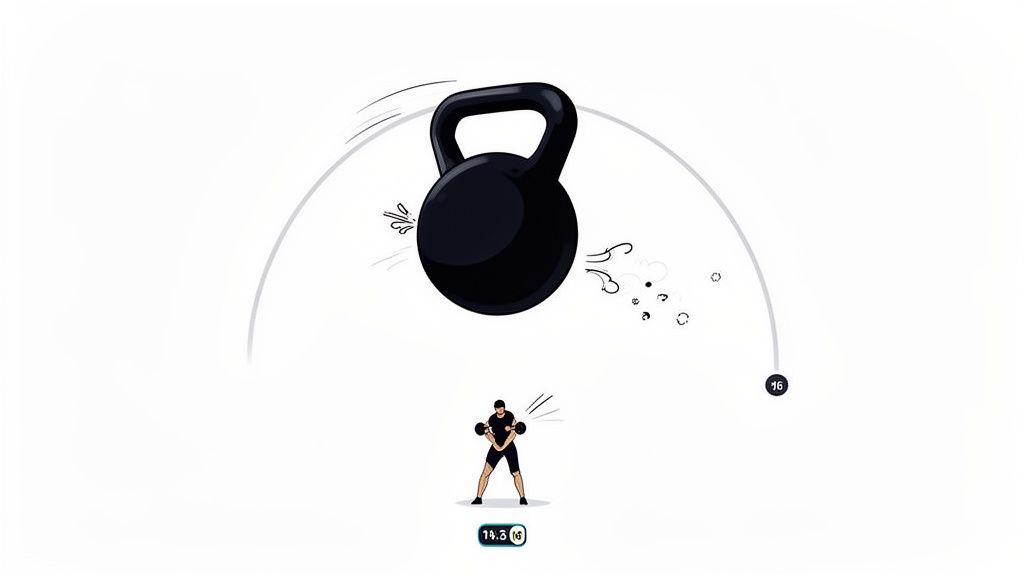
The structure typically involves 30-60 seconds of continuous, powerful swings followed by 30-60 seconds of rest, repeated for a set number of rounds. The focus here is on maintaining explosive power and perfect form in every rep, even as fatigue mounts. The goal is to generate maximum force from the hips, not just to move the weight.
Why It Works for Home Training
The kettlebell swing is ruthlessly efficient. It requires minimal space and a single tool, yet it targets the entire posterior chain (glutes, hamstrings, back) while jacking up your heart rate. This makes it an ideal choice for home athletes looking to build explosive strength and work capacity without a fully equipped gym. The rhythmic nature of the swing also builds mental toughness.
Sample Kettlebell Swing HIIT & Progressions
Structure these workouts in numerous ways to target different energy systems. The key is consistent, high-quality repetitions.
- Work Capacity Builder: Perform 10 rounds of 45 seconds of max-rep kettlebell swings, followed by just 15 seconds of rest. Track your total reps and aim to beat that score in a future session.
- Strength Endurance Focus: Complete 8 rounds of 50 seconds of swings at a steady, powerful 75% effort, followed by 40 seconds of active recovery (e.g., walking).
- Complex Training: Create a circuit by performing 12 rounds of 30 seconds of swings, followed by 30 seconds of a complementary movement like push-ups or goblet squats.
Pro Tip: Use an interval timer with loud audio cues. Fatigue can cause pacing to drift, and sharp signals will keep your work and rest periods precise, allowing you to focus entirely on explosive hip drive.
10. Bodyweight Circuit Training (Minimal Equipment)
Bodyweight circuit training is the quintessential "no excuses" format for high-intensity training. This method involves performing a sequence of different exercises back-to-back with minimal rest, creating a powerful metabolic and muscular endurance challenge. By alternating between upper-body, lower-body, and full-body movements, you can sustain a high heart rate without completely fatiguing a single muscle group.
The structure is highly flexible but typically involves 40-50 seconds of work per exercise, followed by a short 10-20 second transition period to the next movement. A complete circuit is performed for multiple rounds, often lasting between 10 and 20 minutes. The goal is to move with purpose and precision, maintaining form as the cardiovascular system is pushed to its limits.
Why It Works for Home Training
This format is a staple of the best home HIIT workouts because it requires nothing more than your body and floor space. It builds exceptional general physical preparedness (GPP), mental toughness, and the ability to maintain good mechanics under fatigue. For those who want intensity without high-impact stress, many movements can be modified. To dive deeper, you can learn more about low-impact, high-intensity options.
Sample Circuit Movements & Progressions
The beauty of bodyweight circuits is their infinite customizability. Build a workout to target specific weaknesses or create a well-rounded, full-body session.
- Full-Body Grinder: Complete 4 rounds of: 40 seconds of pull-ups (or inverted rows), 40 seconds of jump squats, 40 seconds of push-ups, and 40 seconds of lunge jumps, with 20 seconds of rest between each movement.
- Core and Conditioning: Perform 5 rounds of: 50 seconds of burpees, 50 seconds of mountain climbers, and 50 seconds of V-ups, with a 10-second transition between each.
- Beginner-Friendly Start: Do 3 rounds of: 40 seconds of air squats, 40 seconds of knee push-ups, and 40 seconds of plank holds, with 20 seconds of rest to transition.
Pro Tip: Use an interval timer to manage your work/rest periods precisely. Set distinct haptic and sound cues for work, rest, and round completion so you can focus on movement quality instead of watching the clock.
Top 10 Home HIIT Workouts Comparison
| Workout | 🔄 Implementation complexity | ⚡ Resource requirements | 📊 Expected outcomes (⭐ effectiveness) | Ideal use cases | 💡 Key tip |
|---|---|---|---|---|---|
| Tabata Protocol | High — strict 20s/10s timing and maximal effort | Minimal — bodyweight or basic equipment | Rapid aerobic & anaerobic gains; strong metabolic afterburn (⭐⭐⭐⭐) | CrossFit, boxing, time-constrained home trainers | Use preset timers/audio cues; scale exercises and track rounds |
| EMOM (Every Minute on the Minute) | Medium — requires pacing and rep planning | Minimal to moderate — depends on chosen movements | Sustainable intensity, improved pacing and consistency (⭐⭐⭐) | CrossFit, threshold runners, small-group coaching | Start with conservative reps; use haptics to mark minute starts |
| Assault Bike Sprint Intervals | Medium — manage all-out sprints and recovery | Equipment required — assault/air bike | Excellent VO2max and anaerobic power; measurable watts (⭐⭐⭐⭐) | Endurance/VO2max athletes, CrossFit competitors, home gyms | Use loud cues, record watt averages, allow nervous system recovery |
| 400m Repeat Running Workouts | Medium — pacing and distance accuracy critical | Track, treadmill, or measured outdoor route | Improved speed, lactate clearance, running economy (⭐⭐⭐⭐) | Track athletes, distance runners, treadmill users | Pre-set target paces and record splits; use countdown/timing tools |
| Boxing Combination Intervals | Medium — technique and footwork matter to avoid injury | Minimal — heavy bag, mitts, or shadowboxing; small space | Builds hand speed, upper-body power, and cardio (⭐⭐⭐) | Boxing/MMA practitioners, home fitness, stress relief seekers | Use interval beeps/haptics; film technique and warm up combos |
| Dumbbell Complex HIIT | Medium–High — flow, load, and grip management | Moderate — set of dumbbells and safe flooring | Strength-endurance and metabolic conditioning (⭐⭐⭐⭐) | Home gym owners, functional fitness, strength-conditioning | Choose flowing complexes, use interval mode, monitor grip fatigue |
| Rowing Machine Sprint Intervals | Medium — technique-dependent for effectiveness | Equipment required — rowing machine | Full-body power, VO2max, low-impact conditioning (⭐⭐⭐⭐) | Endurance athletes, CrossFit, home gym users with rower | Use distance presets, prioritize technique early in sessions |
| Jump Rope Intervals (Double-Unders) | Low–Medium — coordination and cadence driven | Minimal — jump rope and small clear area | Explosive ankle/calf power, coordination, high-calorie burn (⭐⭐⭐) | CrossFit, boxers, traveling/home exercisers | Practice footwork pre-fatigue; use short cycles and haptic cues |
| Kettlebell Swing HIIT | Medium — strict hip-hinge technique required | Minimal — one kettlebell and small space | Posterior-chain power, explosive strength, metabolic effect (⭐⭐⭐) | Home gym users, functional fitness, posterior-chain focus | Emphasize hip drive over arm pull; track reps and pair with pulls |
| Bodyweight Circuit Training | Low–Medium — requires smart exercise sequencing | None to minimal — no equipment needed | Broad general fitness, body composition, work capacity (⭐⭐⭐) | Beginners, busy parents, travel, office wellness programs | Alternate muscle groups, film form, and scale difficulty as needed |
The Common Denominator: Precision Timing
You now have an arsenal of the best home HIIT workouts. We've broken down everything from the classic 20/10 Tabata protocol and the relentless pace of EMOMs to the raw power output demanded by Assault Bike sprints and dumbbell complexes. Each workout offers a unique stimulus to forge elite-level conditioning.
The core lesson is this: effective HIIT isn't just about going hard. It's about going hard with structure and intent. The magic happens within the precise work-to-rest intervals that define each protocol. Those seconds of recovery are a strategic component of the workout, allowing you to replicate high-intensity efforts round after round. When you respect the clock, you get the intended metabolic response. When you don't, you're just doing unstructured cardio.
From Good to Great: The Non-Negotiable Tool
The single variable tying all these protocols together is precision timing. Fumbling with your phone's stopwatch, guessing rest periods, or doing mental math when your heart rate is redlining is a recipe for sloppy execution and subpar results. You wouldn't use a broken barbell, so why train with an inaccurate clock?
The difference between an athlete who consistently progresses and one who plateaus often comes down to this detail. Accuracy ensures you are adhering to the protocol, whether it's the brutal 10-second rest in a Tabata or the strict top-of-the-minute start in an EMOM. This discipline drives adaptation. It forces you to maintain intensity and teaches you to recover faster, turning random movements into a targeted training session.
Key Takeaway: The stopwatch is as critical to your HIIT workout as the dumbbell or running shoes. It dictates intensity, governs recovery, and determines the effectiveness of your training.
Your Action Plan for Flawless Execution
Don't just read this list; implement it with precision. Your path forward is straightforward:
- Choose Your Protocol: Pick one workout from this list that aligns with your current goals and equipment. An EMOM with kettlebell swings? A bodyweight Tabata circuit? A rowing machine sprint session? Commit to one.
- Define Your Progression: Plan how you'll beat the workout next time. Will you add a round? Increase reps per minute? Decrease rest? Track your performance so you have a clear target to attack.
- Eliminate the Variables: The most common point of failure in executing the best home HIIT workouts is a clumsy, quiet, or complicated timer. This is a variable you can control. A dedicated, high-fidelity interval timer removes the guesswork and lets you focus 100% on the work.
Mastering these workouts is about building the capacity to perform under pressure, and that starts with respecting the clock. The discipline you apply to your interval timing is the same discipline that will carry you through the final round when every muscle is screaming. Stop letting a weak timer compromise strong effort. Get the right tool, lock in your focus, and execute.
Stop guessing your intervals and start mastering them. The KNTC timer was built for exactly this type of training: loud, simple, and dead-on accurate so you can focus on performance, not your phone. Download KNTC and give your workouts the precision they deserve.
A Practical Guide to Home CrossFit Workouts for Beginners
Start your journey with effective home CrossFit workouts for beginners. This guide provides foundational movements, sample WODs, and smart training principles.
A Performance Guide to Kids HIIT Workouts
Build a smarter kids HIIT workout with this guide. Learn age-specific drills, interval programming, and safety cues for peak youth athletic development.