
How to Improve Running Pace and Run Faster Today
Random jogs won’t cut it. You need targeted intervals, tempo runs, strength work, and recovery. This guide lays out the practical steps to raise your speed and sustain a faster pace.
Stop Guessing and Find Your Baseline
You can’t train precisely without a starting point. A timed effort gives you the data to structure every workout instead of guessing.
The All-Important Time Trial
A max-effort time trial sets your training zones. Pick 1.5 miles (2.4 km) or a 5k (3.1 miles) and treat it like a key session.
- Warm-Up (10–15 min): Easy jog, dynamic drills (high knees, leg swings), plus 4–6 strides to prime your nervous system.
- Execution: Run your distance at the fastest sustainable pace. It should feel brutally hard at the finish.
- Cool-Down (10–15 min): Jog or walk to flush out metabolic waste and start recovery.
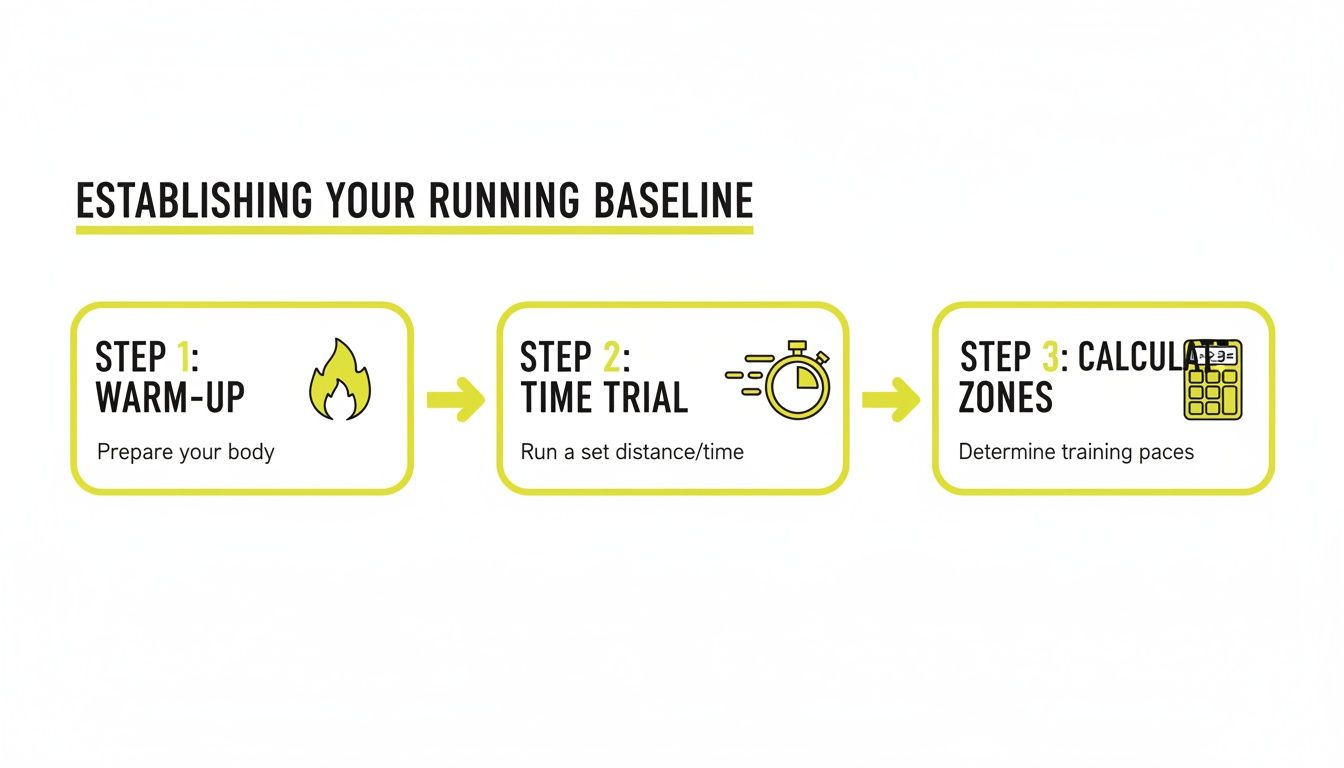
With a solid baseline, you’ll hit every workout at the right intensity.
Turning Your Time Into Training Paces
Use your time trial result to calculate zones. A 25-minute 5k runner trains at different paces than a 20-minute runner. Plug your 5k time into this table to get VO₂ max, lactate-threshold, and easy-pace targets.
Running Pace and Training Zone Calculator
| 5k Time Trial Result | Estimated VO₂ Max Pace (per 400 m) | Lactate Threshold Pace (per mile) | Easy/Recovery Pace (per mile) |
|---|---|---|---|
| 18:00 (5:48/mile) | 1:26 | 6:05 – 6:15 | 7:45 – 8:30 |
| 20:00 (6:26/mile) | 1:36 | 6:45 – 6:55 | 8:30 – 9:15 |
| 22:00 (7:05/mile) | 1:45 | 7:25 – 7:35 | 9:15 – 10:00 |
| 24:00 (7:43/mile) | 1:55 | 8:05 – 8:15 | 10:00 – 10:45 |
| 26:00 (8:22/mile) | 2:04 | 8:45 – 8:55 | 10:45 – 11:30 |
| 28:00 (9:01/mile) | 2:14 | 9:25 – 9:35 | 11:30 – 12:15 |
| 30:00 (9:39/mile) | 2:23 | 10:05 – 10:15 | 12:15 – 13:00 |
Your baseline anchors every future session.
Build Your Engine with Structured Interval Training
Intervals force your body to adapt key systems: VO₂ max and lactate threshold. Randomly pushing hard isn’t enough—you need a plan.
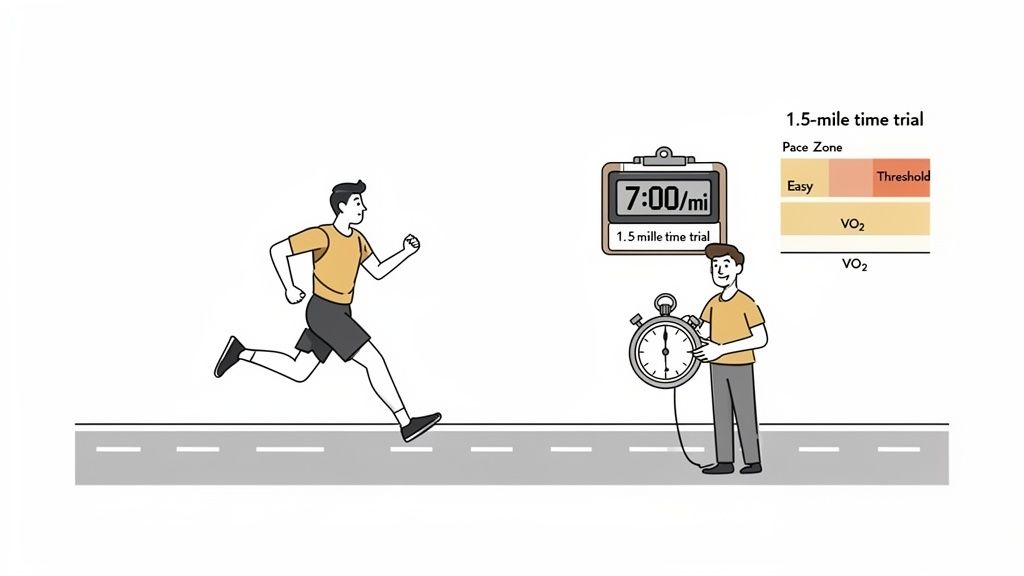
VO₂ Max and Lactate Threshold: The Two Pillars of Speed
- VO₂ Max: Your engine’s capacity. Short, all-out intervals (e.g., 400 m repeats) push this ceiling higher.
- Lactate Threshold (LT): The pace you can sustain without lactate buildup. Longer intervals and tempo runs push this tipping point back.
A complete plan targets both.
Designing Your Go-To Interval Workouts
Use your baseline paces. Adjust distances, reps, and rest to target the right system.
Workout 1: VO₂ Max Builder (400 m Repeats)
- Goal: Boost top-end speed and aerobic power.
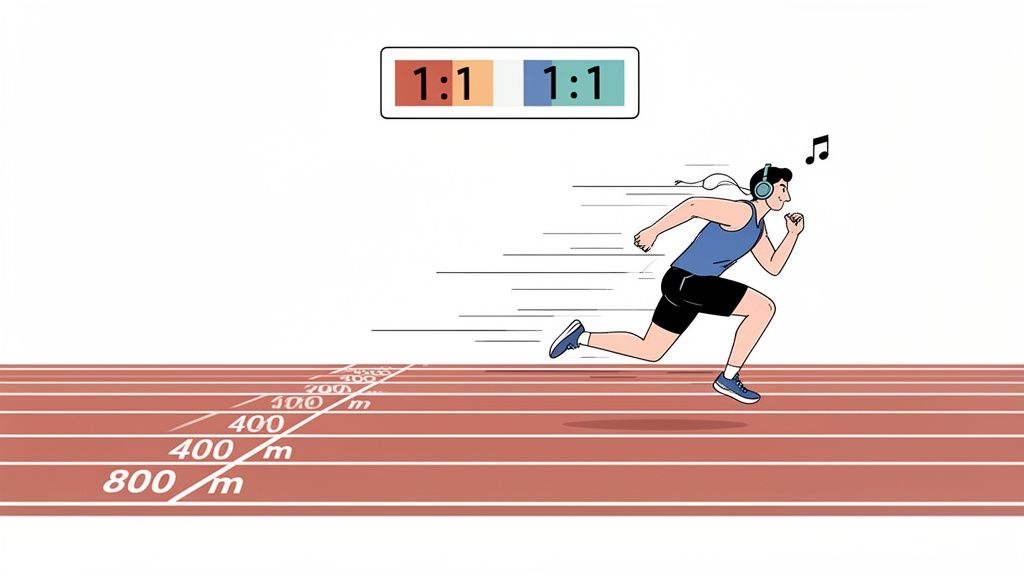
- Session: 8 × 400 m at VO₂ max pace.
- Rest: 1:1 work-to-rest ratio (e.g., 90 s work, 90 s easy jog).
- Tip: Keep splits consistent—don’t start fast and fade.
Workout 2: Lactate Threshold Grinder (800 m Repeats)
- Goal: Raise the pace you can hold.
- Session: 4 × 800 m at slightly faster than LT pace.
- Rest: 1:0.5 or 1:1 ratio (e.g., 4 min work, 2–4 min rest).
- Tip: Focus on rhythm and form as fatigue builds.
Data from marathon training between 2008–2018 shows countries using structured workouts shaved over 10 minutes from average race times.
Nail Your Pacing with an Interval Timer
Fumbling a watch kills focus. Program your intervals in an app and lock in.
- Plug in work & rest (e.g., 90 s on, 90 s off).
- Set reps (e.g., 8).
- Use audio cues to switch phases.
Save presets for “400 m Repeats,” “800 m Threshold,” or Tabata. For more on Tabata, see our complete guide to Tabata HIIT workouts.
Build a Stronger Chassis with Strength Work
Strength underpins speed. A rigid, powerful frame improves running economy and durability.
Focus on Power and Stability
- Compound Lifts: Squats, deadlifts for posterior-chain strength.
- Unilateral Work: Lunges, single-leg RDLs, step-ups to fix imbalances.
- Plyometrics: Box jumps, broad jumps for explosive force and reduced ground contact time.
How to Fit Strength Work Into Your Running Schedule
Aim for 2 sessions per week on non-key running days. If you must double up, lift several hours after a run. Keep sessions short—30–45 minutes.
Session Outline:
- Warm-Up: Dynamic drills and hip/core activation.
- Main Lifts: 2–3 compounds (e.g., 3×5 back squats, 3×8 single-leg RDL per leg).
- Accessory & Plyos: 2 exercises (e.g., 3×10 weighted step-ups, 3×5 box jumps).
The Proven Link: Why a Stronger Runner is a Faster Runner
Strength training can boost running economy by 4–8%. For routines that mix strength and endurance, see our lower body HIIT workout.
Fine-Tuning Your Engine: Running Mechanics and Pacing
Wasted motion costs speed. Dial in efficiency to make your goal pace feel easier.
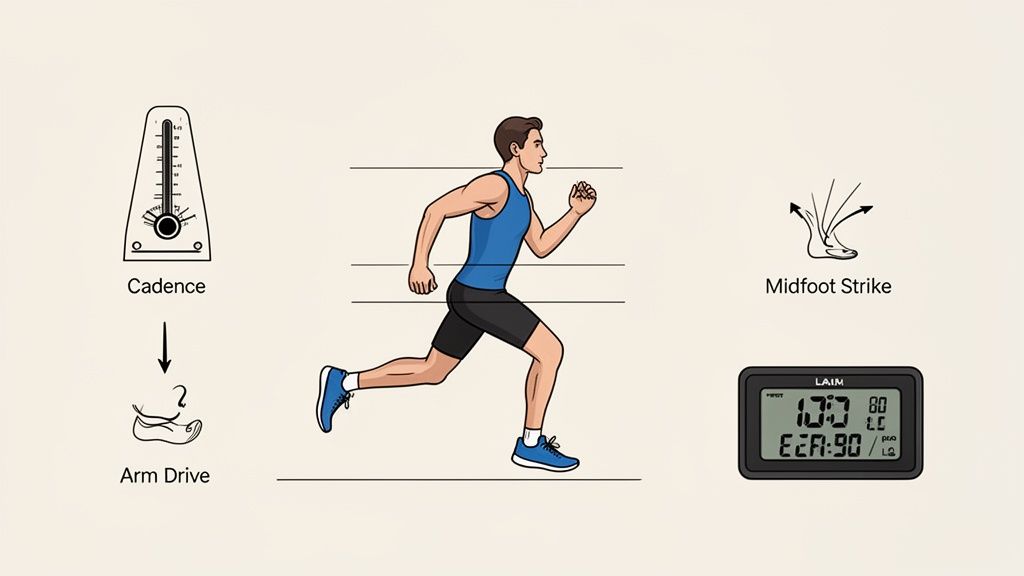
Dialing in Your Cadence and Form
- Cadence: Aim for 170–180 steps per minute. Quicker turnover cuts braking forces.
- Run Tall: Lean from the ankles, not the waist.
- Drive Arms: Keep elbows driving back, wrists relaxed.
- Stay Relaxed: Drop tension in hands, shoulders, and face.
Small tweaks in form can unlock 3% economy gains for many runners.
Mastering Your Pacing Strategy
Even or negative splits win races. A controlled start prevents acid-build up and fatigue.
- Use a lap/counter timer for tempo runs.
- Set alerts every 400 m or quarter-mile.
- Use your interval timer on your Apple Watch to hit precise splits without staring at your wrist.
Master Recovery and Adaptation to Get Faster
Workouts are the stimulus. Adaptation happens in recovery. Treat recovery as a core piece of training.
Active Recovery and Mobility
- Foam Rolling (5–10 min): Quads, hamstrings, glutes, calves.
- Mobility Drills: Leg swings, hip circles, ankle rotations.
The Ultimate Performance Enhancer: Sleep
Aim for 7–9 hours nightly. Sleep triggers muscle repair, hormone release, and neuromuscular adaptation.
Fueling for Performance and Repair
- Carb Timing: 30–60 min before hard workouts, and again post-run to replenish glycogen.
- Protein Intake: Within 1–2 hours post-run to supply amino acids for repair.
Tracking Progress and Applying Progressive Overload
Your body adapts quickly. When workouts feel easy, turn the dial:
- Increase volume (e.g., 9×400 m instead of 8).
- Decrease rest (e.g., 75 s instead of 90 s).
- Increase intensity (run reps 1–2 s faster).
Log every session. When your go-to workout stops challenging you, make it harder.
Got Questions About Getting Faster? We’ve Got Answers.
How Long Until I Actually Get Faster?
With smart training 3–4 times per week, expect to feel a difference in 4–6 weeks. Measurable PRs typically take 8–12 weeks.
Should I Work on My Cadence or Stride Length?
Prioritize cadence. A quicker turnover (170–180 spm) reduces braking forces and injury risk. Over-striding often causes impact issues.
What Should I Track Besides My Pace?
- Heart Rate: A lower HR at the same pace shows progress.
- Perceived Exertion (RPE): A workout that felt 9/10 and now feels 7/10 indicates fitness gains.
- Total Training Time: Consistent volume drives adaptation.
Ready to train with precision? Program workouts in seconds, lock into pacing with audio cues, and focus 100% on execution. Download KNTC and nail your next interval session.
Master Your Running Interval Training App with This Guide
Stop guessing and start training. This guide shows you how to use a running interval training app to build powerful, precise workouts that get results.
Unlocking Peak Conditioning with Tabata HIIT Workouts
Discover how real Tabata HIIT workouts build elite conditioning. Learn the science, sample routines, and programming tips to maximize your performance fast.