
Low Impact High Intensity Training for Elite Conditioning Without Joint Stress
High-intensity interval training delivers elite conditioning. The problem is the joint stress that comes with it. Low-impact high-intensity training is the solution—a strategic way to build a massive engine without the orthopedic cost of running and jumping.
Think less box jumps, more all-out Assault Bike sprints.
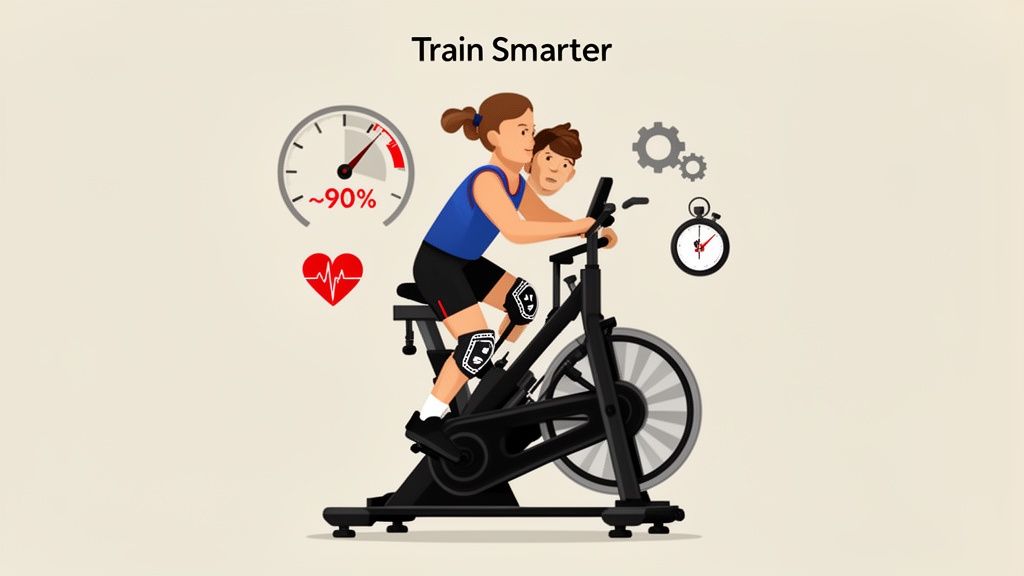
Train Smarter, Not Just Harder
You put in the work. The hours in the gym, on the track, or on the mat are non-negotiable. But what separates good from elite isn't just grinding harder—it’s the intelligence behind the effort. This is where low-impact high-intensity training (LIHIIT) becomes an essential tool.
This isn't an easy way out. It’s a smarter, more sustainable path to pushing your limits. High-impact movements like sprints, burpees, and box jumps work, but they come at a price. Every landing sends shockwaves through your ankles, knees, and hips, creating cumulative stress that leads to nagging injuries and unwanted time on the sidelines.
Decoupling Intensity from Impact
The principle of LIHIIT is simple: separate workout intensity from joint impact. This lets you consistently push into the money-making training zones—typically 85-95% of your max heart rate—where real cardiovascular and metabolic gains happen, but without the beatdown.
Compare a 30-second all-out sprint on pavement to a 30-second sprint on an Assault Bike. Metabolically, the demand is nearly identical. Your lungs will burn, your legs will turn to lead. The difference? The bike spares your joints from thousands of pounds of cumulative force.
For any serious athlete, this approach has clear advantages:
- Enhanced Recovery: Less structural stress means faster recovery between sessions. This allows for more frequent, high-quality training.
- Consistent Training: It's a bulletproof way to keep building your engine, even when nursing a minor injury or deloading from high-impact work.
- Targeted Adaptation: You can focus 100% on maxing out your cardiovascular system—the primary driver for improving metrics like VO2 max.
The Science: Building a Bigger Engine Without the Beatdown
So, why is low-impact high-intensity training a game-changer? It’s about creating the ideal conditions for your body to adapt and build a more powerful engine.
By removing the stress that pounds your joints, you free up your body to push its cardiovascular system to the absolute limit, repeatedly.
This allows you to spend more time in the 85-95% max heart rate zone. That's not a random number; it's the specific intensity that triggers major physiological upgrades. When you're not sidelined by aching knees or shin splints, you can hit this zone consistently. That's where true conditioning is forged.
Supercharging Your Performance Markers
Low-impact high-intensity training is a direct line to improving two critical performance metrics: VO2 max and lactate threshold. Think of them as the key specs on your body's engine.
- VO2 Max: The maximum amount of oxygen your body can utilize during an all-out effort. A higher VO2 max means you can fuel working muscles more efficiently, sustaining a higher output for longer.
- Lactate Threshold: The point where lactic acid accumulates faster than your body can clear it. Training to push this threshold higher allows you to hold a harder pace for longer before fatigue forces you to stop.
Machines like the rower, air bike, and SkiErg excel here. They are tools designed to let you go full-throttle without jarring impact. You force your heart and lungs to level up, creating a more powerful metabolic system that pays off in the final round of a fight, the last mile of a race, or the home stretch of a WOD.
The objective isn't just to get sweaty or burn calories. It's a calculated approach to stress your body's energy systems to build raw, functional work capacity that translates to your sport.
Get More Bang for Your Buck
The efficiency of this training is backed by science. Even short, intense sessions deliver massive results.
One decade-long research review found that low-volume HIIT (sessions under 20 minutes) can produce health benefits on par with the WHO's guideline of 150–300 minutes of moderate activity per week.
Low-impact HIIT is also directly linked to significant increases in VO₂max, a marker strongly connected to longevity. For every 3.5 ml·kg⁻¹·min⁻¹ you increase your VO₂max, data shows a 10–15% reduction in your risk of all-cause mortality. Learn more about the research behind low-volume HIIT.
Your Arsenal of Low-Impact, High-Intensity Tools
Serious conditioning requires the right tools. We're not talking about just any cardio equipment; we're talking about machines that let you push your engine into the redline without blowing a gasket. The best tool depends on your goal—whether it's pure metabolic punishment, building a rock-solid posterior chain, or developing relentless upper-body stamina.
This isn't about finding an "easy" option. It's about picking the most effective weapon to create a specific physiological stimulus. The global fitness equipment market is projected to hit USD 56.22 billion by 2031, with cardio machines like rowers and bikes leading the charge. The trend is clear: athletes are investing in gear that delivers intensity without the impact.
The concept is simple: pair low-impact movements with high-intensity effort to directly improve your VO2 max and overall conditioning.
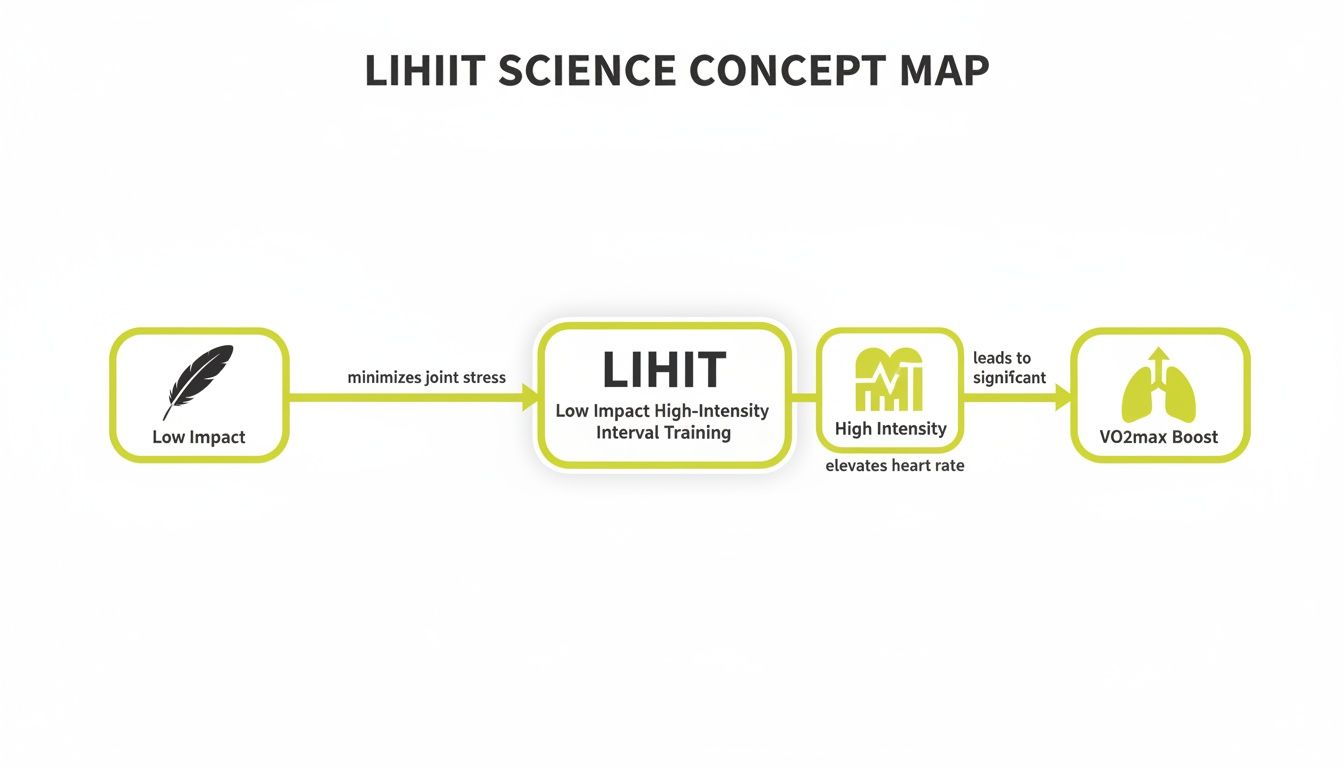
By taking joint stress out of the equation, you can consistently push your cardiovascular limits. This is how you drive elite-level aerobic adaptations without beating yourself up.
The Best Machines for the Job
Let's break down the go-to tools for any serious low-impact, high-intensity training program. Each has a unique specialty, making it better for certain goals. Precision is everything, which is why using a dedicated interval training timer app is non-negotiable for nailing your work and rest periods.
This table helps you pick the right weapon for the workout.
Low Impact High Intensity Modality Comparison
| Modality | Primary Muscle Groups | Cardio Demand | Best For |
|---|---|---|---|
| Rowing Machine | Full Body (Legs, Back, Core, Arms) | Very High | Power endurance, posterior chain development |
| Air Bike | Full Body (Legs, Arms, Core) | Extreme | Max-effort sprints, full-body metabolic stress |
| Swimming | Full Body (Shoulders, Back, Legs, Core) | High | Zero-impact conditioning, active recovery, lungs |
| SkiErg | Upper Body (Lats, Triceps, Core, Glutes) | Very High | Upper body stamina, core strength, pulling power |
Choosing the right machine comes down to matching the tool to your specific goal, whether that's building a bigger engine or shoring up a weakness in your posterior chain.
Breaking Down The Big Four
The Air Bike (Assault/Echo Bike): The king of full-body metabolic devastation. By engaging your arms and legs simultaneously, it jacks your heart rate faster and higher than almost anything else. It’s an unparalleled tool for short, brutal Tabata intervals or longer conditioning pieces.
The Rower (Concept2): The rower builds raw power and posterior chain endurance. The movement is a powerful, rhythmic pull that hammers your glutes, hamstrings, back, and core. It’s perfect for raising your lactate threshold and developing the grit to sustain high power output for minutes at a time.
The SkiErg: If the rower owns the posterior chain, the SkiErg dominates the anterior. This machine delivers a punishing upper-body and core-focused workout mimicking the double-pole motion of Nordic skiing. It’s an exceptional choice for building pulling strength, core stability, and lung capacity without taxing your legs.
Swimming: As the only truly zero-impact option, swimming is the ultimate tool for both active recovery and serious conditioning. It forces your lungs to work overtime and builds full-body muscular endurance while giving your joints a complete break from gravity. A tough interval session in the pool can be as demanding as anything on land.
The right machine is the one that best targets the specific energy system or muscle group you need to strengthen. The point isn't just to get tired; it's to create a targeted physiological stress that forces your body to adapt.
Workout Blueprints You Can Use Today
Enough theory. Let's get to the workouts. This is where you put low-impact high-intensity training into practice.
These are proven protocols, each designed to hammer a specific energy system and drive measurable progress. Whether you're chasing raw power, better pacing, or a bigger gas tank, there's a blueprint here for you.
Pick your weapon, fire up your timer, and get to work.
Tabata Protocol for Anaerobic Power
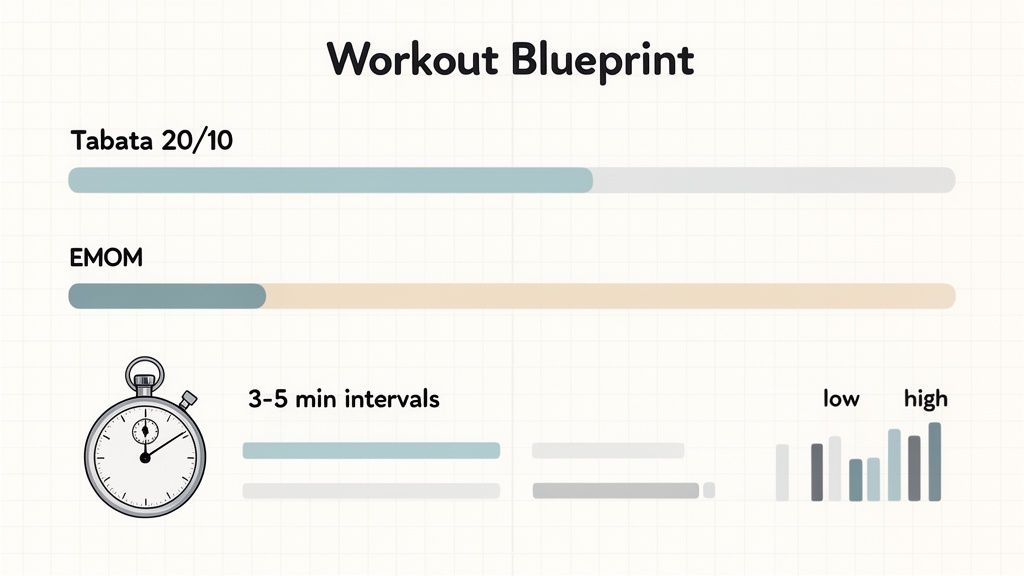
The classic 20 seconds on, 10 seconds off format is pure anaerobic work. It's about unleashing everything you have for eight short, brutal rounds. This is a potent metabolic shockwave that forces your body to operate at its absolute peak.
- Machine: Assault Bike
- Structure: 8 Rounds: 20 seconds MAX EFFORT sprint / 10 seconds complete rest.
- Execution: The first few rounds feel deceptive. By round five, you'll be questioning your choices. The goal is to go all out, every time. Your score is the lowest calorie count from any single round. This keeps you honest and prevents sandbagging.
EMOM for Pacing and Lactate Threshold
Every Minute On the Minute (EMOM) is a masterclass in self-awareness, consistency, and performing under fatigue. The built-in rest forces you to recover under pressure, training your body to clear lactate more efficiently.
It's about finding a gear that's tough but sustainable. For more ideas, check out our guide to the ultimate lower body HIIT workout, which includes low-impact options.
- Machine: Rower (Concept2)
- Structure: EMOM for 12 minutes: Row 200 meters.
- Execution: Aim to finish your 200m row in 40-45 seconds, leaving 15-20 seconds to recover. If you can no longer hit the 200m mark within the minute, the workout is over. This is a phenomenal tool for developing lactate threshold.
Long Intervals for Aerobic Capacity
To build a massive aerobic engine, you have to spend time in the pain cave. That's where longer intervals come in. These 3-5 minute efforts are designed to push your VO2max and forge the endurance needed for sustained, high-output work.
These longer work periods train your body and mind. You learn to find a rhythm at an uncomfortable pace and hold on. That's where real conditioning is built.
This isn't about a frantic sprint. It's about finding the highest output you can hold for the entire work period.
- Machine: SkiErg or Air Bike
- Structure: 5 Rounds: 3 minutes of work / 90 seconds of rest.
- Execution: Focus on consistency. Try to maintain a steady pace or wattage for all 3 minutes. The 90-second rest should feel just long enough to bring your heart rate down before you go again. This is about building repeatable power.
How to Nail Your Workouts with Precision
Intensity is useless without accuracy. If you're guessing your intervals or fumbling with your phone's stopwatch, you're killing your momentum and short-changing the workout. When it comes to low impact high intensity training, precision is everything.
Your ability to repeat a workout and measure progress depends on hitting your work and rest periods exactly as planned. This requires a tool built for the job, not a generic timer.
Make Every Second Count
A dedicated interval timer is your secret weapon. Purpose-built tools like the KNTC app let you program tough workouts in seconds, so your mental energy goes into the effort, not clock-watching. You need loud audio cues and strong vibrations that cut through gym noise or your own heavy breathing, keeping you on track deep in the hurt locker.
This move toward smarter training tools is critical for low-impact, high-intensity workouts. These protocols live and die by their timing. Fast, science-backed interval tools are becoming fundamental. You can learn more about the growing market for HIIT-focused training tools to see the trend.
Setting up a custom EMOM or Tabata should be simple, not a chore. Here’s what that looks like in the KNTC timer.
The display is clean and focused on what you need mid-workout: your time, your current interval, and your overall progress. It's all there so you can just execute.
From Guesswork to Real, Measurable Gains
Using a reliable timer does more than keep you honest; it turns sweat into data. Repeatable, trackable workouts are the only way to know if you're getting fitter.
When your rest is precisely 60 seconds—not "about a minute"—you create a consistent training stimulus. That’s the line between exercising and training for specific results.
A powerful HIIT timer app provides the structure needed to push your limits safely and effectively. It guarantees that when you re-test a benchmark workout, the only variable is your performance. That’s how you make undeniable progress.
Weaving Low-Impact HIIT Into Your Routine
How do you fit low-impact high-intensity training into your week? The advantage of LIHIIT is its flexibility—it’s not about overhauling your program, but strategically plugging it in to make your training smarter and more sustainable.
Think of it as a multi-tool for conditioning. Schedule LIHIIT sessions as your main cardio days, using longer intervals to build your aerobic engine.
It also works as an "active recovery" tool. On days you're beat up but want to move, a shorter session gets blood flowing and helps you recover without pounding your joints.
LIHIIT is also a game-changer when dealing with injuries. A sprained ankle means running is out, but it doesn't have to torpedo your fitness. The rower or SkiErg lets you keep your cardiovascular system firing while your body heals.
How to Scale and Progress Smartly
Improving at LIHIIT isn't just about going harder. It's about making deliberate tweaks to the workout variables to get specific results. Progression must be intentional.
- Tweak Work-to-Rest Ratios: To build top-end power, shrink your rest periods. If you started with a 1:2 ratio (30 seconds work, 60 seconds rest), move to a 1:1 ratio (30 on, 30 off) to challenge your recovery.
- Add More Volume: This is straightforward but effective. Add a few more rounds to your interval workout or another 5 minutes to your EMOM. Taking an EMOM from 10 to 15 minutes is a massive jump in total work.
- Bump Up the Resistance or Pace: Instead of just "going hard," set a concrete target. Challenge yourself to hold a specific wattage on the bike, maintain a certain split time on the rower, or hit a target number of calories each round.
The goal is simple: build a massive aerobic engine while protecting the chassis. Smart progression allows you to perform at your best for years, not just burn out after a few months.
Got Questions About LIHIIT? Let's Dig In.
Let's tackle some common questions about low-impact, high-intensity training. No fluff, just straight answers.
How Often Should I Do LIHIIT?
For most athletes, 2-3 LIHIIT sessions per week is the sweet spot. That’s enough to drive cardiovascular fitness forward without causing overtraining, especially if you're also lifting or doing sport-specific work.
Listen to your body. If you're deep in a heavy strength cycle, two sessions might be the max. If your primary goal is building a bigger engine, three might be perfect. It’s about balancing your total workload.
Can LIHIIT Actually Replace My Old-School Cardio?
Yes. For many performance goals, it's a smarter, more joint-friendly upgrade. Long, slow distance (LSD) cardio has its place for building an aerobic base, but low impact high intensity training is a sniper rifle for improving the metrics that win competitions—like VO2max and lactate threshold.
Don't think of it as a substitute. Think of it as a more potent tool for building top-end work capacity.
Is This Going to Help Me Build Muscle?
Let's be clear: its primary job is building your engine, not your biceps. That said, LIHIIT is excellent for preserving lean muscle mass, especially compared to the catabolic potential of excessively long cardio sessions.
To maximize muscle maintenance, stick to machines that demand power, like the rower or SkiErg. They support strength better than just spinning on a bike.
Intensity is your best tool for measuring progress. If you aren't tracking it, you're just guessing.
How Do I Know if I'm Really Going Hard Enough?
A heart rate monitor is the best way to know for sure. You want to be in the 85-95% max heart rate zone during your hard efforts. This provides objective data.
No heart rate monitor? Use the RPE scale (Rate of Perceived Exertion). Your effort should feel like an 8 or 9 on a scale of 1 to 10. This is a pace where talking is impossible. Be honest with yourself—if you can chat, you’re not in the right zone.
Ready to stop guessing and start executing? The KNTC interval timer was built for exactly this kind of training. It lets you focus on your effort, not on fumbling with a stopwatch. Get set up in seconds with loud cues, a big display, and ready-to-go presets for Tabata, EMOMs, and anything else you can dream up. Try it free and see the difference at https://www.kntctimer.com.
A Performance Guide to Kids HIIT Workouts
Build a smarter kids HIIT workout with this guide. Learn age-specific drills, interval programming, and safety cues for peak youth athletic development.
Lower Body HIIT Workout: Build Explosive Power and Endurance
Discover a focused lower body hiit workout to boost power, speed, and endurance with clear progressions and proven routines.