
The Best Free Workout Timer App for Serious Athletes
Your workout is dialed in. Fumbling with a stopwatch between sets is a momentum killer. The best free workout timer app is the one you don't have to think about. It needs loud, clear audio cues and a big display so you can focus on performance. It should be dead simple, reliable, and ready to go in seconds.
Your Stopwatch Is a Weak Link in Your Training
Your phone's built-in clock app is a bottleneck. It forces you to watch the seconds, adding mental clutter when you should be locked in on your next rep. This isn't a small annoyance; it's a hole in your training protocol.
For anything more complex than a simple countdown—Tabata, EMOMs, fight rounds—a generic stopwatch fails. The audio cues are buried under gym music, and trying to hit 'start' and 'stop' while gassed leads to sloppy timing. It distracts from the actual work.
The Real Cost of Bad Timing
Every second spent glancing at a screen is a second not spent preparing for the next interval. That friction chips away at intensity. In a tough workout, focus is everything. A dedicated timer automates the process, letting you execute the plan.
You wouldn't run a marathon in worn-out shoes or spar with frayed gloves. Your timer is a critical piece of gear. Treat it that way.
The fitness app market, which includes the kind of free workout timer app essential for HIIT and CrossFit, is projected to hit $10.5 billion by 2026, up from $2.1 billion in 2019.
In 2023, free interval timers were used for over 500 million sessions. High-intensity athletes made up 62% of those users and reported a 25% improvement in workout adherence, driven by simple audio cues. You can dig into these fitness app market trends and see how tech is shaping performance.
This is about more than convenience. It’s about upgrading a core piece of your training toolkit to match the effort you bring to every session. A purpose-built app enforces discipline, removes guesswork, and keeps you honest when you’re too fatigued to think.
Non-Negotiable Features of a High-Performance Timer
Not all free workout timer apps are built for serious training. When you're deep in a workout, the last thing you need is an app that's confusing or unreliable. A great timer becomes an extension of your session; a bad one is a distraction.
Here is what separates a useful tool from digital junk.
Cues You Can Hear and Feel
In a loud gym, a weak beep from your timer is useless. Your timer needs sensory cues that cut through the noise. Loud, distinct sounds should clearly signal a work interval versus a final 3-second countdown.
Haptic feedback—vibration—is just as critical. If you're wearing boxing gloves or headphones, a strong buzz might be your only cue. It needs to be powerful enough to feel mid-burpee or during a heavy clean, so you never second-guess your transitions.
A timer’s job is to enforce discipline when you're too fatigued to do it yourself. If you can't hear or feel its cues, it's just a distraction.
A Display Built for the Gym Floor
You shouldn't need a telescope to see your timer from across the room. A good app has a massive, high-contrast display with huge digits. Landscape mode is a major plus, making it readable from 15 feet away when your vision is blurry with sweat.
This is about function over flash. The screen should show only what you need: time remaining, current interval, and what’s next. Cluttered interfaces add mental load when you should be 100% focused on the next rep. For a deeper look, our guide on finding a great interval training timer app covers this in more detail.
This table breaks down what actually impacts your training.
Essential vs. Nice-to-Have App Features
| Feature | Why It's Non-Negotiable | Training Scenario |
|---|---|---|
| Loud, Distinct Sounds | In a loud gym, you need audio cues that can't be missed. | Doing a CrossFit WOD with gym music blasting and needing to hear the start of each round. |
| Powerful Haptics | The only reliable cue when wearing headphones or unable to hear your phone. | On a run, listening to music, and needing to feel the buzz for the next sprint interval. |
| Massive, Readable Digits | You need to see the time at a glance from a distance without stopping. | Phone is on a box across the room for an EMOM and you need to see the countdown clearly. |
| Reliable Background Operation | A timer that stops when you switch apps is useless. It must run with music apps. | Powering through a long workout with a playlist running; the timer can't miss a beat. |
| Simple Preset Saving | Re-creating workouts every time is a waste of energy. One-tap access is key. | Doing the same Tabata warmup every Tuesday and wanting to start it instantly. |
The best features are the ones that work so well you forget they're there. They let you focus on what you came to do: train.
How to Set Your Timer for Peak Performance
A great free workout timer app is only as good as its setup. The fastest way to kill pre-workout procrastination is to program presets for your go-to sessions. This gets you off the couch and into the action.
Here are the exact settings for the most common high-intensity formats. Save these, and you can start a session in seconds.
Building Your Go-To Workout Presets
Most solid apps let you build and save custom timers. The goal is a library of your most-used routines so you're never fumbling with settings when you should be warming up.
Here’s how to set up the essentials:
- Classic Tabata: Program 8 rounds of 20 seconds work, followed by 10 seconds rest. Nothing else.
- 10-Minute EMOM: Set for 10 rounds, with each round lasting 1 minute. The app will signal the start of each minute. Do the work. The remaining time is your rest. For a deeper dive, check our guide on using an EMOM timer app.
- Boxing Rounds: Program 3 rounds of 3 minutes each, with a 1-minute rest between. A good app includes a 10-second warning before the bell.
- 400m Repeats: A simple work/rest split. Set a work interval for your target 400m time—typically 75-90 seconds—and a rest interval of 90 seconds. Program 6-8 rounds.
Fine-Tuning the Details
Beyond programming numbers, you need to customize the sensory feedback. The cues must cut through the noise of a tough workout, whether in a loud gym or out on the track.
Pay attention to these three critical feedback features.
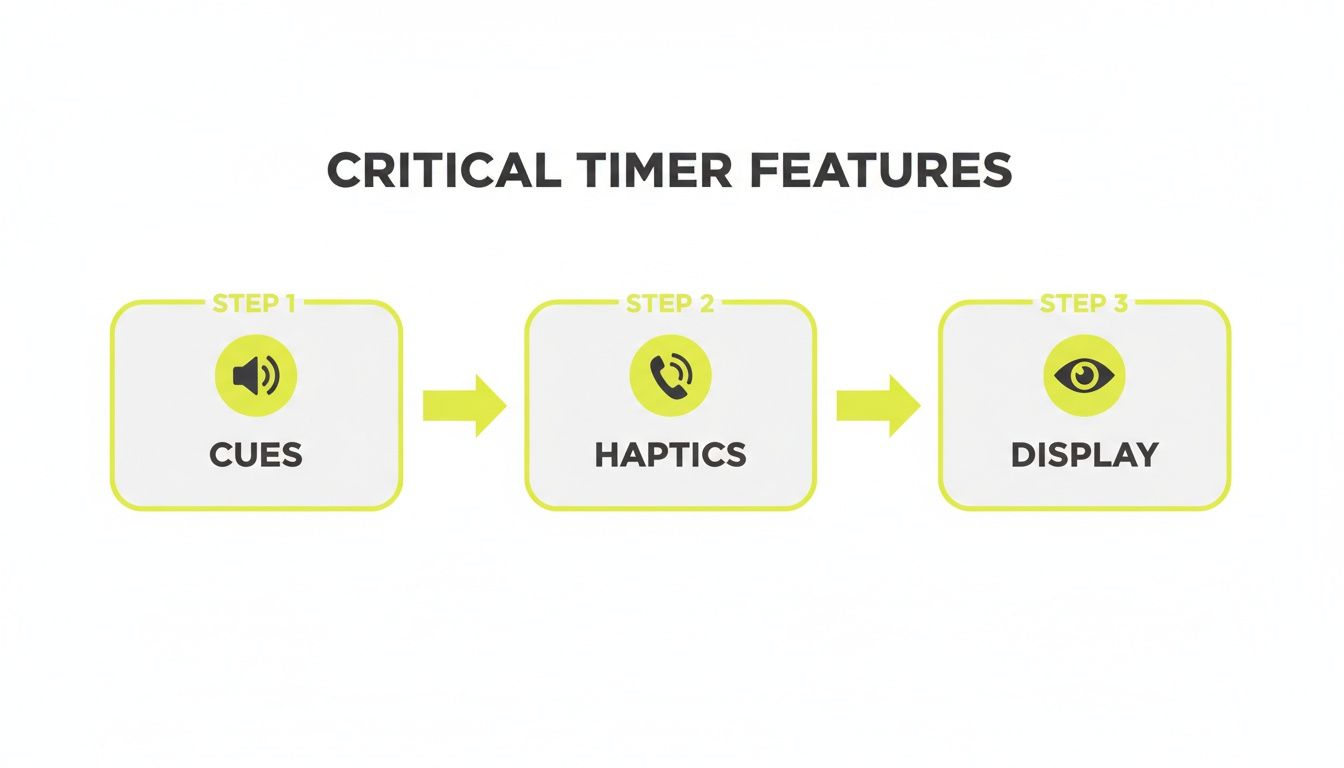
Audio, haptic (vibration), and visual cues must work together to keep you on pace.
Your timer should be a tool that demands precision, not another screen you have to babysit. Set it, save it, and let it do its job so you can focus on yours.
Taking a few minutes to get this right pays off. A reliable, well-programmed timer provides a distinct advantage. It's the difference between a sloppy session and a great one.
Our Recommendation: A No-Nonsense Free Timer
After testing dozens of options, one app stands out: the KNTC Timer. It was clearly built by people who train. We recommend it because it does its job flawlessly and gets out of your way.
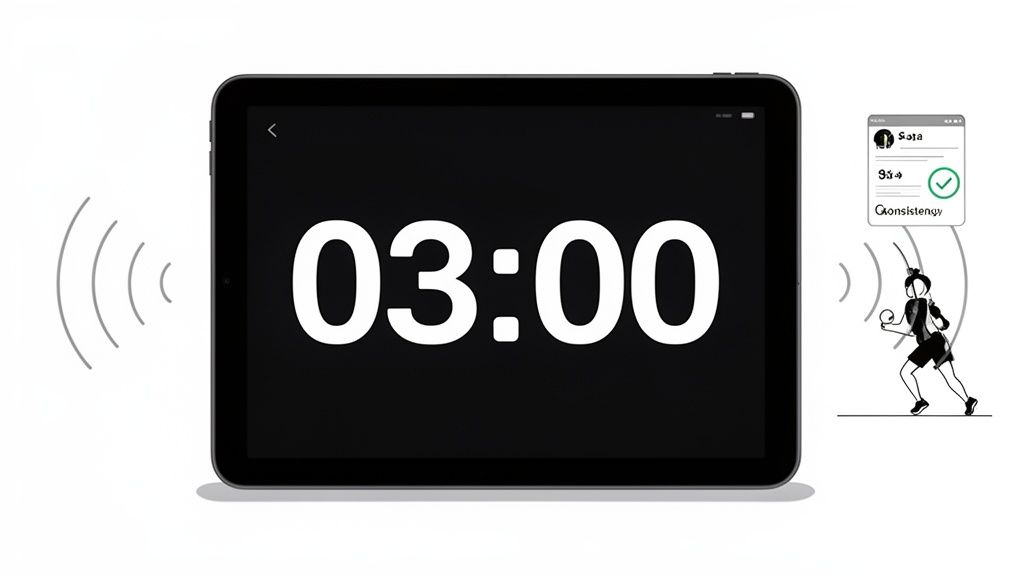
The design is simple. No flashy animations, no complicated menus—just the essentials to set intervals and get to work. This minimalist approach is exactly what you need when you’re about to redline; it eliminates friction between you and the workout.
How to Program a Custom Interval Workout
Programming a workout in KNTC takes less than a minute. Let's set up a classic: 5 rounds of 45 seconds on, 15 seconds off.
The process is simple:
- Open the app and select Intervals mode.
- Set your work period to 0:45 and your rest period to 0:15.
- Set the number of rounds to 5.
- Save it as a preset, like "45/15 Grinder."
Once saved, that entire workout launches with one tap. This reflects the app's philosophy: get in, get set, get moving. You can build a library of your protocols—from EMOMs to fight rounds—and have them ready to go.
A timer's job is to enforce structure, not add complexity. The best tools are ruthlessly simple, letting your effort be the only variable that matters.
The demand for focused tools is huge. Apps like Tabata Timer have over 5 million downloads. Simple interval timers make up 28% of the entire free fitness app category.
Athletes are choosing precision without fluff. You can check out roundups of the top free workout apps to see how this trend is shaping modern training. The KNTC timer is a perfect example, giving serious athletes exactly what they need and nothing they don’t.
Stop Guessing and Start Training with Precision
The takeaway is simple: precision timing is the core of effective training. Eyeballing a stopwatch between sets kills focus and intensity when every second matters.
A dedicated free workout timer app eliminates that mental friction.
It’s the digital coach that keeps you honest when you’re too gassed to count, with cues you can hear over your music. It automates your protocols so you can stop clock-watching and concentrate on form and effort.
The right timer removes the guesswork. It makes every single interval accountable, which is how you push harder and get consistent results.
Having presets for your go-to routines—a classic Tabata, an EMOM, or your favorite running drills—means you can launch the app and be training in seconds. This is critical, especially if you need an interval timer on your Apple Watch that just works.
Stop letting a clunky tool sabotage your sessions. Use a timer built for athletes. You will feel the difference in your next workout. That structure is the foundation of measurable progress.
Common Questions, Direct Answers
When switching to a new workout timer, a few questions always come up. Here are the answers.
Are Free Apps as Good as Paid Ones?
Yes. For the core job of timing intervals, a solid free app often outperforms paid competition. It focuses on doing one thing perfectly: providing reliable, easy-to-read timing without fluff.
The best free timers give you what you need—precision timing for work and rest—without distracting add-ons or subscription pop-ups. They are about function, not flash.
Can I Listen to Music?
Yes. A good workout timer is designed to run in the background. It should layer its audio cues or vibrations over music from Spotify or Apple Music.
This way, you can stay locked in with your playlist and still get the clear alerts you need to switch intervals without fumbling with your phone.
A great timer fits into your workout flow, it doesn't try to take it over. Your music and your timer should work in harmony.
Interval Timer vs. EMOM Timer: What's the Difference?
Knowing the difference is critical for proper setup. They’re built for two different training styles.
- An interval timer is a classic work/rest setup. Think Tabata: 20 seconds of all-out effort, followed by 10 seconds of rest. You set specific times for both work and rest periods.
- An EMOM (Every Minute On the Minute) timer is simpler. It signals the start of each minute. It's a CrossFit staple where you might do 10 burpees and rest for whatever time is left in that 60-second window.
Getting this right ensures your programming is as effective as it should be.
Ready to stop messing with a stopwatch and start training with a purpose-built tool? Grab the KNTC timer and feel the difference. You can download it for free right here.
The Running Interval Timer App Built for Serious Training
Discover how a running interval timer app can optimize workouts, boost endurance, and take your training to the next level.
Your Interval Timer for Running: The Guide to Structured Training
Stop guessing your splits. This guide shows you how to use an interval timer for running to master pacing, build speed, and execute workouts with precision.