
Lower Body HIIT Workout: Build Explosive Power and Endurance
A focused lower body HIIT workout is a non-negotiable tool for building explosive power and expanding work capacity. It’s about executing short, maximal-effort intervals targeting the glutes, quads, and hamstrings. This isn't steady-state cardio; it's a direct method for building a more powerful engine in significantly less time.
Why Lower Body HIIT Is a Requirement for Athletes
Training time is a finite resource. A dedicated lower body HIIT session isn't about chasing sweat; it’s a precision tool for forging a more powerful and resilient athletic base. This is the training that builds the capacity to sustain high power output when performance matters most.
By overloading the largest muscle groups in the body with intense intervals, you create an enormous metabolic demand. The heart and lungs must adapt. These adaptations translate directly into measurable performance gains, regardless of sport.
Driving Superior Metabolic Adaptations
The primary advantage is efficiency. Research consistently shows that lower-body HIIT protocols—like sprints or explosive jumps—can improve VO₂max as effectively as traditional endurance training, but in 30–60% less time. You achieve the same or better aerobic adaptations, freeing up time for skill development and recovery. This comprehensive meta-analysis provides the data.
For any athlete balancing strength, skill work, and conditioning, this is critical. By concentrating work into dense, high-output sessions, you drive significant adaptation without accumulating junk volume that leads to overtraining.
Translating Training to Performance
The science is clear, but application is what counts. A well-structured lower body HIIT program has a direct impact on the field, in the box, or on the mat.
- For CrossFit Athletes: This builds the leg endurance required to maintain pace in the back half of a WOD. It forges the capacity to keep repping out wall balls and box jumps when others hit a wall.
- For Combat Athletes: This develops the explosive drive for powerful takedowns and the conditioning to remain agile in later rounds. When an opponent's output fades, your leg power remains accessible.
- For Endurance Athletes: This is how you develop a finishing kick or the strength to power up a steep climb and create separation from the competition. It's the high-end gear most athletes lack.
The objective of this training is to systematically increase your tolerance for discomfort. You are conditioning the body and nervous system to continue performing under extreme metabolic stress, turning a previous breaking point into a competitive advantage.
Pre-Workout Activation Protocol
Initiating a high-intensity leg workout without a proper warm-up compromises performance and increases injury risk. A lackluster session or a pulled muscle is the likely outcome.
This is not about static stretching. The objective is to prime the system for the demands to come. Increase blood flow, activate target musculature, and mobilize the hips and ankles. This sequence switches on the central nervous system and ensures the glutes and hamstrings are firing correctly.
Dynamic Activation Sequence
Execute this circuit 1-2 times before the main workout. Focus on controlled movement and muscle engagement. This is preparation, not the workout itself.
- Leg Swings (Forward & Side-to-Side): 10-12 reps per leg in each direction. This dynamically opens the hip capsule and prepares the hamstrings.
- Hip Circles: 10 circles clockwise and 10 counter-clockwise on each leg. This increases synovial fluid in the hip joint, essential for deep squats and lunges.
- Bodyweight Cossack Squats: 8-10 reps per side, moving to the lowest point mobility allows. This is highly effective for opening the adductors and improving ankle flexion.
- Glute Bridges: 15 reps. On the final rep, hold the top position and isometrically contract the glutes for 10 seconds. This ensures proper glute activation, preventing the lower back from compensating.
Workout quality is a direct result of preparation. Inadequate warm-ups don't just risk injury—they leave potential performance gains unrealized. Apply the same focus to your warm-up as you do to your main sets.
Once this sequence is complete, the body should feel warm, mobile, and neurologically prepared for explosive output. Using an interval timer on my Apple Watch keeps my warm-up structured and ensures a seamless transition into the workout without losing intensity.
Three Proven Lower Body HIIT Protocols
Theory is useless without application. These are three distinct lower body HIIT protocols, each designed to elicit a specific physiological adaptation.
Select the protocol that aligns with your training objective for the day. Are you targeting raw explosive power, work capacity under fatigue, or muscular endurance?
Before starting, confirm your muscles are warm. Do not begin an intense session like this from a cold start.
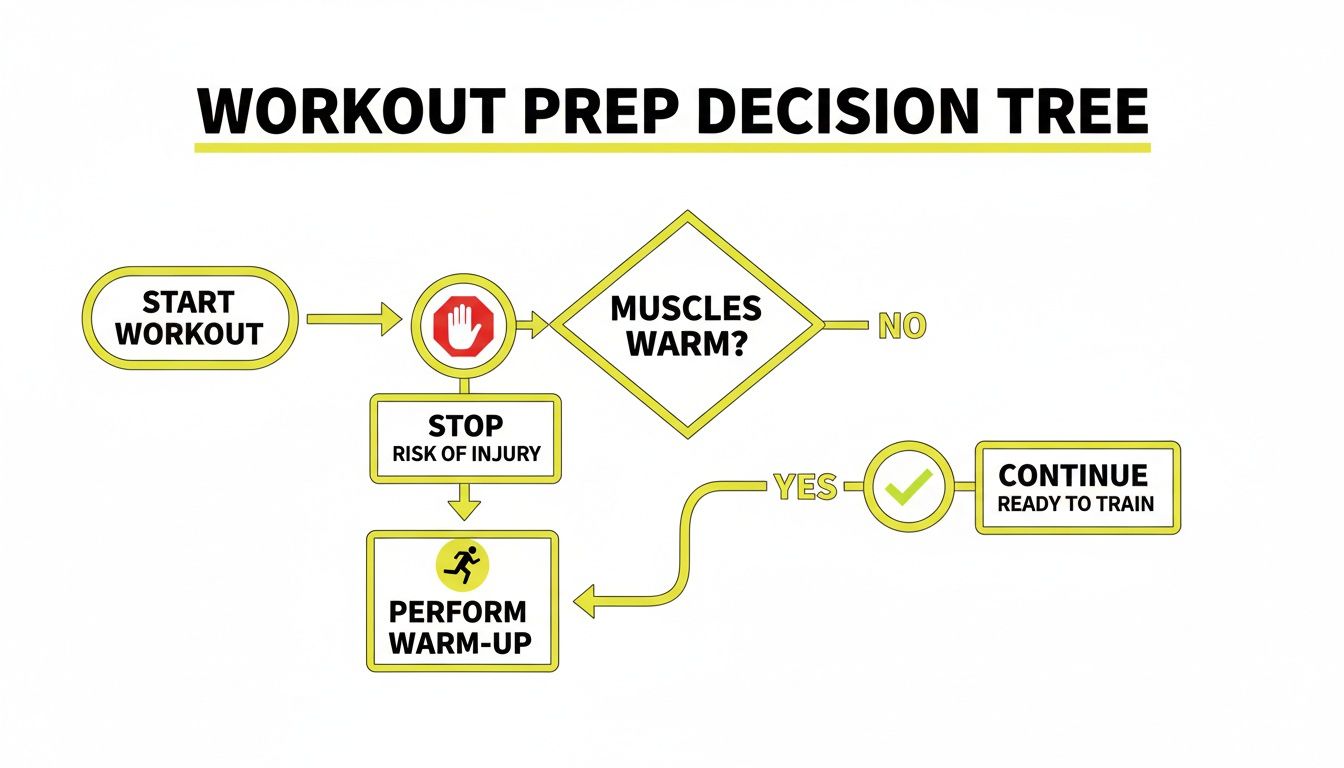
A dynamic warm-up is mandatory. It's the difference between a productive session and a setback.
Protocol 1: Tabata Leg Finisher
The Tabata protocol is brutal and efficient, completed in four minutes. The objective is to redline the anaerobic system. The stimulus is aimed at improving the body's ability to handle maximal-effort bursts and recover rapidly.
The structure is 8 rounds of 20 seconds of maximal work, followed by 10 seconds of rest. A single movement is used for all eight rounds.
- Total Time: 4 Minutes
- Primary Goal: Anaerobic Power & VO₂ Max Improvement
- Suggested Movements: Air Squats, Kettlebell Swings (light to moderate), Alternating Lunges.
Select one exercise. The first few rounds will feel manageable. By round five or six, significant metabolic stress will occur. The challenge is to maintain the same rep count in the final rounds as in the first. The pursuit of this goal forces maximal output.
Protocol 2: EMOM Grinder
EMOM (Every Minute On the Minute) is a protocol for developing work capacity. It trains an athlete to manage effort and recovery under accumulating fatigue—a critical skill.
This lower body workout alternates between two exercises for a total of 10 minutes.
- Total Time: 10 Minutes
- Primary Goal: Work Capacity & Pacing Under Fatigue
- Structure:
- Minute 1 (Odd Minutes): 15 Goblet Squats
- Minute 2 (Even Minutes): 12 Burpee Box Jump Overs
At the start of each minute, perform the prescribed reps. The remaining time within that minute is rest. For example, if the goblet squats take 40 seconds, you have 20 seconds of rest before the burpees begin. This structure rewards efficient work and penalizes slow reps. For a deeper look at this structure, use an EMOM timer app.
The EMOM is self-regulating. As fatigue increases and rep speed decreases, rest time automatically shortens, which intensifies the stimulus. It systematically finds an athlete's breaking point and forces adaptation.
Protocol 3: The Endurance Gauntlet
This is a longer, grinder-style workout designed to build muscular endurance and mental toughness. It is structured as "Rounds for Time," where the objective is to complete the work as fast as possible while maintaining sound technique.
This workout trains the ability to find a sustainable rhythm and push through deep muscular fatigue.
- Total Time: 15-25 Minute Target
- Primary Goal: Muscular Endurance & Mental Fortitude
- Structure: 5 Rounds For Time:
- 20 Kettlebell Swings (24 kg / 16 kg)
- 15 Box Jumps (24 in / 20 in)
- 10 Dumbbell Reverse Lunges (per leg)
The clock runs continuously until all five rounds are complete. The final time is the score. This protocol tests the ability to sustain high power output over a longer duration, which is a key differentiator in competition.
Lower Body HIIT Protocol Comparison
The choice of protocol depends on the day's training goal and available time. Each delivers a different stimulus.
| Protocol | Primary Goal | Total Time | Work to Rest Ratio | Example KNTC Preset |
|---|---|---|---|---|
| Tabata Leg Finisher | Anaerobic Power & VO₂ Max | 4 Min | 2:1 (20s On / 10s Off) | Tabata: 20/10s x 8 |
| EMOM Grinder | Work Capacity & Pacing | 10 Min | Varies (Rest = 60s - Work) | AMRAP: 1 Min x 10 |
| Endurance Gauntlet | Muscular Endurance & Grit | 15-25 Min | N/A (For Time) | Stopwatch |
A precise timer is non-negotiable for these protocols. Effective interval training depends on accurate work-to-rest ratios. Guessing is insufficient. Dedicated timer apps are the standard for executing sprints, EMOMs, and Tabatas with precision.
Movement Execution: Power and Precision
High output is one component; high output with sound mechanics is what drives adaptation. As fatigue accumulates during a lower body HIIT session, technical proficiency is the first thing to degrade. These cues ensure every rep builds functional strength and power, not just fatigue.
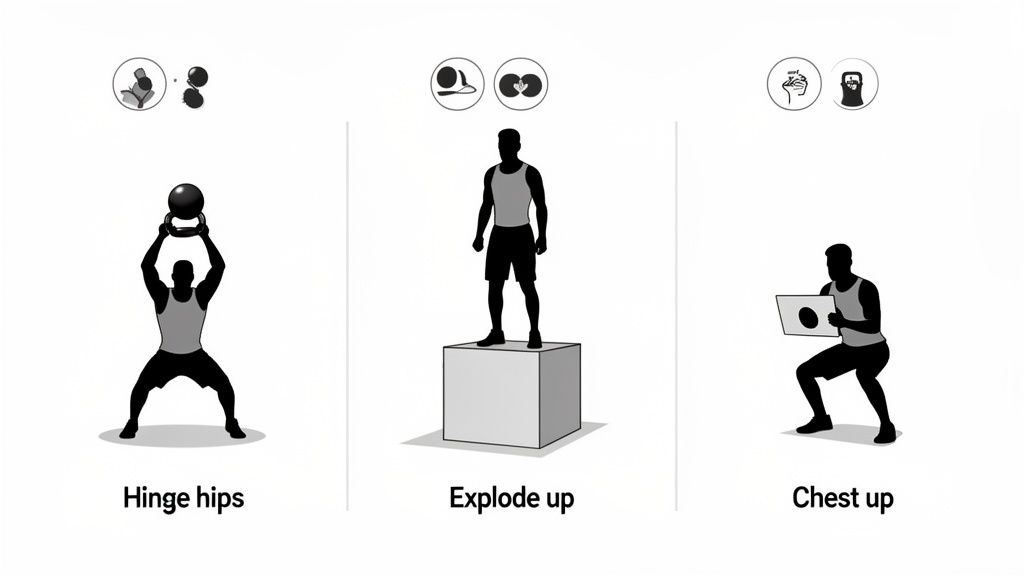
Mastering these key movements transforms a decent workout into a highly effective one. Internalize these cues.
The Kettlebell Swing
This movement is a powerful hip hinge, not a squat. It builds power in the posterior chain by generating horizontal force.
- Initiate with the Hinge: Drive the hips back, keeping the shins nearly vertical. Feel a stretch in the hamstrings at the end range.
- Generate Power from the Hip Snap: The arms do not lift the bell. The work is done by an explosive forward hip extension and maximal glute contraction. The kettlebell floats to chest height as a result of this power.
- Common Fault: Squatting the bell down. The correction is to think "hips back, not hips down." Keep the kettlebell high in the groin on the backswing.
The Box Jump
The box jump is a pure expression of vertical explosive power. The goal is maximal upward propulsion followed by a controlled landing. It is a power development exercise, not a cardio drill.
The key is a powerful concentric drive followed by a quiet, efficient landing.
- Load and Explode: Use a quarter-squat to load the glutes and hamstrings. Drive upward aggressively, using the arms to assist momentum.
- Land Softly: Land in the same quarter-squat position. Feet should be fully on the box, and the landing should be nearly silent. A loud landing indicates poor impact absorption.
- Common Fault: Using an excessively high box. This forces a deep, flexed-spine landing, increasing injury risk to the knees and back. Always step down; do not jump down.
The final rep must be as technically sound as the first. When form degrades due to fatigue, scale the movement or take a brief rest. Pushing through sloppy reps leads to injury.
The Goblet Squat
This exercise develops quadriceps strength while reinforcing proper squat mechanics. The anterior load forces core engagement and an upright torso.
Maintain an upright posture throughout the entire range of motion.
- Maintain an Upright Torso: Keep the elbows tucked and the weight in contact with the chest. This promotes a neutral spine.
- Drive Knees Out: Actively push the knees apart during the descent. This opens the hips, allowing for greater depth, and increases glute activation.
- Common Fault: Thoracic flexion (chest collapsing forward). To correct this, brace the abdominals and focus on keeping the weight pinned to the sternum.
Programming for Long-Term Progress
A single HIIT session is just one data point. Lasting improvements in power and endurance are the result of consistent, intelligent programming. The goal is to move from random workouts to purposeful training.
The first skill is scaling. Not every training day will be a peak performance day. The ability to adjust a workout based on physiological readiness is the mark of a mature athlete. If you are fatigued or form is breaking down, modify the workout to maintain intensity without risking injury.
How to Scale Intelligently
Scaling is a strategic adjustment, not a failure. It ensures the intended training stimulus is achieved even when not at 100%.
- Modify the Movement: If high-impact box jumps are not viable, substitute explosive box step-ups. If jumping lunges cause knee pain, switch to weighted reverse lunges to maintain quality movement.
- Reduce the Load: If the prescribed weight for goblet squats causes form breakdown, decrease the weight. Focus on executing perfect, fast reps. The objective is power output.
- Adjust the Intervals: In an EMOM, if you are consistently failing to get any rest, reduce the target reps by 2-3. This maintains the intended work-to-rest ratio where conditioning adaptations occur.
A Smart Plan for Progressive Overload
Once a workout can be completed with solid technique, it's time to increase the demand. This is progressive overload, the fundamental principle of adaptation.
The goal is not merely to survive the workout, but to own it. Progress is measured by completing the session with better form, faster times, or more reps. This is the only metric that matters.
Methods for systematically increasing the challenge:
- Increase Density: Perform more work in the same timeframe. In the EMOM Grinder, aim to complete the reps five seconds faster each week, thereby increasing the rest period.
- Increase Volume: Add more total work. Add an extra round to the Endurance Gauntlet or another minute to the EMOM. This is a direct method for building muscular endurance.
- Increase Complexity: Substitute a more advanced movement. Progress from air squats to goblet squats in a Tabata finisher. This introduces a new stability and strength demand. Using a reliable HIIT timer app is essential for tracking these progressions over time.
Sample Weekly Training Split
Integrating a demanding lower body HIIT session requires careful planning to avoid interference with heavy strength days.
- Monday: Max Effort Upper Body Strength + Skill Work
- Tuesday: Lower Body HIIT Workout (e.g., EMOM Grinder)
- Wednesday: Active Recovery (light cardio, mobility)
- Thursday: Max Effort Lower Body Strength (Heavy Squats/Deadlifts)
- Friday: Upper Body Volume + Metcon
- Saturday: Endurance Gauntlet or Long-Duration, Low-Intensity Cardio
- Sunday: Full Rest
This split ensures at least 48 hours between the heavy lower body day and the lower body HIIT session. This separation is critical for muscular and central nervous system recovery.
Lower Body HIIT FAQs
Common questions regarding the programming of lower body HIIT.
How often should I do lower body HIIT?
For most athletes who are also strength training or playing a sport, 1 to 2 times per week is optimal. This frequency is sufficient to drive adaptation without compromising recovery for other training sessions.
This training is neurologically and metabolically demanding. If primary lifts are stalling or sport-specific performance is declining, reduce the frequency to once per week.
Can I do this on the same day as a strength session?
It is possible but suboptimal if the goal is maximal performance in both. Ideally, separate heavy lifting and HIIT sessions by at least 6-8 hours, or place them on different days.
If they must be done on the same day, perform strength work first. The nervous system must be fresh for heavy, technical lifts. The HIIT session can be used as a finisher. Reversing this order compromises lifting mechanics and increases injury risk, as the legs and core will already be fatigued.
What is the best way to track progress?
Track objective data, not just subjective feelings of fatigue. Record your results for every workout.
- For an EMOM: Log the total reps completed for each exercise.
- For "Rounds for Time": Record your final time.
The objective is to beat your previous numbers. Week over week, the goal is to perform more reps in the same time or complete the same work faster. This data is the only objective proof of increased fitness and power.
Stop estimating your intervals and start training with precision. The KNTC interval timer is designed for athletes who demand reliability and efficiency. Set up custom timers in seconds, save your presets, and execute every session perfectly with loud audio cues and strong haptics. Try it free and train with less friction at KNTC.
Low Impact High Intensity Training for Elite Conditioning Without Joint Stress
Explore how low impact high intensity training builds elite conditioning without joint stress. Get proven workouts and programming for serious athletes.
Master Your Interval Timer on Apple Watch for Peak Performance
Stop guessing your work and rest periods. Learn how to master the interval timer on Apple Watch for HIIT, running, and combat sports with practical setups.