
A Performance Guide to Kids HIIT Workouts
A kids HIIT workout is a method for building athletic fundamentals through short, intense bursts of exercise followed by structured recovery periods. Instead of long-duration cardio, this approach rapidly develops cardiovascular fitness and explosive power, essential attributes for young athletes who need to be fast and strong.
Why HIIT Is a Game-Changer for Young Athletes
More training volume isn't always the answer. Smarter, more intense work often yields better results, and the same logic applies when programming for kids. A well-designed kids HIIT workout is a strategic tool for building a solid athletic foundation, not just a watered-down adult session. The objective is targeted adaptation, not simply exhaustion.
This style of training targets the systems that are critical for sports and long-term health. By pushing the heart rate into higher zones for short intervals, HIIT drives significant improvements in cardiorespiratory fitness. On the field, this translates to better endurance, faster recovery between plays, and a stronger, more efficient heart.
The Power of Intensity and Efficiency
The primary advantage of HIIT is its efficiency. Most young athletes have schedules packed with school, sports practices, and homework, leaving little time for extra conditioning. High-intensity training delivers a high return on a small time investment, boosting fitness without adding hours of low-intensity work.
This is supported by research. A large meta-analysis found that HIIT programs lasting ten weeks or less, performed at least three times per week, led to significant gains in aerobic capacity and improved cardiovascular health markers in children.
The core principle is quality over quantity. A focused, 15-minute high-intensity session can be more effective for building athletic traits than 30 minutes of jogging.
The following table outlines how HIIT supports youth development.
Core HIIT Benefits for Youth Development
| Benefit | Performance Outcome | Why It Matters for Athletes |
|---|---|---|
| Improved VO2 Max | Better aerobic endurance | Can sustain high effort for longer during games. |
| Increased Power Output | More explosive jumps & sprints | Faster acceleration and higher verticals. |
| Enhanced Muscular Endurance | Less fatigue during repeated efforts | Stays stronger and faster late in the game. |
| Faster Recovery | Quicker heart rate recovery | Ready to go for the next play sooner. |
This table shows how HIIT directly translates to better performance on the court, field, or track.
Building More Than Just Endurance
While the cardio benefits are clear, HIIT also develops other critical athletic skills. The explosive nature of common HIIT exercises—such as squat jumps, burpees, or high knees—builds raw power and muscular endurance. These movements train the body to generate force quickly, a key component of sprinting, jumping, and changing direction in any sport.
Effective HIIT workouts can also be designed using low-impact movements, which is crucial for protecting the joints of growing athletes. By focusing on bodyweight exercises and precise form, it's possible to create challenging workouts that build strength without unnecessary stress. For movement ideas, our guide on low-impact high-intensity training provides useful alternatives.
Ultimately, incorporating a kids HIIT workout into a young athlete's routine builds a more resilient, powerful, and efficient body. It teaches them how to work with intensity, push their limits safely, and connect focused effort to measurable performance gains.
Programming HIIT Workouts for Different Age Groups
Training a seven-year-old is not the same as training a teen preparing for a sports season. A one-size-fits-all approach is ineffective for kids' fitness. To program a safe and effective HIIT workout for kids, you must tailor the structure, intensity, and exercise selection to their developmental stage.
This requires clear intent. The goal—whether building fundamental motor skills or honing athletic power—determines the session design.
The infographic below highlights the three primary benefits that apply to all kids, regardless of age: improved fitness, increased power, and efficiency.
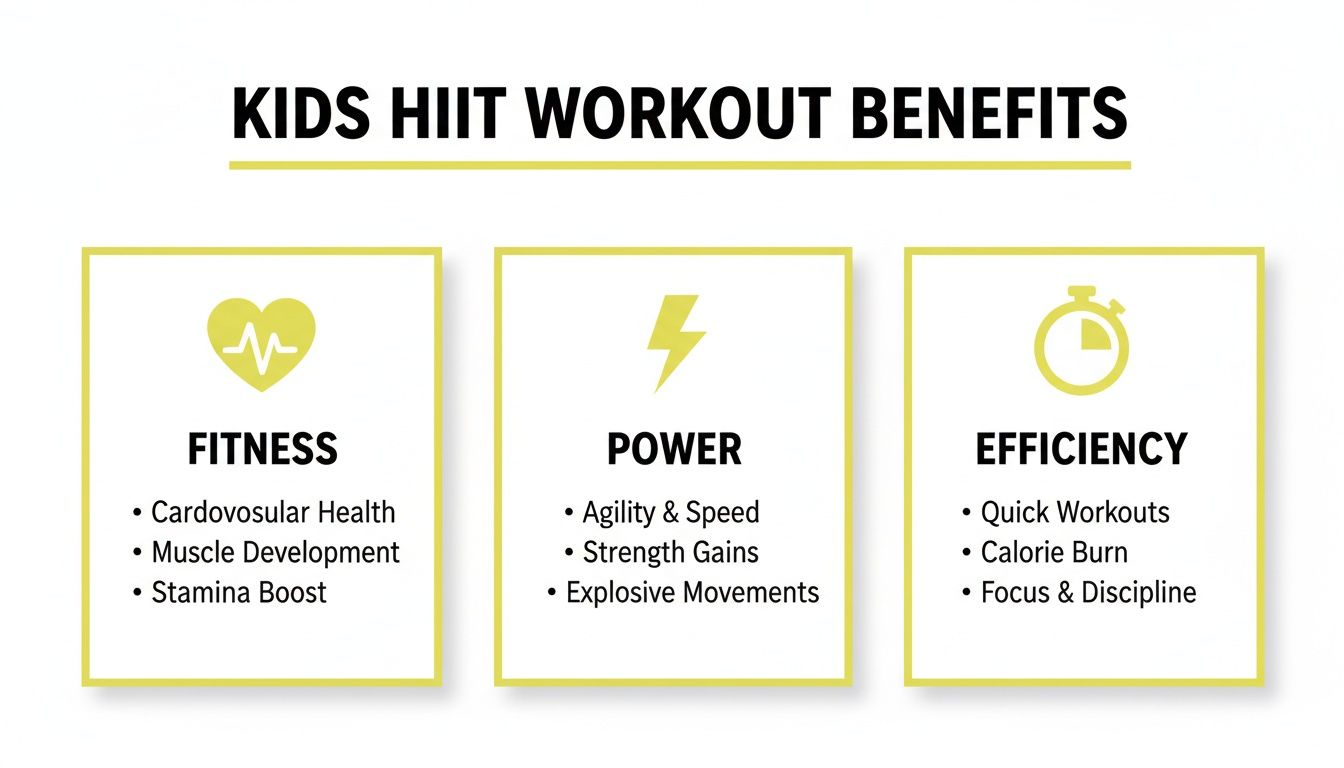
While the how changes with age, the why remains constant: building a stronger heart, developing explosive capability, and maximizing time.
Ages 5-8: Focus on Fun and Foundational Movement
For young children, the primary goal is to make movement enjoyable. Sessions should resemble structured play more than a formal workout, focusing on gross motor skills, balance, and coordination through game-based activities.
Intensity is not the focus. Children at this age are adept at self-regulation; they will exert themselves during enjoyable activities and rest when needed. Prioritize effort and exploration of movement over perfect form.
- Exercise Selection: Use simple, playful movements like animal walks (bear crawls, crab walks), skipping, hopping, and jumping over small, soft objects. Basic bodyweight movements like "touch your toes" or simple squats can be integrated into games.
- Session Structure: Keep sessions short, around 10-15 minutes total. Use very short work intervals, such as 15-20 seconds, followed by longer rest periods of 40-45 seconds. This rest is essential for recovery and for delivering the next instruction.
Ages 9-12: Building Coordination and Athletic Skills
This age group is ready for more structure and can begin to focus on technique. Their improving coordination allows for more complex movements. The objective shifts from pure play to skill acquisition and building a solid athletic foundation.
Introduce more traditional exercises, but insist on perfect, unloaded bodyweight form. This is the time to build the movement patterns they will rely on for years.
This is the ideal window to teach proper mechanics for squats, lunges, and push-ups. Mastering these patterns now prevents the formation of bad habits before they are ready for external loads.
Incorporate basic agility drills to improve footwork and reaction time.
- Exercise Selection: Begin incorporating bodyweight squats, lunges (forward and lateral), planks, and push-up variations (from the knees or an incline). Add agility ladder drills, cone drills for changing direction, and box jumps onto low, stable surfaces.
- Session Structure: Sessions can be extended to 15-20 minutes. A 1:2 work-to-rest ratio is a good starting point (e.g., 30 seconds of work followed by 60 seconds of rest).
Ages 13+: Developing Strength and Performance
Teenage athletes can handle higher intensity and more sophisticated programming that directly supports their sport-specific goals. Their bodies are more resilient, and they possess the mental focus to develop strength, power, and muscular endurance.
At this stage, their cardiovascular system can be challenged by increasing work density and shortening rest periods. The focus shifts to optimizing performance and preparing them for the physical demands of competitive sports.
- Exercise Selection: Progress to more dynamic movements like burpees, squat jumps, and other plyometric exercises. Introduce movements that cross multiple planes of motion and incorporate more advanced core work.
- Session Structure: Workouts can last 20-25 minutes. Program with a 1:1 or even a 2:1 work-to-rest ratio. A Tabata-style interval (20 seconds on, 10 seconds off) can be highly effective for teens with a strong fitness base.
How to Structure a Complete Training Session
A kids' HIIT workout requires structure to be safe and effective: a warm-up, the main workout, and a cool-down. Each component plays a critical role.
The session should follow a logical progression, starting slow, ramping up intensity, and then gradually tapering down. Skipping the warm-up and cool-down is a common mistake that can lead to injury, especially in growing bodies.
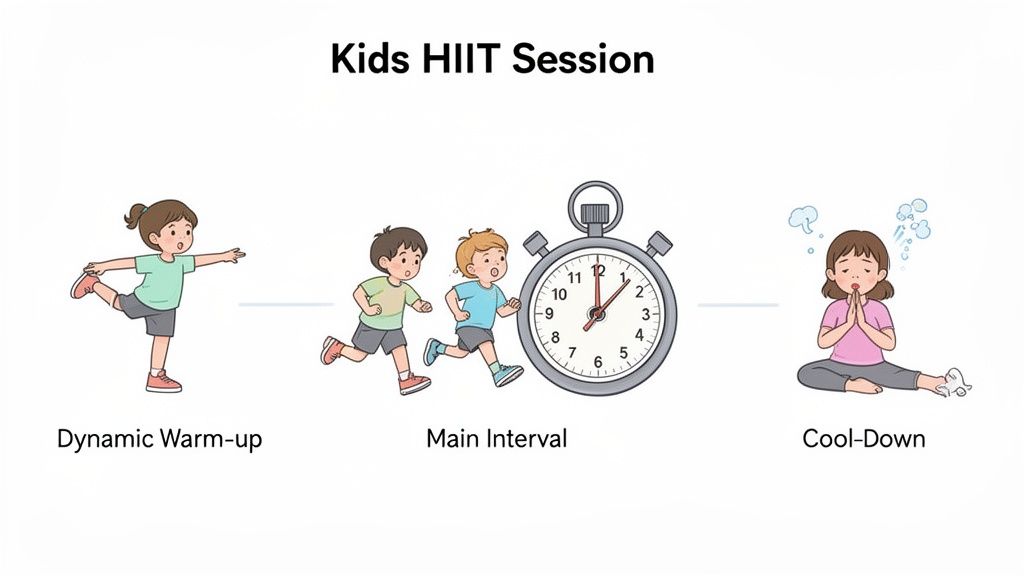
The Dynamic Warm-Up
A proper warm-up involves movement. The goal is to raise core body temperature and improve the neuromuscular connection for the explosive work to come. It should consist of active movements that mimic the exercises in the main set.
A solid warm-up should last 5-7 minutes and increase in intensity.
- Phase 1: General Mobility (2 minutes): Start with large, simple joint movements like arm circles, leg swings (forward/backward and side-to-side), and torso twists to lubricate the joints.
- Phase 2: Muscle Activation (3 minutes): Activate key muscle groups with bodyweight squats, walking lunges, and glute bridges to engage the legs and core.
- Phase 3: Neural Prep (2 minutes): Finish with short bursts of high knees, butt kicks, or quick feet to prime the nervous system and elevate the heart rate.
Programming the Main Workout
This is the core of the session. Clear instruction is essential for kids. They need to know precisely when to work and when to rest. An interval timer is a necessary tool for keeping the session on track.
The work-to-rest ratio is the primary variable for controlling intensity. For younger kids or beginners, a 1:2 or 1:3 ratio is appropriate. This means for every second of work, they get two or three seconds of recovery.
A starting point of 20 seconds of work followed by 40 seconds of rest allows for sufficient recovery to maintain good form and high effort during work intervals without causing excessive fatigue.
As fitness improves, the ratio can be adjusted toward 1:1 (e.g., 30 seconds on, 30 seconds off). Using an app with loud, clear audio cues allows kids to listen for signals instead of watching a screen. Setting up presets on an interval timer on your Apple Watch is an efficient way to run a session without handling your phone.
The Cool-Down and Recovery
After the final interval, a structured cool-down is necessary to gradually lower the heart rate and improve flexibility. This should take about 5 minutes and focus on static stretching and deep breathing.
- Static Stretching: Hold each stretch for 20-30 seconds, focusing on the major muscles used during the workout, such as quads, hamstrings, glutes, and chest.
- Diaphragmatic Breathing: Conclude with one to two minutes of deep belly breathing while lying supine. This helps shift the nervous system from a sympathetic ("fight or flight") to a parasympathetic ("rest and digest") state, initiating the recovery process.
Using the Right Tools to Drive Consistency
Consistency is the engine of progress. For a kids HIIT workout, adherence requires removing friction and distractions, making it simple for them to execute the session.
Feature-packed fitness apps are often counterproductive for children. Complicated interfaces, notifications, and other app distractions create barriers. The goal is to make the session easy to start and follow.
Why Most Fitness Apps Don't Work for Kids
Many digital fitness tools require visual attention. A child performing a squat jump should not be looking at a countdown on a phone screen. Their focus must be on their body: their movement, effort, and breathing.
A study on a HIIT smartphone app for kids found that participants used it only half as often as prescribed. After the study, none continued using the app independently. This demonstrates a disconnect between a program's design and real-world applicability.
Complexity kills consistency. The more steps, decisions, or distractions involved in starting a workout, the lower the probability of it happening.
Stripping down the tools simplifies the entire process and keeps kids engaged in the physical work.
The Power of a Simple, Loud Interval Timer
A high-performance interval timer is essential. Unlike a cluttered fitness app, a dedicated timer is designed for one purpose: running intervals. The dynamic shifts from watching a screen to listening for clear audio cues.
This minimalist approach is effective for a kids HIIT workout for several reasons:
- Loud, Unmistakable Cues: A good timer uses distinct sounds for "WORK," "REST," and the warning before the next interval. Kids learn these sounds quickly and can react without looking at a device.
- Fewer Distractions: Once the timer is set, the phone can be put away. The workout environment is focused solely on the work, guided by sound. This builds focus and discipline.
- Set It and Forget It: The entire session—warm-up, work/rest intervals, and cool-down—can be programmed in advance. Once started, you are free to coach and motivate without managing your phone.
The right tool removes barriers to consistency. The workout becomes a powerful, repeatable habit rather than another screen-time chore. Our guide to choosing the best HIIT timer app explains the features that matter for making a kids HIIT workout an automatic routine.
Coaching Cues and Common Mistakes to Avoid
Intensity without control is ineffective and dangerous, especially with kids. When running a HIIT workout, the primary role is that of a coach, not just a rep-counter. The objective is to build solid movement habits under fatigue, not just induce exhaustion. This means prioritizing fundamentals over speed.
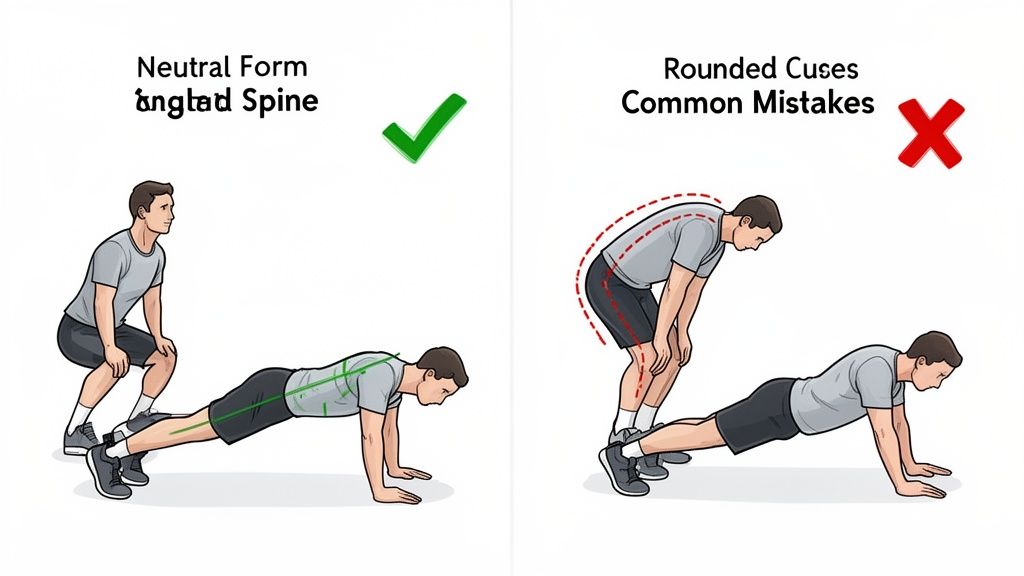
Good coaching involves clear, simple instructions. Focus on one correction at a time with actionable cues.
Foundational Movement Cues
These cues are effective for children because they are direct and do not require lengthy explanations.
- Squats:
- Cue: "Push your knees out to rip the floor apart."
- Why it works: This engages the glutes and prevents knee valgus (inward collapse), a common squat fault.
- Lunges:
- Cue: "Imagine your feet are on two separate train tracks."
- Why it works: This corrects a narrow, unstable stance by widening the base of support.
- Push-Ups:
- Cue: "Screw your hands into the floor."
- Why it works: This engages the latissimus dorsi and stabilizes the shoulder, resulting in a stronger, safer push-up.
- Planks:
- Cue: "Tuck your tailbone and squeeze your glutes."
- Why it works: This promotes a posterior pelvic tilt, correcting a sagging or piked lower back and establishing a neutral spine.
Spotting Fatigue Before It's Too Late
In children, fatigue often manifests as a breakdown in form rather than overt signs of exhaustion like gasping for air.
When you observe a rounded back in a squat, a "worming" push-up, or stumbling during a drill, their body is signaling it has reached its limit. This is the signal to reduce intensity, not demand more reps.
The goal is to challenge, not to break. Teaching kids to recognize and respect fatigue is a critical skill for long-term injury prevention.
Subtler signs like a sudden loss of focus, increased silliness, or complaining can also indicate physical exhaustion. When these shifts occur, it is time to add extra rest or begin the cool-down.
Common Programming Traps to Sidestep
Avoid these common mistakes when adapting HIIT for younger populations.
- Adding Weight Too Soon: Master bodyweight movements before adding external load. Perfect movement patterns are the foundation for future strength.
- Chasing Intensity Over Quality: A slow, perfect repetition is always superior to a fast, sloppy one. Establish from the beginning that good form is non-negotiable.
- Forgetting About Rest Days: Growth and adaptation occur during recovery, not during the workout. Schedule 2-3 HIIT sessions per week on non-consecutive days to allow for adequate recovery.
Answering Your Top Questions About Kids HIIT
Here are answers to common questions from parents and coaches about implementing HIIT with children.
How Often Should Kids Do HIIT?
For most children and young athletes, two to three HIIT sessions per week is optimal.
Schedule sessions on non-consecutive days (e.g., Monday, Wednesday, Friday) to allow their growing bodies the necessary time to recover, adapt, and get stronger. The workout provides the stimulus, but recovery is where adaptation occurs.
Is HIIT Actually Safe for Young Kids?
Yes, when implemented correctly. The safety of a HIIT workout for a child depends on three factors: qualified supervision, appropriate exercise selection, and age-appropriate intensity.
For younger children (ages 5-8), sessions should be framed as fun and games, not a push to their physical limits.
For all ages, these principles are non-negotiable:
- Master basic bodyweight movements before performing them at high speed.
- Perfect form always takes priority over rep count. 5 perfect squats are better than 15 sloppy ones.
- A qualified adult must actively coach, monitor for fatigue, and ensure a safe environment.
How is HIIT for Kids Different Than for Adults?
The principle of alternating work and rest intervals is the same, but the application is different. Adult HIIT often focuses on pushing to maximum physical capacity. This is not the goal for kids.
A kids' HIIT session is designed to develop coordination, build a positive association with effort, and improve overall fitness. The intensity is always relative and should never compromise technique.
The objective is not to replicate a grueling adult CrossFit WOD. The goal is to use the interval format to make training fundamental athletic skills more engaging and effective. It is structured, high-energy play, not a test of survival.
Do I Need a Bunch of Fancy Equipment?
No. The most effective HIIT workouts for kids are built around bodyweight exercises. All you need is a safe, open space and a reliable timer.
Movements like squats, lunges, bear crawls, and burpees are sufficient for building strength, coordination, and cardiovascular health. Focus on mastering bodyweight control before considering external resistance.
Run your kids' HIIT workouts without being tied to your phone. The KNTC interval timer provides loud, clear cues and simple presets, allowing you to focus on coaching, not screen management. Eliminate distractions and build consistency with a tool designed for real training. Check it out at https://www.kntctimer.com.
10 Effective Home HIIT Workouts for Serious Athletes
Ditch the fluff. Here are the 10 best home HIIT workouts for athletes who need structure, intensity, and results. For CrossFit, boxing, and endurance.
Low Impact High Intensity Training for Elite Conditioning Without Joint Stress
Explore how low impact high intensity training builds elite conditioning without joint stress. Get proven workouts and programming for serious athletes.