
Boxing Timer App: A Precision Tool for HIIT and Combat Training
Using your phone's standard stopwatch for a serious workout is a recipe for broken focus. A dedicated boxing timer app isn't a luxury—it’s a precision tool built to manage high-intensity training, letting you focus on the work, not the clock.
Why Your Phone's Stopwatch Sabotages Your Training
You're in the zone, breathing hard, and the gym's music is pounding. Fumbling with a tiny phone screen to hit "start" and "stop" between rounds kills your momentum. It’s a distraction you can’t afford.

Every moment spent squinting at the screen, guessing if your rest is over, is a moment you're not mentally preparing for the next burst of effort. When you're deep in a workout, manually tracking complex intervals is impossible.
The True Cost of Imprecise Timing
Sloppy timing isn't a minor hassle—it actively undermines your gains. Rest too long, and you lose the metabolic conditioning benefits. Rest too short, and you won't have the energy to push hard in the next round, hurting your power and skill development. A basic stopwatch offers no structure, forcing you to play timekeeper when you should be focused on performance.
A dedicated training tool shouldn’t add to your mental load—it should reduce it. The goal is to offload the task of timekeeping so you can pour all your energy into the physical work.
Built for the Realities of Training
A purpose-built boxing timer app is designed for the loud, chaotic reality of a gym, giving you signals you can't miss. It’s essential for any athlete serious about executing training protocols with consistency and discipline.
It streamlines common workout formats:
- Classic Boxing Rounds: Perfectly timed 3-minute work periods with 1-minute rests. No guesswork.
- Tabata Intervals: The brutal 20 seconds on, 10 seconds off protocol that demands absolute precision.
- EMOMs (Every Minute On the Minute): Loud, clear cues telling you exactly when to start each round, every single time.
Instead of fighting your phone, you get a reliable corner man that sets the pace and keeps you honest. It’s about trading guesswork for a higher level of performance.
Standard Stopwatch vs. Dedicated Boxing Timer App
| Training Factor | Standard Stopwatch | Dedicated Boxing Timer App |
|---|---|---|
| Focus & Flow | Constantly broken by manual start/stop actions. | Uninterrupted focus on the workout, not the clock. |
| Interval Accuracy | Prone to human error, especially when fatigued. | Automated, precise timing for every single interval. |
| Audio/Visual Cues | Minimal (often just a quiet beep). | Loud, distinct bells and large, high-contrast displays. |
| Customization | Zero. Just a basic start/stop/lap function. | Fully programmable rounds, rests, and warning sounds. |
| Setup Time | Fiddly and must be reset for every interval. | Set it once and go. Save presets for future workouts. |
The difference is clear. A stopwatch can tell you how long you've been running, but it fails completely when you need to manage the structured chaos of a high-intensity interval workout. A dedicated app is built for the job.
The Features That Truly Matter in a High-Performance Timer
Not all timer apps are created equal. In the middle of a brutal training session, you need a tool built to perform under pressure, not a flimsy app that can't keep up. A serious athlete needs rock-solid functionality that supports training instead of getting in the way.
The right features cut out the mental guesswork, letting you pour every ounce of energy into the work itself.
Cues That Actually Cut Through the Noise
Most timers fail in a real gym environment. A quiet chime is useless when music is blasting and weights are dropping.
- Loud, Distinct Audio: Look for sharp, piercing sounds designed to slice through background noise. A classic boxing bell or a high-frequency beep grabs your attention far better than a melodic alarm.
- Powerful Haptics: When you’ve got headphones in or the gym is deafening, strong vibration is your best bet. The app must have noticeable haptic feedback that you can feel, even when you're moving explosively.
These sensory cues are essential. They are the signals that keep your workout on track and ensure every interval is hit with precision.
Visuals You Can Read at a Glance
During a grueling set, you need a display you can read instantly from across the room, even when you're gasping for air. The screen's only job is to give you critical information without making you think.
A timer’s job is to deliver information with zero ambiguity. The bigger and clearer the digits, the less mental energy you waste deciphering the clock, freeing you up to focus on the next rep.
A large, high-contrast display is non-negotiable. Think big, bold numbers on a clean, dark background. The best apps offer a landscape mode to maximize the screen, turning your phone into a dedicated gym clock. It’s a simple touch that makes a massive difference in maintaining your flow.
Effortless, Savable Presets
Decision fatigue is real, especially before a tough workout. A top-tier timer lets you do the thinking ahead of time. Creating, naming, and saving your go-to workout protocols is a game-changer.
This means your most common sessions are ready to go with a single tap:
- Championship Rounds: Five 3-minute rounds with 1-minute rests.
- Tabata Protocol: Eight rounds of 20 seconds on, 10 seconds off.
- CrossFit EMOM: A 15-minute timer that cues you at the top of every minute.
With presets, you can launch a complex, custom workout in seconds. That speed and simplicity separate a professional tool from a toy. For more ideas on structuring these workouts, check our guide on what to look for in a HIIT timer app.
Reliability When It Counts
The fitness app market is projected to grow from USD 12.12 billion in 2025 to USD 33.58 billion by 2033. In this crowded space, many apps get the fundamentals wrong. While 80% of CrossFit athletes say timing precision is critical, 62% have ditched an app because it was unreliable or they couldn't hear it over the noise. This proves how vital it is to pick a boxing timer app built for real-world gym conditions.
A great timer has to be dependable. It needs to run flawlessly in the background while you play your music, and it cannot crash mid-session. Your training is too important to be derailed by a buggy app. Focus on these core features, and you’ll find a training partner that helps you perform at your best.
Getting Your Timer Dialed In for Peak Performance
A great boxing timer app is like a good cornerman—it does its job so you can focus on yours. The magic happens when you program it to run proven training protocols automatically. Set it, forget it, and concentrate on the work.
Let’s walk through setting up your timer for some of the most effective training methods.
This flowchart shows how the best features work together.
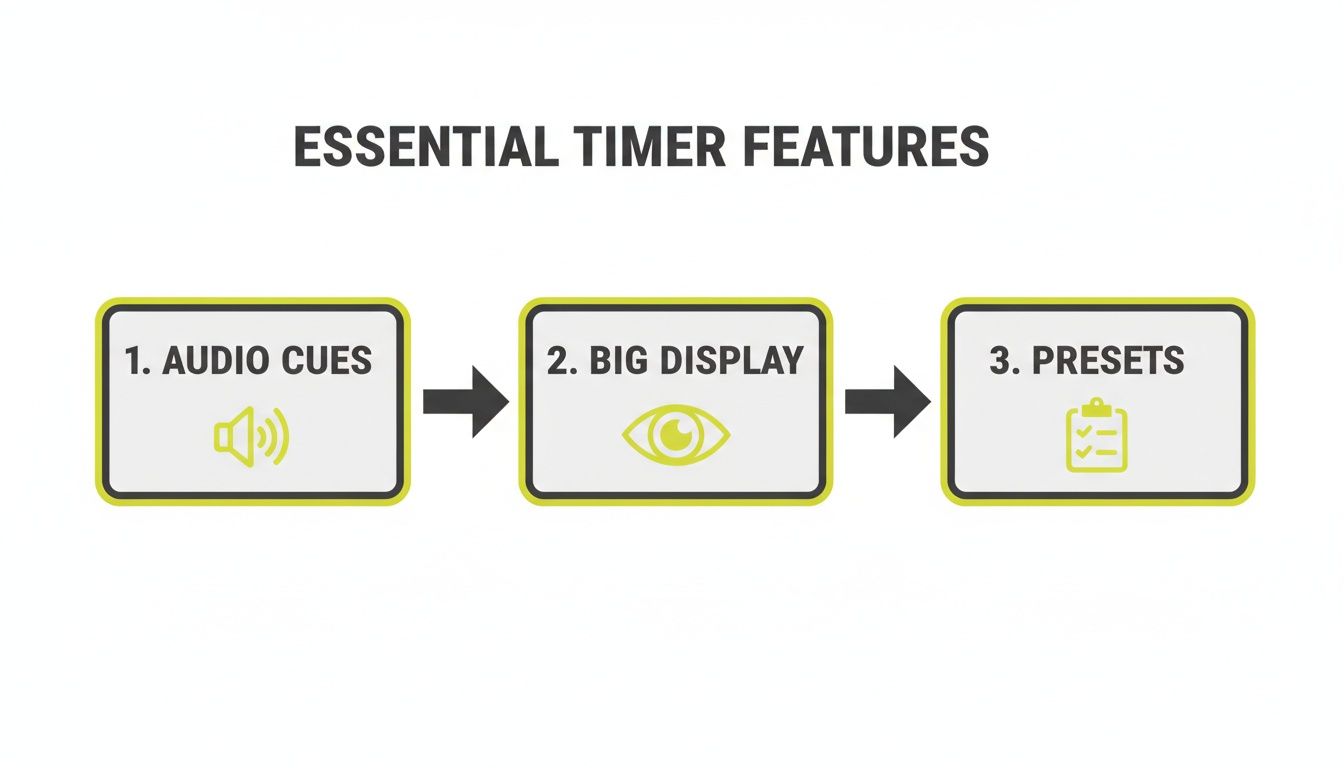
It all flows together: clear sounds, a visible display, and one-tap presets. It’s about removing the friction between you and your training.
The Classic Boxing Round Structure
This is the bread and butter of combat sports and a fantastic setup for general conditioning. The 3-minute work to 1-minute rest ratio is a time-tested formula for building your gas tank while allowing just enough recovery to maintain sharp form.
Here’s the setup:
- Work Interval: 3 minutes (03:00)
- Rest Interval: 1 minute (01:00)
- Rounds: 3 rounds for a warm-up, up to 12 rounds for a championship-level session.
Once set, save it as a preset named "Boxing Rounds." Now, that entire workout is ready to go with one touch.
Programming the Tabata Protocol
Tabata is brutal but effective. The protocol is simple: go all-out for 20 seconds, recover for 10 seconds, and repeat. It’s designed to maximize metabolic stress, but it only works if your timing is precise.
For a true Tabata, use these exact settings:
- Work Interval: 20 seconds (00:20)
- Rest Interval: 10 seconds (00:10)
- Rounds: 8 (for a total of 4 minutes)
The effectiveness of Tabata is in its strictness. The 2:1 work-to-rest ratio, repeated eight times without fail, is what produces the unique training effect. A good timer is the perfect drill sergeant for this.
Create a "Tabata" preset in your app. This makes it instantly available for heavy bag sprints, burpees, or assault bike intervals, ensuring you stick to the protocol perfectly every time.
Setting Up CrossFit EMOMs
EMOM stands for "Every Minute On the Minute," a protocol built to develop work capacity. You have 60 seconds to complete a set number of reps. The faster you finish, the more rest you get before the next minute starts. It teaches pacing and builds serious conditioning.
Programming an EMOM requires two settings:
- Work Interval: 1 minute (01:00)
- Rounds: The total number of minutes for the workout (e.g., set 10 rounds for a 10-minute EMOM).
Your timer will signal the top of every minute. There’s no rest interval to program because your rest is the time remaining in the minute. Save it as an "EMOM" preset, and you’re set for your next WOD.
Endurance Work and Interval Repeats
Interval training is essential for runners, cyclists, or rowers looking to get faster. A classic track workout is the 400-meter repeat: run a hard lap, then recover for a set time.
A boxing timer app is perfect for this. If your goal for a 400m is 90 seconds with a 90-second recovery, set your timer accordingly:
- Work Interval: 1 minute, 30 seconds (01:30)
- Rest Interval: 1 minute, 30 seconds (01:30)
- Rounds: A typical session might be 6 to 8 rounds.
This setup ensures your recovery is as disciplined as your effort—a critical factor for results. By turning these protocols into presets, your timer becomes a versatile coach for any workout.
Pro Workouts Designed for Your Training Style
Theory is one thing; execution is another. A top-tier boxing timer app is your cornerman, dictating the pace of proven workout protocols. Let’s move from settings to application with concrete, ready-to-go sessions for different athletes.
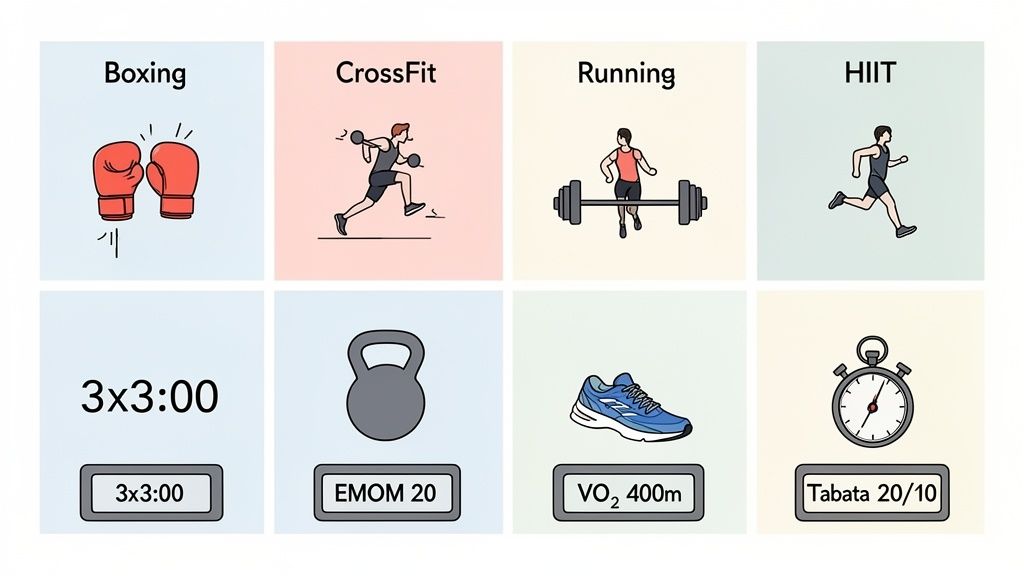
Think of these as actionable game plans. The timer provides the structure and removes the guesswork. Your only job is to put in the work.
For Boxers and MMA Fighters: The Championship Simulation
This workout builds fight-specific endurance—the ability to explode, recover, and repeat under pressure. We’ll simulate the grueling pace of a five-round championship bout to test your conditioning and focus.
Set your timer for a classic fight structure:
- Work Interval: 3 minutes (03:00)
- Rest Interval: 1 minute (01:00)
- Rounds: 5
In each three-minute round, mix steady-state work with intense bursts. A simple protocol: 2 minutes at 70-80% effort, then empty the tank for the final 60 seconds. The warning bell is your cue to go all out.
That one-minute rest is critical. Focus on controlled breathing and active recovery. When you hear the ten-second warning, get ready to go again. This is how you learn to manage energy and recover on the fly.
For CrossFitters: The Grueling EMOM Gauntlet
Every Minute On the Minute (EMOM) training forges work capacity. The clock is relentless, forcing a consistent pace. This workout combines three movements to hammer your conditioning, strength, and skill under fatigue.
Program this as a 15-round EMOM, with a one-minute work interval for each round.
- Minute 1: 15 Kettlebell Swings (53/35 lbs)
- Minute 2: 12 Burpees Over the Kettlebell
- Minute 3: 9 Toes-to-Bar
You'll cycle through this sequence five times for a total of 15 minutes. The faster you complete the reps, the more rest you earn. The timer is an unforgiving coach, starting the next round whether you're ready or not. A solid timer app is non-negotiable here; check our guide on choosing the perfect EMOM timer app for more.
The beauty of an EMOM is its built-in accountability. The clock is objective; it doesn't care if you're tired. You either keep up, or you learn where your conditioning needs work.
For Runners: The VO2 Max Developer
To get faster, you need to raise your aerobic ceiling. This means pushing your VO2 max with intense efforts followed by specific recovery periods. This track-style workout is built on a demanding 1:1 work-to-rest ratio.
Here's how to set it up for 800-meter repeats:
- Work Interval: Set this to your target 800m time (e.g., 3 minutes, or 03:00).
- Rest Interval: Match your work interval exactly (e.g., 3 minutes, or 03:00).
- Rounds: 4-6
The timer forces your recovery to be as disciplined as your effort. The second your work interval ends, the rest timer starts. No shortcuts. That precision is what drives adaptation.
The demand for these tools is growing. Dataintelo pegged the 2024 global boxing timer market at USD 105.6 million, while the broader fitness app industry is projected to hit USD 10.5 billion by 2026. For athletes grinding through VO2 max sessions, app features like high-contrast digits are critical for hitting their marks.
For HIIT Enthusiasts: The Full-Body Tabata Circuit
Tabata is the king of high-intensity protocols: 20 seconds of all-out effort followed by 10 seconds of rest, repeated eight times. You can apply this four-minute cycle to almost any exercise for an effective full-body workout.
Program your timer for a single Tabata interval:
- Work Interval: 20 seconds (00:20)
- Rest Interval: 10 seconds (00:10)
- Rounds: 8
Now, build a circuit. Perform one full Tabata (all 8 rounds) for each movement, with one full minute of rest between blocks.
- Assault Bike Sprints: (4 minutes)
- Rest 1 minute
- Dumbbell Thrusters: (4 minutes)
- Rest 1 minute
- Renegade Rows: (4 minutes)
- Rest 1 minute
- Battle Ropes: (4 minutes)
This 20-minute session is ruthlessly efficient and relies completely on the timer to enforce the pace. You don't watch the clock—you just work.
How to Choose the Right App in a Crowded Market
In a sea of fitness apps, most are bloated with features you don’t need. Choosing the right boxing timer app isn’t about finding the most complex tool; it’s about finding the one that gets out of your way the fastest.
A great app should feel like essential gym equipment—reliable, simple, and built for a single purpose. It needs to work flawlessly when you’re exhausted and can’t afford distractions.
Speed and Simplicity First
When you’re preparing for a tough session, you don't want to navigate a clunky interface. The most important question is: how fast can I start my workout? If it takes more than a few taps to launch a standard interval, the app has failed.
Look for a clean design that puts your presets front and center. A performance-built tool lets you go from opening the app to starting your timer in seconds.
Reliability Is Non-Negotiable
Your timer has one job: keep time accurately and consistently. It must run in the background with your music, and it cannot crash mid-workout. Period.
Test its stability under real-world conditions. Does it handle interruptions like calls gracefully? A solid app will pause and resume without losing your place, ensuring your momentum stays intact. This core reliability separates professional-grade tools from amateur apps.
A timer that crashes mid-session isn’t just an annoyance; it’s a liability. It breaks your focus and undermines the structure you’re trying to build. Choose an app that’s as dependable as your equipment.
Clarity Under Extreme Fatigue
When you’re deep in a workout, your ability to process information plummets. The app’s cues—visual and auditory—must be unmistakable.
- Massive, High-Contrast Digits: Can you read the time from across the room without squinting? The numbers should be huge and bold. A landscape mode that turns your phone into a gym clock is a major advantage.
- Loud, Piercing Audio Cues: You need sharp, distinct sounds like a boxing bell or a high-frequency beep that cut through gym noise.
- Powerful Haptic Feedback: Strong vibrations are your silent cornerman, especially with headphones. You should feel the start of a work interval or the final ten-second warning.
The global boxing timer market hit a valuation of USD 142.3 million in 2024, proving the demand for precise tools. Top-tier apps focus on efficiency; KNTC, for example, allows athletes to launch a 3-round session in just 8 seconds using presets. This speed is critical in a high-demand market, where North America holds a 42% share, and CrossFit box owners report 40% faster workout starts compared to generic timers.
Focus Over Features
Ultimately, the best boxing timer app strips away everything but the essentials. Social feeds, complicated workout builders, and calorie trackers are just noise. Your focus should be on performance, not navigating a confusing app.
A purpose-built tool just works. It delivers crucial information—time, state, and progress—and nothing else. Your choice should come down to which app helps you train harder with the least amount of friction.
Your Questions, Answered
Got questions about using a boxing timer app? Here are direct answers.
Can I Really Use This for More Than Just Boxing?
Absolutely. It's a high-performance interval timer that works for any training built around work-and-rest periods.
It’s a game-changer for:
- CrossFit WODs: Setting up an EMOM or AMRAP becomes simple. No more staring at the gym clock.
- HIIT Sessions: Whether it's Tabata sprints or a custom circuit, the timer keeps you precise.
- Running and Endurance: Perfect for track work like 400m or 800m repeats, where disciplined recovery is key.
- Strength Training: Use it to lock in rest periods between heavy sets, ensuring you're recovered for a strong lift without getting distracted.
If your workout involves intervals, this is the best tool for the job.
Will It Work with My Music?
Yes, and this should be a non-negotiable feature. A quality training timer is built to work with other apps. You can play your playlist on Spotify or Apple Music, and the timer's cues will cut through when you need them.
The best apps layer their sounds—like a bell for the round or a ten-second warning—right over your music. You stay in the zone without missing a cue.
What's the Real Difference Between EMOM and AMRAP?
Both build conditioning, but they challenge you in different ways.
- EMOM (Every Minute On the Minute): The clock is your pacer. You have a 60-second window for the work. The faster you finish, the more rest you get. It builds sustainable pace and recovery under pressure.
- AMRAP (As Many Rounds as Possible): You race the clock. You have a set time (e.g., 20 minutes) to complete as many rounds as possible. The timer is a simple countdown. This is a pure test of work capacity.
An EMOM forces rhythm; an AMRAP tests grit. A good timer app will have simple modes for both.
Could I Use This for Something Like the Pomodoro Technique?
Yes. The Pomodoro Technique is interval training for your brain, breaking work into focused 25-minute sprints followed by short breaks. The structure is identical to a workout.
Set your timer like this:
- Work Interval: 25 minutes
- Rest Interval: 5 minutes
- Rounds: As many as you need.
The same principles of discipline and recovery apply, whether you're training your body or your mind.
A timer doesn’t just measure effort; it structures it. By letting the app handle the clock, you take the mental load off your shoulders. All your focus can go into the task at hand—whether that’s a heavy squat or a deep work session.
Why Not Just Use a Free Timer on a Website?
Two words: reliability and environment. A browser-based timer fails in a real gym. It can't run in the background with your music, has no haptic feedback, and its weak audio alerts are useless against gym noise.
A dedicated app is a self-contained tool built for the chaos of a workout. It just works, every time, without needing an internet connection. For serious training, you need a tool that's as serious as you are.
Ready to stop wrestling with your clock and start focusing on your performance? The KNTC timer was built for athletes who need speed, precision, and zero fuss. Go from opening the app to starting your workout in seconds and train with a tool that actually keeps up.
The Best CrossFit Timer App for Flawless WOD Execution
Stop letting a clunky timer ruin your WOD. Discover the features a high-performance CrossFit timer app needs to keep up with your intensity and drive results.
Master Your Pacing with the Right EMOM Timer App
Stop guessing and start performing. Discover how an EMOM timer app transforms your workouts by enforcing precision, building work capacity, and driving results.