
Best Interval Timer App: Top Picks for HIIT, CrossFit & More
When you're a serious athlete, the best interval timer app isn't the one with the most bells and whistles. It’s the one that’s fast, accurate, and gives you cues you can’t miss. Your phone's built-in clock wasn't designed for a WOD, a set of sprint repeats, or hard sparring rounds. The right tool gets you from zero to sweat in seconds and keeps you honest when you're deep in the pain cave.
Why Your Standard Timer Fails Under Pressure
In serious training, timing isn't just about counting seconds; it's a critical part of the program. For anything structured like CrossFit, HIIT, or fight training, every second of work and rest is designed to trigger a specific physiological response. Fumbling with a generic stopwatch adds mental clutter right when you need to focus on physical work.
This is more than a minor inconvenience—it compromises the effectiveness of your workout. Your timer should be like a good coach: an invisible, reliable partner that keeps you on track, not another thing to manage. That's where a dedicated app built for performance comes in.
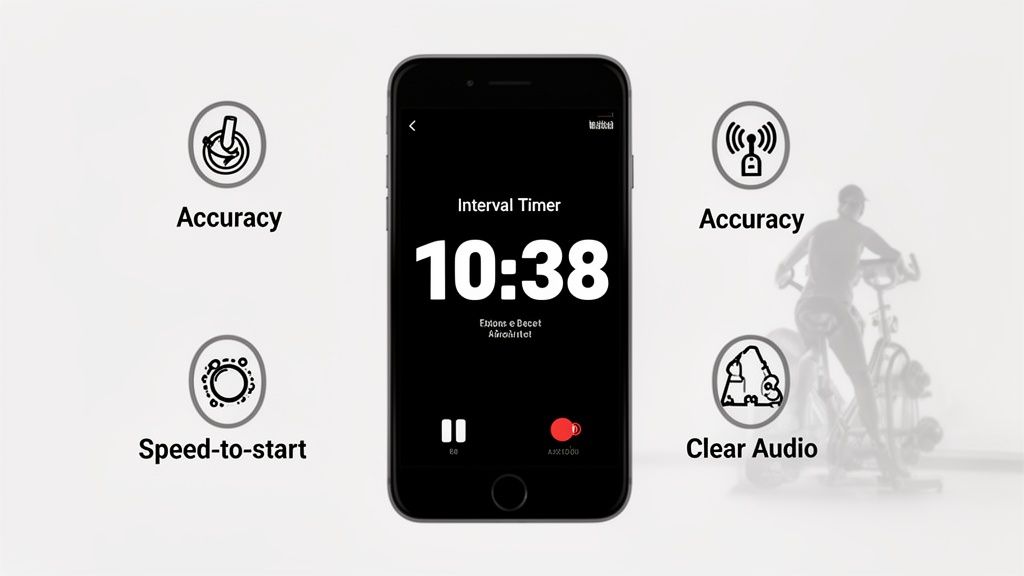
The Non-Negotiables for an Athlete's Timer
Forget bloated feature lists and confusing menus. When evaluating an interval timer, focus on what actually matters mid-workout.
Here are the absolute must-haves:
- Speed-to-Start: You should be able to launch a saved workout—like a complex EMOM or a classic Tabata—in just a couple of taps. The less you have to think before you start moving, the better.
- Absolute Accuracy: The timing has to be perfect. If it's off, it can throw off the entire training block, especially during max-effort work like VO2 max intervals.
- Clear Sensory Cues: A weak beep is useless in a loud gym or when your heart is pounding in your ears. Look for loud, distinct sounds (like a real boxing bell) and strong vibrations you can feel, even during burpees.
- Sport-Specific Modes: For functional fitness, dedicated modes for EMOM (Every Minute On The Minute) and AMRAP (As Many Rounds As Possible) are non-negotiable. These aren't just timers; they're the engine for the workout.
- Reliable Background Operation: The timer must keep running perfectly in the background while your music is playing or you're tracking reps in another app. It can't drop a single cue.
The need for tools like this has grown alongside the digital fitness boom. The global fitness app market was valued at $2.1 billion in 2019 and is on track to hit $10.5 billion by 2026. That explosive growth shows that athletes are demanding better tools for serious, structured training. You can learn more about the fitness app market's rapid expansion and see the scale of this trend.
Comparing The Core Features Of Performance Timers
Not all interval timer apps are created equal. While most can count down from ten, the difference between a basic app and a true performance tool is in the details—the kind that either support your training or become a distraction under physical stress.
To determine what makes a timer great, we need to look past flashy marketing and focus on the core features that directly impact the quality of your workout. These are the five pillars that separate professional-grade tools from the rest.
Accuracy And Reliability
This is non-negotiable. At its most basic level, a timer has to be accurate. A few seconds of drift might not sound like much, but for a Tabata set (20 seconds on, 10 seconds off), that inaccuracy undermines the entire protocol. You're trying to stress specific energy systems, and that only works with exact work-to-rest ratios.
On top of that, it has to be reliable. An app that crashes mid-WOD or goes silent because your screen locked is worse than no timer at all. The best apps just work, running flawlessly in the background so you can listen to music and lock your phone without worrying about a missed cue. This isn't a bonus feature; it's the bare minimum for any serious training tool.
Speed And User Experience
Nothing kills momentum faster than fiddling with a frustrating app before a tough session. You're mentally preparing for the workout, and the last thing you need is a clunky, multi-step process just to program a simple set of intervals.
A performance-focused app is all about speed-to-start.
The gold standard is being able to fire up a complex, saved workout in eight seconds or less. This isn't a luxury; it's a critical feature that respects an athlete's focus and gets you moving before doubt creeps in.
This philosophy should carry through the entire user experience. Are the buttons big enough to hit when you're tired and your hands are shaking? Is the display bright and clear enough to read from across the room? These details make a world of difference in a real training environment. Our team is constantly looking at how different tools measure up, and we share our findings on the KNTC blog.
Sensory Cues Audio And Haptic Feedback
When you’re gasping for air, the last thing you want to do is stare at your phone screen. Your connection to the timer comes through your senses—what you hear and feel. Generic, weak beeps are useless; they get lost in a noisy gym or drowned out by a playlist.
A great timer gives you a library of distinct, powerful audio cues. Consider the difference between a soft chime and a classic boxing bell signaling the end of a round. One cuts through the noise and provides a clear, immediate signal to work or rest.
Haptic feedback is just as important. A strong, customizable vibration pattern means you get the cue even with headphones on. You can feel the start of your rest period without looking down, letting you stay 100% locked in on your form and effort.
Customization And Flexibility
Every athlete's needs are different. A boxer needs a timer set for 3-minute rounds with 1-minute rests. A CrossFit athlete needs dedicated EMOM and AMRAP modes. A runner might be programming 400-meter repeats with specific recovery periods. A one-size-fits-all timer doesn't cut it for serious training.
The best timers offer deep customization that’s still easy to use. This means you get:
- Unlimited Saved Presets: Your go-to workouts should always be just one tap away.
- Sport-Specific Modes: Pre-built functions for EMOM, AMRAP, Tabata, and other common protocols are huge time-savers that prevent setup mistakes.
- Adjustable Cues: You should be able to pick different sounds and vibration patterns for your work, rest, and warning signals.
- Visual Settings: High-contrast displays or a landscape mode with huge numbers are essential for visibility, whether for you or a whole class.
Data Tracking And Motivation
What happens in the workout is what matters most, but what happens after is important, too. Good data tracking isn’t about burying you in charts and graphs. It's about giving you simple, meaningful feedback that reinforces consistency.
Seeing your total minutes trained for the week or keeping a workout streak alive can be a powerful psychological boost. It closes the loop and gives you tangible proof that your hard work is paying off. This simple tracking is designed to build momentum and keep you on track without adding complexity.
Performance Timer Feature Matrix KNTC vs The Competition
When you lay it all out, the difference between a standard timer and a performance-focused tool like KNTC becomes clear. It's not just one or two features, but how they all work together to support you when the workout gets tough.
| Core Feature | Standard Interval Timers | KNTC Performance Advantage | Why It Matters Mid-Workout |
|---|---|---|---|
| Speed & UX | Clunky, multi-step workout builders. | 8-second preset launch. High-contrast, large digits. | Reduces pre-workout friction and maintains focus. |
| Sensory Cues | Generic, quiet beeps. Weak, single-pattern vibration. | Loud, distinct boxing bells and voice cues. Strong, customizable haptics. | Cues cut through gym noise and headphone music, eliminating clock-watching. |
| Customization | Basic interval and round settings only. | Dedicated EMOM & AMRAP modes. Unlimited saved presets. | Matches the specific demands of your sport, from WODs to fight training. |
| Reliability | May lag or crash; poor background performance. | Flawless background operation with music. Millisecond accuracy. | Guarantees you never miss a cue, ensuring the workout protocol is executed perfectly. |
Ultimately, a standard timer just counts time. A performance timer respects your time, your focus, and your effort, ensuring nothing gets between you and a great training session.
Finding The Right Timer For Your Sport
Your sport has its own rhythm and its own set of demands. A runner's needs are a world away from a fighter's, and that's where most generic timers fall flat. We need to look past surface-level features and dig into what specific athletes need to get the most out of every training session.
This isn't about finding a single "best" app for everyone. It's about matching the right tool to your discipline, so your timer becomes a seamless part of your workout, not a distraction.
For The CrossFit And HIIT Athlete
In CrossFit or any high-intensity functional fitness, the timer is the heartbeat of the workout. You're not just counting down from 60 seconds; you're running complex protocols like EMOMs and AMRAPs. Trying to manage an "Every Minute On The Minute" workout with a basic stopwatch is a surefire way to lose focus and mess up your pacing.
A timer built for this world absolutely must have:
- Dedicated EMOM/AMRAP Modes: These need to be dead simple to set up. You just plug in the total time and interval structure, and you're good to go.
- A Giant, High-Contrast Display: When you're gasping for air and glancing at the clock from across the box, you need to see those numbers instantly. A landscape mode is a huge plus here.
- Loud, Obnoxious Cues: Let's be real—the gym is loud. Your timer's beeps need to cut through dropping barbells, blaring music, and the general chaos of a WOD.
For these athletes, the right interval timer isn't just a gadget; it's a critical piece of gear. It brings order to the chaos of a workout, making sure you're hitting the exact stimulus your programming intended.
This boils down to a choice: do you need a streamlined, purpose-built tool, or one that's endlessly customizable? This flowchart lays it out clearly based on what you value most.
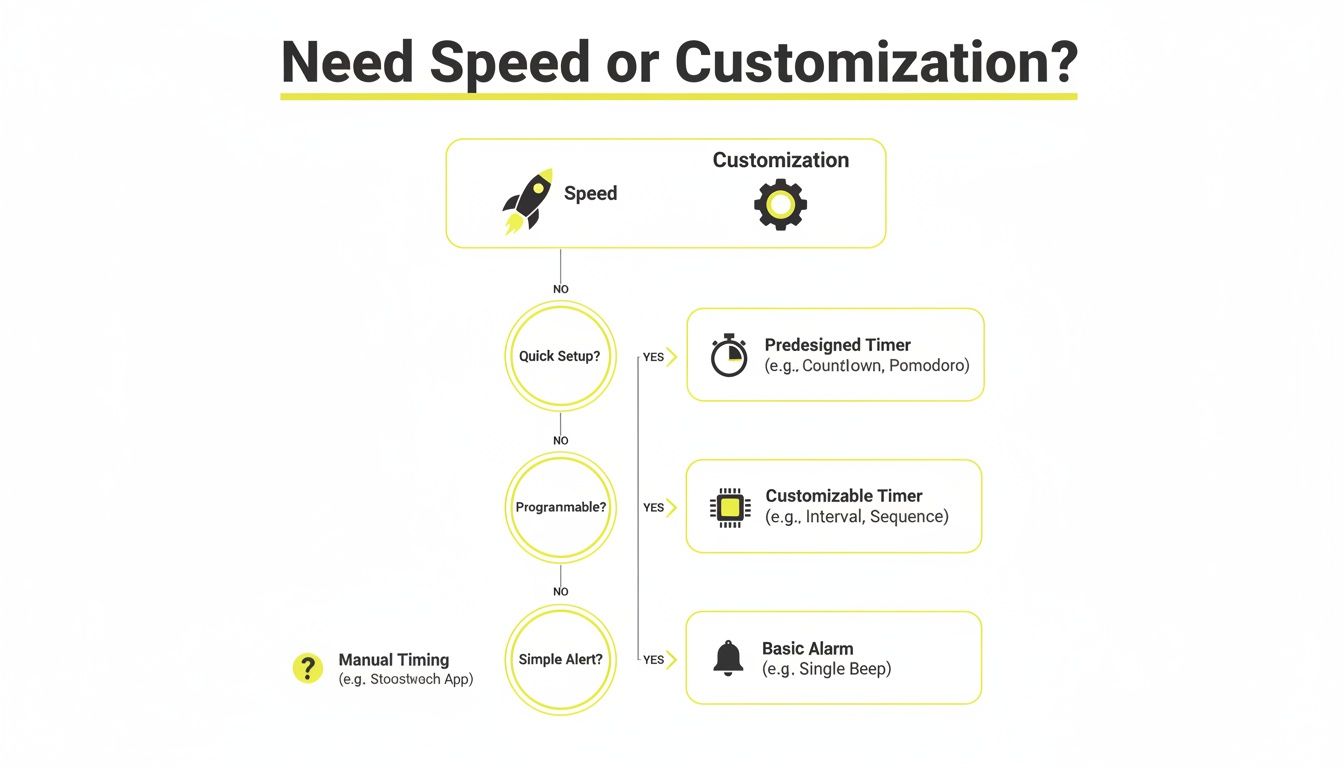
As you can see, if your goal is to jump into a workout with zero fuss, a speed-focused tool with presets is your best bet. If you're building unique, complex sessions from the ground up, you'll need something with deep customization options.
For The Boxer And Combat Athlete
Fighters live and die by the round clock. Whether it's boxing, Muay Thai, or MMA, training is built around precise work-to-rest periods that mimic a fight. A combat athlete’s timer has one crucial job: to replicate the sound and feel of being in the ring.
Key features are non-negotiable:
- Distinct Round Bells: A generic beep doesn't cut it. You need an authentic boxing bell to trigger the right psychological response for starting and ending a round.
- 10-Second Warnings: The clapper warning you the round is about to end is vital for managing energy and finishing strong.
- Powerful Haptic Feedback: A weak buzz is useless when you're wearing gloves and headgear. The vibration has to be strong enough to feel, letting you know where you are in the round without having to see or hear the clock.
This specificity is why so many athletes are ditching generic timers. The fitness app market, which includes these niche tools, is expected to grow from $12.12 billion in 2025 to $33.58 billion by 2033. That growth comes from athletes in demanding sports who need tools that help, not hinder, their performance. You can dig into more data on how fitness technology is expanding.
For The Runner And Endurance Athlete
For runners, cyclists, and rowers, it all comes down to reliability over the long haul. When you're grinding out 400-meter repeats on the track or settling into a long tempo run, your timer has to just work—flawlessly, in the background, without killing your battery or messing with your music.
The must-have features are:
- Perfect Background Operation: The app must deliver every single audio cue or vibration on time, even with the screen off while you're also running a GPS app and Spotify.
- Millisecond Accuracy: For sprint work, precision is everything. The timer needs to be exact to ensure you’re hitting the physiological markers you’re targeting with your work and rest periods.
- Simple Preset Functionality: When you show up to the track, you want to tap your "Sprint Day" preset and just go. The focus should be on your run, not on fiddling with settings.
For The Personal Trainer And Coach
As a coach, your most valuable asset is time. Juggling back-to-back clients or running a small group means you can't afford to be building new timers from scratch for every session. Your workflow needs to be fast, efficient, and flexible.
A trainer-centric app should provide:
- Rapid Preset Switching: You need to pull up a client's specific warm-up, main workout, and finisher with a single tap.
- Clear Visuals for Groups: A big, easy-to-read display that you can prop up for everyone to see is essential for keeping the whole class in sync.
- Simple Data Tracking: Basic metrics, like tracking total training minutes, can be a huge motivator for clients, helping them see their consistency build over time.
By identifying your specific training context, you can cut through the noise and find a timer that actually makes you better. The best interval timer app is the one that feels like it was designed just for you and your sport.
How To Set Up Your First Workout
Alright, enough theory. A great tool is only as good as how you use it. This is a practical, no-fluff guide to setting up your first workouts, focusing on features that will immediately improve your training.
The point is to make this effortless. A good interval timer app shouldn’t feel like you need to read an instruction manual. You should be able to build, save, and start a workout in under a minute. We’ll focus on creating presets so your go-to sessions are always one tap away, eliminating hesitation between you and the work.
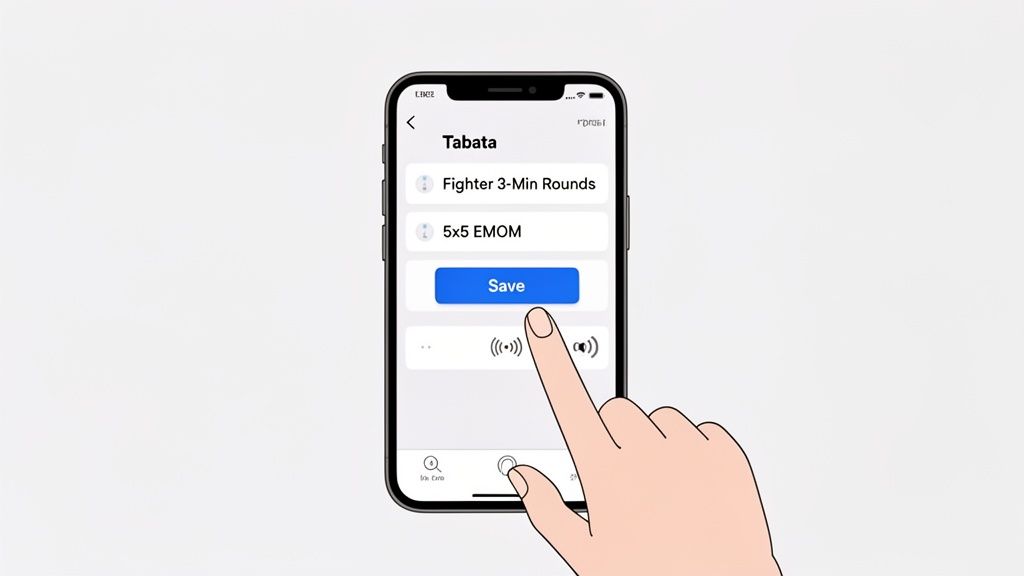
Building Your First Presets
Presets are the core of efficient training. Why waste mental energy rebuilding the same workout every time? Save it once, and launch it in seconds. This is huge for keeping your head in the game before a tough session.
Here’s how to create a classic Tabata preset in less than 30 seconds.
- Select 'Intervals' Mode: This is your basic work/rest setup.
- Set Work Time: Punch in 20 seconds.
- Set Rest Time: Punch in 10 seconds.
- Set Rounds: Set it to 8.
- Save Preset: Give it a name like "Classic Tabata" and hit save.
That's it. You’ve just locked in one of the most effective conditioning protocols, ready to go with a single tap. This simple act gets rid of decision fatigue and lets you pour all your focus into the effort ahead. If you're curious about other timer options, check out our guide on finding a great free interval timer app.
Essential Presets For Every Athlete
Your saved presets should reflect how you train. Don't stop at just one; build out a small library of your most frequent workouts. This way, you have the right tool ready for any kind of day—whether it's strength, conditioning, or skill work.
Here are a few essential presets to build right away:
- The Fighter's 3-Minute Rounds:
- Mode: Intervals
- Work: 3 minutes
- Rest: 1 minute
- Rounds: 10-12 (adjust for your session)
- The CrossFit 5x5 EMOM:
- Mode: EMOM (Every Minute On The Minute)
- Time: 5 minutes
- Intervals: 1 minute
- The Runner's 400m Repeats:
- Mode: Intervals
- Work: 75-90 seconds (your target 400m pace)
- Rest: 120 seconds
- Rounds: 6-8
When you save these core workouts, your timer stops being just a clock. It becomes a personalized training dashboard that understands your routines and helps you get in the zone instantly.
Customizing Your Sensory Cues
The last piece of the puzzle is dialing in your audio and haptic cues. Don't just stick with the defaults—they might not cut it in your training environment. A quiet garage gym has different needs than a loud commercial gym.
Dive into your app’s settings and explore the options.
Audio Cues: A generic beep might get lost in the noise. Switch it to something sharp and distinct, like a boxing bell. A sound like that is designed to pierce through background noise and your own mental fatigue. I also recommend setting different sounds for "Work" and "Rest" to create an immediate, instinctual trigger.
Haptic Feedback: A weak buzz is useless. A high-quality timer will let you choose the vibration pattern and intensity. Pick something strong and noticeable that you can feel even when you're moving explosively during burpees or sprints. Think of it as your silent coach, tapping you on the shoulder when it's time to go.
Spending two minutes customizing these cues means you'll never miss a signal again. It frees you from clock-watching and lets you focus completely on your form and effort. It’s a small tweak that makes a massive difference in your workout intensity.
So, Why Is This The Last Interval Timer You'll Ever Need?
After analyzing the countless options out there, breaking down what makes a timer truly great, and matching features to how real athletes train, one thing becomes clear. The search for the "best" interval timer ends when you stop chasing more features and start demanding better fundamentals. For any serious athlete, the right tool isn't a distraction; it's an invisible, reliable partner that just works.
This isn't about finding another app to fiddle with. It's about finding a tool that gets out of your way so you can get to work. A great timer feels like an extension of your own focus, matching your intensity with flawless performance, every single time.
Built On A Foundation Of Performance
The core principles of a world-class timer are simple but non-negotiable. It all comes down to an obsession with reducing friction, a deep commitment to sensory cues that cut through the chaos of a hard workout, and a stripped-down interface designed for action, not distraction. Every element is there for a reason, backed by exercise science to support your effort.
This design philosophy isn't just about looking clean; it directly translates to better, more consistent training at a higher intensity. When your timer is dialed in, you eliminate the small hesitations that kill a workout's momentum.
Think about it: instead of fumbling with settings, you hit your saved preset and go. That isn't just a convenience—it's a psychological trigger that flips the switch. It tells your brain it's time to work, knocking down the mental barrier between you and a tough session.
This no-nonsense approach is exactly what the market is demanding. The fitness tech world is booming, with the connected fitness segment jumping from $1,228 million in 2024 to a projected $9,986 million by 2033. In this crowded space, precision and speed are what set the best interval timer apps apart. Users want instant access—one-tap presets, not complicated setups. That’s why KNTC’s eight-second workout launch and dedicated modes for Intervals, EMOM, and AMRAP hit the mark. You can read more about the data driving the fitness app market to see the trends for yourself.
Cues That Actually Cut Through The Noise
Your focus should be on your form and your breathing, not on the clock. A performance-grade timer gets this, giving you sensory cues that are impossible to miss, no matter what's going on around you.
- Auditory Precision: We’re talking about loud, distinct sounds—like a classic boxing bell—that are specifically designed to pierce through the noise of a busy gym, your own heavy breathing, or your workout playlist. You hear the signal to start or stop without thinking about it.
- Haptic Feedback: Strong, customizable vibrations give you a physical cue you can actually feel. This is a game-changer for athletes wearing headphones or for anyone who trains by feel, letting you stay completely locked in without ever glancing at a screen.
These cues are more than simple alerts. They’re your direct connection to the workout's structure, keeping you honest on every single rep and every rest period. That reliability means the integrity of your training is never compromised.
The Final Word For Serious Athletes
You’ve put in the work to build your physical capacity. You deserve a tool that respects that effort. An app like KNTC is built from the ground up for the athlete who knows that details make all the difference.
It's for the CrossFit athlete who needs a big, high-contrast display they can see from across the box during a brutal WOD. It's for the boxer who relies on the sharp sound of the round bell to manage their energy. It's for the runner who needs a timer that keeps running flawlessly in the background for miles on end.
This is the last interval timer you'll need because it was built with a single purpose: to help you execute your training with absolute focus and precision. It’s not just another app on your phone; it's an essential piece of your training equipment. Your search ends here.
Got Questions? We've Got Answers.
When you're dialing in your training, the little things make a huge difference. You've got questions about how an interval timer really fits into your routine, and you need straight answers, not marketing fluff. Let's break down what athletes like you are asking.
Can I Use An Interval Timer App And Still Listen To Music?
Yes. For most of us, training without music is a non-starter. Any decent timer app is built to run smoothly in the background while you blast your playlist.
You can have Spotify, Apple Music, or whatever you use running, and the timer's audio cues will layer right over the top when an interval starts or ends. The haptic feedback (vibrations) will also fire off, so even with your headphones maxed out, you won’t miss a cue. Your workout stays on track, and your playlist keeps going.
What's The Real Difference Between An EMOM And AMRAP Timer?
Both are cornerstones of functional fitness, but they serve completely different purposes. A top-tier app won't make you jury-rig a simple timer to work for these; it will have specific, easy-to-use modes for both, letting you set up a complex WOD in seconds.
- EMOM (Every Minute On The Minute): This timer signals the top of each minute. You do your prescribed reps, and whatever time is left in that minute is your rest. It’s all about working against the clock.
- AMRAP (As Many Rounds/Reps As Possible): An AMRAP is just a block of time. You go all out to get as much work done as you can before that final buzzer sounds. It's about pure work capacity.
Having dedicated modes for these is a game-changer. It eliminates setup mistakes and lets you focus on your performance, not on messing with the clock.
Is A Real Interval Timer App Actually Better Than My Phone's Stopwatch?
For any kind of serious training? Absolutely, and it's not even close. A basic stopwatch forces you to be a clock-watcher, which is the last thing you want to do mid-workout. It pulls your focus away from your form, your breathing, and your effort.
With a dedicated app, you program your work, rest, and rounds ahead of time. You hit start and you just go. No more fumbling with your phone between sets.
The real win here is freedom. Loud audio cues and strong vibrations mean you can put your phone down and concentrate entirely on your movement and intensity. That focus translates directly to better pacing and, ultimately, better results. Period.
How Much Can I Actually Customize The Sounds and Alerts?
The best apps give you a ton of control here. We all know that a generic, quiet 'beep' is useless in a noisy gym—it just gets swallowed up by the sound of dropping weights and loud music.
You should look for an app that lets you dial in the cues that work for you.
- Distinct Sounds: Think boxing bells, loud gongs, or clear voice cues. These are designed specifically to cut through the noise and grab your attention.
- Custom Haptics: You need to be able to choose a vibration pattern strong enough to feel, even when you're in the middle of an explosive movement.
Your training deserves a tool that matches your intensity. KNTC was built from the ground up to be fast, reliable, and totally focused on performance. It's time to stop managing a clunky timer and start crushing your workouts.
HIIT Timer App: Your Guide to Precision-Driven Training
Discover the essential features of a hiit timer app to train with precision. Track intervals, stay on pace, and boost performance - click to learn more.
Your Guide to a Free Interval Timer App for Better Workouts
Discover how a free interval timer app can transform your training. Learn to set up custom presets for HIIT, running, and CrossFit for peak performance.